Showing posts with label food education. Show all posts

Tuesday, May 19, 2020

Grow Your Own: Sprouts and Microgreens

Pea shoots ready for my salad....
So, readers, you may have noticed I haven't written in a few weeks. I'm fortunate enough to have lots of work to do: live streaming cooking sessions with some of my classes, scaling up food production in the garden for local families and to contribute to the aggregated PopUp Food Hub, and working with a team to develop distance learning activities. And I've been cooking. A LOT.

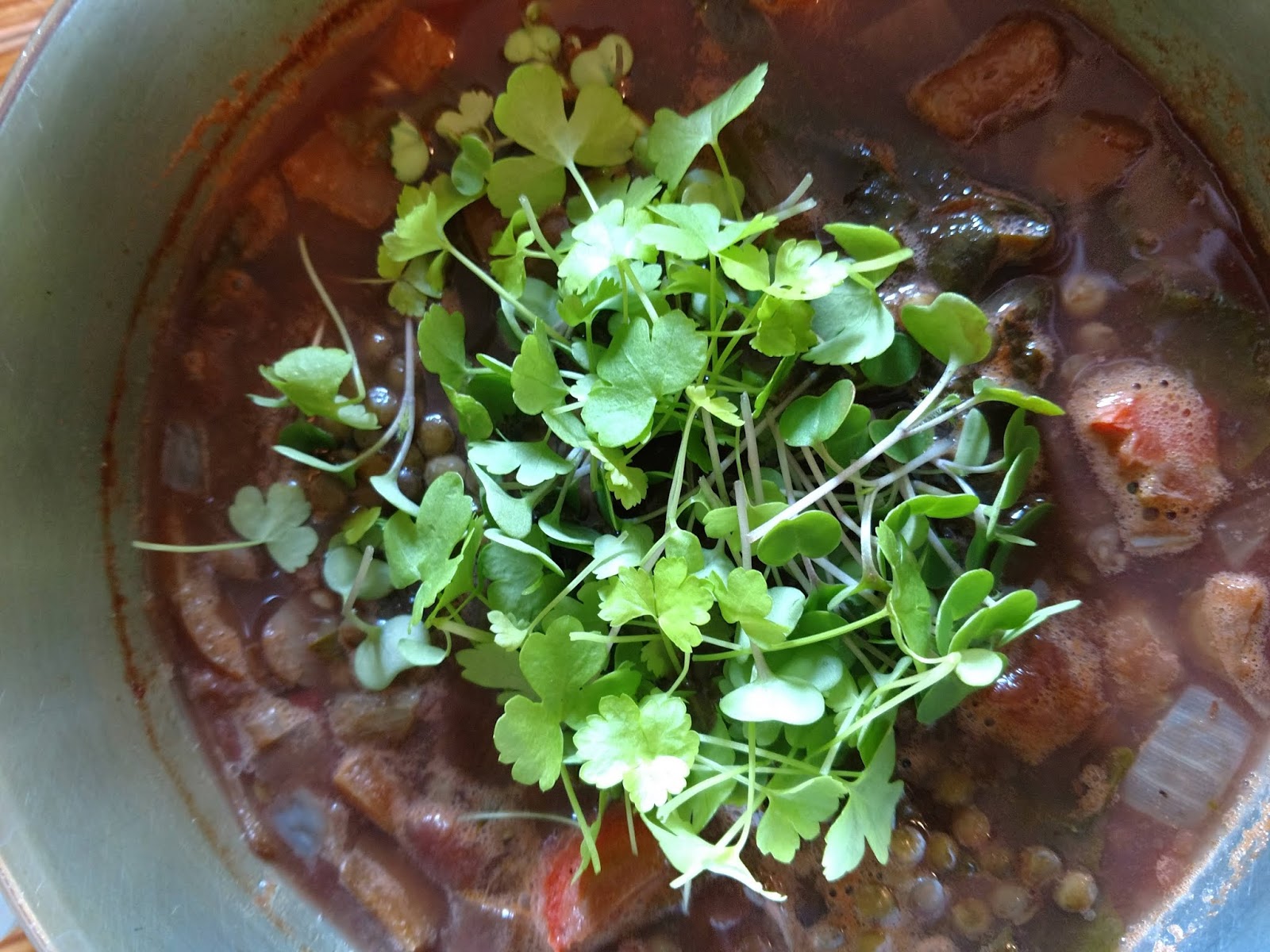
One of my favorite virtual lessons I helped to put together was for growing sprouts and microgreens with what you have around. It all started about a month ago, when I took an online class offered by local microgreen farmers, Little Wild Things, and since then I have been growing and using sprouts on just about everything...

Celery sprouts on lentil soup
Kale microgreens on tacos


In case you'd like to try your hand at growing these inexpensive, easy, and nutrient-dense foods -- they are 4-6 times more nutritious than the full grown plant! -- here's a link to the instructions

It only takes about a week from when you plant the seeds to when you are devouring the fruits (sprouts?) of your labors. I found that I had reasonably good luck even with older seeds, like dried peas from 2016 that never got planted in the garden. Even with... popping corn from my pantry! (Who knew you could sprout that? Not me, until a couple of weeks ago!)

Let me know if you try growing some yourself... and of course what delicious dish you used your homegrown microgreens in!

Wednesday, June 22, 2016

You may be a food educator if...

1. You regularly ride public transit with a backpack overstuffed with garden produce.


2. You end up having a lengthy conversation with the woman behind the counter at the liquor store about her favorite way to cook leafy greens. (What? I was buying some supplies to make more bitters!)

3. You proudly show strangers photos of your seedlings on your phone.


4. You take photos of amusing food-related things while on vacation.

5. You save your old laundry detergent bottles to make watering cans. These are especially handy since nobody wants to steal 'em.


Monday, November 12, 2012

All kale, all the time

My, oh, my do I love kale salad. And it's a good thing, too, since the bottom shelf of my fridge seems to be continuously filled with bunches and bunches of kale these days.

making massaged kale salad - 7 nov 2012making kale salad at walker jones clinic 5 - oct 2012

From a Growing Healthy Schools week cooking lesson at Cap City Charter School to an anti-obesity clinic session for seniors at Walker Jones to a healthy cooking class with kiddos at the Upper Cardozo clinic, it seems that I am not the only one who cannot get enough of this most delicious and nutritious of leafy green vegetables. (It's too bad I didn't snap a pic of the 3rd graders at Watkins Elementary clamoring for seconds on the Tuscan kale salad at the end of last week's FoodPrints class. Alas.)

I don't want you to think I am a one-trick pony, though. I can make other things with kale. Like hearty, warming kale and bean soup, which poor Kenton ate no less than 3 versions of over the course of last week as I perfected my recipe for a "Kale Three Ways" cooking workshop at the Upper Cardozo clinic. The first iteration (also taste tested by Cousin Sonia) was good with black beans and chicken sausage, but the best version turned out to be the one made with cannellini beans and cabbage and smoked ham. Oh, it's good. One of the moms who came to join us at the end of last Wednesday night's class may well have licked the pot if I hadn't been standing there next to it.

Should you find yourself with a little extra pork lying around, I'd offer this simple, inexpensive recipe. It's easy to make a double batch for a crowd, too, this holiday season....

Ham, Bean, and Kale Soup

Ingredients
  • 3 tablespoons olive oil
  • 1 onion, peeled and coarsely chopped
  • ½ pound (or more) of ham steak, chopped
  • 2 tablespoons of brown sugar
  • 3-4 garlic cloves, peeled and finely chopped
  • 2 cans beans (Great Northern, cannellini, navy, etc.)
  • 2 cups cabbage, finely chopped
  • 8 cups broth (chicken or vegetable)
  • 1 teaspoon dried thyme
  • 2 cups (or more) fresh kale, stems and center ribs discarded and leaves coarsely chopped
  • salt and pepper, to taste
  • grated Parmesan cheese, optional

Directions


Heat olive oil in a large pot. Add onions, ham, and brown sugar and sauté for about 5 minutes (until onions are tender). Add garlic and saute for a minute, until fragrant. Add one can of the rinsed beans, and use a heavy spoon or potato masher to mash the beans. (This will help thicken the broth later on. I kid you not, this makes the soup really phenomenal.)

Stir in cabbage and thyme and mix well, cooking for a few more minutes. Add broth, cover, and bring to a boil. Turn the heat down to a simmer and cook for about 10 minutes longer. Stir in the rest of the beans and the chopped kale, and simmer until the kale is bright green and tender. Season with salt and pepper. Serve sprinkled with parmesan cheese if you like.

(Y si quiere la receta en español, la tengo....)

Thursday, May 24, 2012

The next generation of strawberry lovers

I spent yesterday afternoon getting mobbed by 3rd graders climbing over each other (and, at times, me) to find the picture of a strawberry on the seasonal food poster, count the number of green berries on the demonstration strawberry plant, and tell me how much they loved the juicy red berries that were in their lunches that day at school. Yes, it was the annual DC Farm to School Network's "Strawberries and Salad Greens" day at Tubman Elementary.


Lettuce was a harder sell. And, oddly, the demonstration plants I had were harder for the students to identify.
"What is that one?" I'd ask.
"It's a plant, " they would answer.
"Yes, what kind of plant?" I would push a little further.
"A plant with leaves." Yes, well.
"Well, most plants have leaves. We usually use these leaves in salad. Can you guess what kind of plant it is?"
"A salad plant." Not an eyelash batted.
Silence.
"It starts with an 'L'," I'd offer.
Silence.
"It's lettuce."
"Lettuce! Hey, it's lettuce! Can I have my sticker now? I want to go get some more strawberries."


I think we're going to have to work a little harder on cultivating salad eaters. Maybe they'd like some of the strawberry-laden spinach and kale salads we've been making at the Columbia Heights farmers' market lately. Yep, I think local strawberries are the portal to a lifetime of loving fresh fruits and vegetables.


Monday, April 2, 2012

Strawberry shortcake stampede


I spent my mornings last week teaching a week-long "Intersession" cooking class to a dozen 9th graders at E.L. Haynes Public Charter School. Were it not for the amazing staff and students, I would not have been able to haul myself and an average of about 50 lbs of ingredients and equipment uphill to Petworth for a 9am class each day, let me tell you. Wooh! (Just like the old days on the bike tour. Actually, I think on the days I dragged along the food processor, Ollie weighed about the same as she did as we huffed our way down the Pacific Highway. In short: too much.) As a group, we made a whole bunch of soups and salads and spreads that week. Pickles and kim chi and bagel chips and garlic bread, too. Even a few desserts. And some fried  food.

Wait... what?? Yes.

See? I'm not a purist. I encourage mostly healthy, mostly fruit and veggie-based diets. To be completely fair, though, the frying came in only during the "Feed a Family of 4 for $15: The Great Grocery Store Challenge" activity on Thursday. I was so proud of my student chefs, as they worked in teams to plan a menu, shop at the local Safeway, and prepare delectable meals that included a minimum of 1 protein, 1 starch, and at least 1 fruit or vegetable. Dishes like chicken fried rice with carrots and shallots, egg and turkey bacon breakfast sandwiches with a side of pineapple, and porkchops and strawberry shortcake graced our classroom that day. Speaking of strawberry shortcake...

There was something of a stampede during the final day of Intersession, as we invited the various students and staff to join us for fresh herbal lemonade and just-baked strawberry shortcake following the whole-group presentation. Those who tasted our class offerings – as well as those who were not quick enough to try the many dozens of samples – asked for the recipe so they could make their own at home.

Strawberry Shortcake

This shortbread recipe is adapted from a fluffy biscuit recipe in my old, falling apart paperback copy of The Joy of Cooking. It makes about 6 large (or 12 small) servings.

Ingredients

  • 2 cups all-purpose flour, sifted
  • 2 ½ tsp baking powder
  • 1 ¼ tsp salt
  • 1 TBSP sugar
  • ¾ cream or milk (we made ours with ¼ cup whipping cream + ½ cup whole milk)
  • 1/8 cup chilled butter, cut into small pieces
  • 2 pints of fresh strawberries
  • 1 pint whipping cream (get that Cool Whip away from me, I mean real cream!)
  • 1-2 tsp sugar
  • vanilla extract (the real stuff, if you can get it)
Directions 

Preheat oven to 450°F.

Wash and chop strawberries. Toss in a bowl with 1 tsp sugar.

In another bowl, sift the flour, baking powder, salt, and sugar together. Mix in butter with your fingers. Stir in the milk/cream until combined. Knead slightly on a floured surface (or in the bowl, if you want a bit less of a mess), then press into a lightly floured baking pan to a thickness of about ¼ inch. (We used a toaster oven pan.) Bake for about 12 minutes, until just lightly browned. Cool slightly, then cut into squares or rectangles.


Beat the pint of whipping cream with a spoonful of sugar and a splash of vanilla until fluffy. (This might take as little as 3 minutes or as many as 15 minutes, depending on if you are using a hand mixer like I do, or a fork like DeMarco did.)


Top shortbread pieces with freshly whipped cream and a few spoonfuls of chopped fresh strawberries. *Beware of adding too much sugar to your whipping cream. You can always add more, but you can't take it away. Just ask the morning cooking crew from March Intersession….

What's that? You're wondering why there is no picture of a finished shortbread, eh? Did I mention the stampede? I was lucky to escape with my body and camera intact! Yes, the shortbread is that good. And the students made it that well. Hope I get to work with them again some day.

Friday, February 17, 2012

A food gallery walk with Brainfood

Last week marked Brainfood's first ever Community MVPs Open House and Food Fair, and boy was it a fun (and delicious) event! Though the group taught their first workshop at Walker Jones Elementary this fall, for many in attendance this was their first opportunity to see the peer nutrition educators hosting food demos and leading a special event.

As I and the Brainfood staff and volunteers stood by, beaming, students welcomed friends and family and interested community supporters, explaining their plans to make an impact on the DC community: teaching people how to prepare healthy, tasty food. Following a narrated slide show, attendees roamed the meeting space on a kind of "gallery walk" of food. Small groups of students at a series of stations discussed healthy alternative ingredients in the (tofu) berry smoothies and (low-fat) creamy potato soup, then handed out samples for folks to try.


They demonstrated how to dredge chicken in cornflakes for "fake flake" baked chicken strips and how to melt chocolate in a double boiler for "trick-or-treat" brownies. They explained how the simple, from-scratch brownie batter had been blended with carrots and spinach to boost the nutrition content that even the pickiest eater would be hard pressed to identify. (So sneaky and chocolaty! Oooh, I can't wait to try out that recipe on a few of my own students who claim to not like vegetables....)


You can't tell from these pics, but in fact just off to the left of the camera there was quite a crowd. Still, there was plenty of food for us to nibble on at each station, and a cornucopia of goodies to eat on the buffet table -- pumpkin chocolate chip muffins, homemade poptarts, spinach artichoke dip, stuffed potato skins. Nobody went home hungry. Actually, I'm pretty sure most people went home well fed and looking forward to seeing the talented teens in Brainfood's second year program ramping up their work with local schools, community groups, and farmers' markets this spring and summer. I know I was.

Tuesday, December 6, 2011

So *you're* the one teaching my daughter to make that stinky food

As one of my heroes, Sandor Katz, once said, you can ferment just about anything. Well, a week ago, a roomful of adolescents and I made kim chi from the greens of daikon radishes. (We pickled the radish roots along with some beets and cucumbers during the following class, but I'm getting ahead of myself. Clearly, I am behind on the blogging about this fantastic project.) It was part of the sustainable food and garden club activities I've been running a couple of afternoons each week at a middle school in Suitland, MD, with my fearless co-instructor Jessica... and boy was it fun.

We started class with the students tasting some turnip green kim chi I'd made two weeks before. (See, this teacher is always thinking ahead: I wanted it to be good and spicy and stinky for them, heheh.) As they fished around the jar with chopsticks, we talked about Korean cuisine and food preservation methods. And, oh, the faces some of them made! It was hilarious. "Wow, that's really spicy!" and "Whoah, that really stinks!" echoed throughout the classroom. We passed around the various ingredients for students to see and smell and, if they wanted to, taste: fresh ginger, garlic, onion, red pepper flakes, sea salt. Then we hauled out the giant radishes that Jessica had brought from the farm, filled up some buckets with clean water for washing everything, and broke out the kitchen equipment.


The 7th and 8th graders really got into it, chatting and chopping and mincing and mashing away. If you've been following this blog for awhile, you might guess that it was a variation on the easy kim chi I've made a few times. (No, it's not exactly authentic kim chi. For one thing, it lacks the particular kind of peppers that are traditionally used. And it's vegan, so actually less fishy smelling than the real stuff.) If you're looking for the recipe we used, it's here.


I was tickled to find William showing a few of his peers the trick to removing garlic skins, to overhear Tiara and Tiffany discussing the complex smell of fresh ginger, to see sometimes rather rowdy teenagers mash, mash, mashing away one layer after another of greens and spices and asking each other if their jar needed more salt/pepper/garlic. I think it was one of the most popular classes to date. It was certainly one of the most intense on the nasal passages.

There was a bit of cleaning up to do afterwards -- note to self: end class 15 minutes early so the kids can help with the cleaning -- but it was definitely one of the more memorable classes for the students. And their parents, apparently. One mother who stopped in to pick up her daughter after the next class said that her teen had loaded up a hamburger with her homemade kim chi one night at dinner. (And here I thought the student wasn't paying attention when I'd casually mentioned doing something similar when Jessica and I had experimented with kim chi and hotdogs a few months ago. Who knew?) Another mother asked if I was the teacher her daughter had been talking about that sent her home with the stinky green jar. Yep, that's me. Sure, some of the food we're making can smell and taste a bit intense. But it's so good for you. And the kids are expanding their taste horizons. (And there is the added bonus of the kim chi's ability to mask the faint smell of garlic emanating from one's person. Or maybe that's just me.)

[Thanks to my dear friend Jeff for capturing some of this excitement on camera!]

Tuesday, July 12, 2011

"Oh come now, don't sound so surprised..."

"...I told you massaged kale salad was delicious!"
I found myself saying this quite often these past few days -- first during a cooking class with some (rather surly) high schoolers at the Lederer Youth Garden on Friday morning, then again during my shift as the resident chef at the Columbia Heights Community Marketplace on Saturday morning. Yep, that was me in the chef's tent. After two hours of crunching bowl after giant bowl of curly kale at the farmers' market with my bare hands, I'm surprised I could even flex my fingers by lunchtime. That just goes to show you how strong my muscles are from biking (death-gripping the brakes as Ollie and I fly screaming down the 13th Street hill) and gardening (ripping up tenacious weeds). And perhaps most of all from the flurry of sourdough bread baking of late (and ripping off hunks to slather in butter). All that kneading, wooh! Boy could I have used a massage myself after all of that, but alas....
It was intense, but fun and totally worth it. Quite a number of folks -- skeptical high schoolers, adventurous market shoppers, curious parents, even a local farmer or two -- were brave enough to try my concoction of kale, apples, red onion, slivered almonds, and cave aged feta. And they loved it. In fact, so many folks loved it that Dragonfly Farms sold out of kale within an hour, and I quickly ran through the photocopies of the recipe I had on me. I've heard from a number of folks via email requesting the surprisingly simple-yet-tasty and infinitely adaptable recipe in the days since. (Yes, I've apparently gone from giving out fake phone numbers at salsa clubs a year ago to handing out my email to total strangers at farmers' markets. I'm not sure what to make of that.)
For those who missed Saturday's market but have been wondering what all the hullabaloo about massaged kale is about, here's the recipe.
Let me know what you think. But just to give you fair warning: it's so good that a friend of mine told me of an incident a few months back where his significant other held him practically at knifepoint in the kitchen insisting that he make another batch after accidentally eating the leftover massaged kale salad she was planning to take for lunch. (Don't worry, it all worked out and they're getting married next month.)

Sent from my Verizon Wireless BlackBerry

Monday, January 17, 2011

After School Special: Brainfood

Feed your mind and the rest will follow....


During my first volunteer shift with Brainfood -- quite possibly my favorite after school food education program in the city-- the focus was on whole grains. (What are the chances? I worry that I'm going to develop a reputation as someone obsessed with roughage. I swear I'm not. Though it is important to include in a healthy diet....) As I stood by as an adult mentor, students chopped and grilled and roasted quite the feast, in this case millet burgers, quinoa salad, a hearty veggie chili, and some forbidden rice with coconut milk. Yum. You must guess by now that the way to my heart is directly through my tummy: I've been volunteering with the same group of young adult from high schools around the city every Tuesday night since.

Since that fateful and delicious first experience working with the crew at Brainfood's Columbia Heights location, I've been enamored with the program's careful cultivation of meaningful relationships between teens and adults as students develop valuable team building, time management, and culinary skills. Mentoring had been my favorite part of teaching, back in the day, and it felt amazing to be back in such a role. After only a couple of months, the students and adults I work with feel like an integral part of my life, and I find myself especially looking forward to Tuesdays. And then there are special events like the holiday party: so much fun!


(I guess they like me well enough, too, including me among the group's compiled affirmations and thank you notes posted on the wall at the holiday party last month. I almost cried when I happened upon the yellow sign with my name on it while wandering around with Carina's camera to snap pics of students decorating gingerbread houses or enjoying food that they'd prepared with friends and family, it was so unexpected and sweet.)


I've learned a lot so far from the students as well as Amy, our fearless leader. Just when I thought I knew everything there was to know about chicken -- I had learned to adeptly roast and carve one up awhile back at CulinAerie -- last week Amy went and taught us all about different methodologies for preparing healthy and tasty alternatives to fried chicken. (Or at least healthier: one recipe had an awful lot of mayonnaise, but it was still baked rather than fried and used cereal as the crunchy coating. It was soooo good. I found myself, as the kids did, going back for seconds. And thirds. I mean, come on, who can resist homemade ranch and honey mustard dipping sauces?) And there was the spicy but irresistible tortilla soup from the week before: I hovered nearby asking students about the kinds of foods they liked to make at home as they expertly diced jalapenos and onions, then slurped up a second helping after everyone had their fill during the closing meal. I had to go home and make some myself!

I'm missing them this week. It feels a little funny not meeting -- school's out for the MLK holiday -- but I'm looking forward to next week when we dive back into the kitchen. Soon we'll be wrapping up the segment on chicken and starting to dabble with sauces and seafood. Mmmm.

Enticed yet? Should you be interested in helping out at Brainfood, they welcome volunteers. There are long-term opportunities (they ask weekly volunteers to commit to coming in once each week from September through May), concentrated stints (like the summer program), and one-time events (for guest chefs/speakers). It's time well spent. And they even feed you at the end.

[Photos courtesy of Brainfood.]

Sunday, January 9, 2011

After School Special: Common Threads

Admittedly, I've fallen a little behind on writing about some of the DC-area after school cooking programs I've had the pleasure of volunteering with in recent months. So I've got some catching up to do....


I am pretty sure I've blathered on about how much I love experimenting with food from different cultures. I even did a spot of teaching about international cuisine this past summer. What better way to learn about and appreciate other cultures than through experiencing their food? You can tell quite a lot about people by looking at what (and how) they eat. (I won't get into that topic too deeply, but should any of you want to discuss food traditions and flavors from different parts of the world, just invite me over for dinner, open a bottle of wine, and we can talk for hours. Depending on how long the dinner runs, I should forewarn you that I may try to talk you into getting a graduate degree in food anthropology, as I've been trying to convince my dear cousin Sonia to do for some time now, heheh.)

Anyway. A few months ago I learned of a Chicago-based program that works with 8-12-year-olds on basic cooking skills while touching on nutrition principles and building an awareness of other cultures around the world. As fate would have it, I had an opportunity to meet with Common Threads' culinary program manager for a cup of coffee while visiting my cousin Brooke in Evanston, IL this past September. (I have a lot of cousins, yes.) The fall term had already begun, but I was so captivated by the program that Courtney suggested that I help out at a few classes at DC locations to see if I might want to be a chef instructor during a later session. So a few evenings this fall I volunteered as a food education assistant to Chef Sam at an elementary school in Southeast DC -- not far from where I used to teach, actually.

Each class during the 12-week session begins with a brainstorm to see what students already know about a particular country. It's interesting to see what people's associations are: the kids' own knowledge of Haiti, for instance, centered around the recent earthquake, where my own impressions were largely informed by conversations with my Haitian students back in Brooklyn, the book Krik? Krak! and a former boyfriend's time in the Peace Corps there. After the warm-up discussion, kids work in groups -- with an adult, or sometimes two per group (they are using real chef knives, after all) -- to prepare three or four native dishes. Then it's time for cleaning up and sharing the meal together. It's good food, too. The evenings that I helped out, we made traditional Brazilian and Haitian fare. The recipes were no joke, requiring garlic mincing and marinade concocting and dessert tasting along the way.


Yeah, they're really in there doing the cooking! Look at that concentration. And, yes, though sometimes needing a little prodding to do so, these boisterous kiddos even helped do the dishes.


It's a pretty cool program that encourages kids to be engaged with food on many levels. As Common Threads so eloquently describes its work: "Through the simple process of preparing and sharing a nutritious meal, children who participate in our programs learn to connect with their bodies, their neighbors, and their world in bite-sized lessons."

Wednesday, December 22, 2010

After School Special: Kids Cook!

I love working with kids and food. (Now, if I can just find a job that pays me to do it....)

In early November, I began helping out as a volunteer food educator through the Capital Area Food Bank. I'd signed up as a Kids Cook assistant on Wednesday afternoons and would be helping Stacy, one of the program's developers, run the 4-week after school program that teaches kids basic nutrition concepts and how to make healthy, low-cost snacks for themselves. I'd taught a few youth cooking classes before, but I've tended to work with slightly older kids. I learned my first afternoon at the nearby elementary school that the 8-10-year-olds had been in testing all day. (Read: lots of pent up energy ready to let loose. Oh boy....)


Week one's session focused on identifying different food groups and introducing students to the idea of balanced eating. Under Stacy's patient guidance, we tried to "pack our snacks" with at least three food groups, using ingredients that included grains, fruits, vegetables, proteins, and dairy. After much face-making and loud insistence that "I'm not gonna eat that, it's nasty!" I couldn't help but notice third and fourth graders awkwardly grinning and asking for second helpings of the bean-corn-cheddar-pineapple-salsa mix on wheat thins. (Some even took ziploc bags of the mixture home.) As we nibbled, we discussed things like how things tasted in comparison to their preconceptions, whether they would make it at home, what ingredients they might change. Some would add more pineapple, others might leave out the cheese... There are few things I love more than trying new foods and helping people figure out their personal eater identity.

The second week, Stacy let me take the lead, and wouldn't you know it, we were focusing on whole grains. These youngsters who were unabashed and loud and silly as they came into the room, as they flailed around during our warm-up and stretching, as they poked and teased each other through most of the hour-long session, well, these same kids turned bright pink in the face when I mentioned fiber. It was hilarious. "Aw, Miss Ibti, you don't need to talk about that!" they squealed. We agreed to the statement that it "helps to clean you out" and moved on to the afternoon's recipe: trail mix and yoghurt parfait. This one was even more of a hit than the previous week's salsa, I noted, as students vigorously stirred the sunflower seeds, cheerios, chocolate chips, raisins, and dried cranberries before scooping the homemade trail mix between layers of vanilla yoghurt.


The final week we focused on calcium's role in building strong teeth and bones and learning to determine which foods are high in calcium. (Milk: excellent source of calcium; cheese-flavored goldfish: not a good source of calcium.) Our final session ended with the group assembling "pizza kabobs" with chunks of whole wheat bagels, mozzarella cheese, and bell peppers -- "Ahem, nobody who looks like they might try and poke their neighbor or start a sword fight will be given a bamboo skewer" -- dipped in pasta sauce. I have to say, for a crowd that insisted they hated vegetables, the big bag of green, yellow, red, and orange bell pepper chunks mysteriously disappeared. What a fun group. I'm going to miss those kids....

As we move close to a new year and you're considering ways to make a difference, I'd encourage folks interested in food education to check out the next round of volunteer programs starting soon at the Capital Area Food Bank.