It was sad to have to pull up the giant cucumber vines and two-foot-tall flowering okra shrubs in the garden earlier today, but what is a renter to do when the house she's been living in goes on the market?
Earlier today as I uprooted and composted a gardenful of plants at the height of their productivity, I harvested, discovering a few slightly overripe cukes and a rather large zucchini hidden under elephant-ear-sized leaves. So there's that. And I'm looking forward to trying my hand at some feta-stuffed, pan-fried squash blossoms at Meredyth and Greg's place, where I'll be staying for the next couple of weeks til I move into my new place.
It's the little things that we gardeners celebrate, and this final harvest is one such thing:
I was tempted to leave the thriving plants they were, but who knows if the people who will be moving in this fall will even want a garden. Though the soil has been improving over the past handful of years' diligent weeding and composting, maybe the new folks will use the back area for a parking spot for their SUV. It could happen. I try not to think about it too much, and comfort myself with the reminder that many of the herbs are in pots and the mushroom logs are transportable. (I also recognize that it's the ideal time for my landlady to sell, as home values in my neighborhood have skyrocketed in recent years. No harm, no foul.)
However, I wish I'd known before the springtime transplanting of heirloom plants Kenton and I started from seed that I would not be there to revel in the bountiful harvest come late summer. Then again, knowing me I probably would have planted them anyway. Oh, to witness the beautiful, purple and cream colored okra blooms unfurl in the late morning as I sipped my morning tea, even if only for a few weeks, was worth the pain of having to uproot them prematurely. (What, was that too dramatic? Try reading Michael Pollan's Second Nature. My ode to okra is comparatively subdued.)
After the better part of six years cooking and gardening in the formerly dicey and now unequivocally hip Columbia Heights neighborhood, it's time to move on to the next backyard plot about a mile and a half down the road. I may or may not have left the strawberry plot and the raspberry bush for the new owners....
Wednesday, July 31, 2013
Tuesday, July 23, 2013
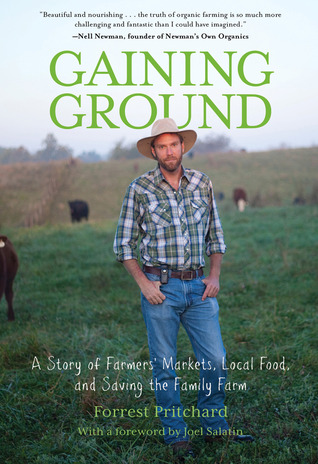
Gaining Ground
I ran into my friend Forrest again at tonight's Eat Local First Week kickoff event. It reminded me that I have yet to write a proper review of his wonderful book, which I devoured over two months ago. And I call myself a friend... And a lover of good writing... Here it is (na endlich!):
A handful of pages into Chapter One, Forrest describes the day he told his parents he wanted to quit his teacher training and become a farmer. "Farming? Are you kidding me? You don't even know how to grow a turnip!" He could well have described my own dad's reaction the day I told my own parents I was going to bike around the country by myself. ("Biking? Around the country? But why? You don't even ride a bike!") It is one of a number of instances with which I suspect many of his readers (and if you are not yet one of these readers, you should be) can identify. It is a book written for dreamers and doers alike, a story of passion and determination and deep love for land and family.
I can't help but laugh out loud at the hilarious turns of phrase throughout, the way this up-and-coming author finds humor and chooses to learn from things that could easily make a lesser man (or woman) throw in the towel. Freshly repaired fences knocked down by 1500-pound cattle again? "I can honestly credit cow butts for helping me to become the carpenter that I am today." Time and again, the newbie farmer gets knocked down and gets up again, wiser each time, and now it's been about 17 years since he went into farming -- still a young farmer by many standards, but a good one and among the most eloquent and thoughtful ones I know.
So much of what I love about this book is the way that anyone -- no matter what their background -- can identify with moments of frustration at ridiculous situations (such as the early attempts at constructing and moving chicken tractors or building cow fences) as well as those moments of giddiness at small but important victories (a slow and steadily growing customer base, financial solvency at last). Lord knows his recounting of the abysmal early days at farmers' markets is encouraging for me amid the slowly growing Suitland market that is absorbing more than its fair share of my waking (and supposedly sleeping) hours. If we pay attention and put our hearts into it and work hard, things will fall into place. Despite many bittersweet moments along the way, Forrest tale of reclaiming the family farm has a happy ending. It gives me hope for what many of my other friends venturing into rural and urban sustainable farming are trying to do: fix our food system one farm, one community, at a time.
At the end of his book, as at the end of his presentation at tonight's Eat Local First event, Forrest gives us hope for the next generation of farmers, if we are brave and determined enough to show them that farming can be a noble and viable profession: "Potential. Respect. The sweet simplicity of toil, the satisfaction of working in harmony with the land. Bounty, and the grateful reward of harvest. These phenomena are both timeless and contemporary, deeply and constantly present. Over the course of a lifetime, farmers grow straight out of the soil, wizening into abstractions of their former selves[...] Somewhere, another farm awaits its farmer."
"[My father] looked at me as though I had just told him I wanted to push helpless old ladies down long flights of stairs."
A handful of pages into Chapter One, Forrest describes the day he told his parents he wanted to quit his teacher training and become a farmer. "Farming? Are you kidding me? You don't even know how to grow a turnip!" He could well have described my own dad's reaction the day I told my own parents I was going to bike around the country by myself. ("Biking? Around the country? But why? You don't even ride a bike!") It is one of a number of instances with which I suspect many of his readers (and if you are not yet one of these readers, you should be) can identify. It is a book written for dreamers and doers alike, a story of passion and determination and deep love for land and family.
I can't help but laugh out loud at the hilarious turns of phrase throughout, the way this up-and-coming author finds humor and chooses to learn from things that could easily make a lesser man (or woman) throw in the towel. Freshly repaired fences knocked down by 1500-pound cattle again? "I can honestly credit cow butts for helping me to become the carpenter that I am today." Time and again, the newbie farmer gets knocked down and gets up again, wiser each time, and now it's been about 17 years since he went into farming -- still a young farmer by many standards, but a good one and among the most eloquent and thoughtful ones I know.
So much of what I love about this book is the way that anyone -- no matter what their background -- can identify with moments of frustration at ridiculous situations (such as the early attempts at constructing and moving chicken tractors or building cow fences) as well as those moments of giddiness at small but important victories (a slow and steadily growing customer base, financial solvency at last). Lord knows his recounting of the abysmal early days at farmers' markets is encouraging for me amid the slowly growing Suitland market that is absorbing more than its fair share of my waking (and supposedly sleeping) hours. If we pay attention and put our hearts into it and work hard, things will fall into place. Despite many bittersweet moments along the way, Forrest tale of reclaiming the family farm has a happy ending. It gives me hope for what many of my other friends venturing into rural and urban sustainable farming are trying to do: fix our food system one farm, one community, at a time.
At the end of his book, as at the end of his presentation at tonight's Eat Local First event, Forrest gives us hope for the next generation of farmers, if we are brave and determined enough to show them that farming can be a noble and viable profession: "Potential. Respect. The sweet simplicity of toil, the satisfaction of working in harmony with the land. Bounty, and the grateful reward of harvest. These phenomena are both timeless and contemporary, deeply and constantly present. Over the course of a lifetime, farmers grow straight out of the soil, wizening into abstractions of their former selves[...] Somewhere, another farm awaits its farmer."
Thursday, July 18, 2013
Sour Cherry Jubilee
I love sour cherries. Which is funny, since I don't much care for cherry pie or cherry preserves -- the two most common ends that sour cherries are known to meet. My sour cherries, like scrumptious, glistening jewels, are destined for greater things than pie.
Most recently, shrubs -- just before booting up the laptop I whipped up a batch with said cherries + brown sugar + apple cider vinegar that will ferment into mouth-watering deliciousness over the coming days -- but last night might have been the creme de la creme of sour cherry usage thus far. I'm talkin' scones. And not just any scones. The kind one's boyfriend writes specifically to thank one for the next day. And I quote: "My goodness these are some fine scones. Love that they are soft. And the cherries and walnuts make a fine pair." Just a little something I whipped up for dessert while I drafted the weekly newsletter for the Suitland farmers' market at 10:30 at night....
I wish I could claim that it was my original recipe, but it's not. My cousin Sonia has been raving about the cooking blog Chocolate and Zucchini for years. Last night, I tried yet another winning recipe -- slightly adapted to accommodate the quart of sour cherries I'd picked up at the 14&U farmers' market last weekend. And with some lemon zest. And vanilla. And, okay, maybe it's kind of a new recipe after all, but it was inspired by the C&Z blog.
Sour Cherry and Walnut Scones
What's that you say? Why, yes, I do frequent a number of farmers' markets these days. Between working with various markets in the area and teaching cooking at a middle school summer camp, I seem to have fallen way behind on blogging in recent weeks. So much for summer being the slow season.
Thanks for coming back to see me, dear readers, and please accept this stellar scone recipe as a sign that I have not forgotten you. You may forget all about me when you're lost in the bliss of eating all eight of them yourself. Yes, you'd better make a double batch.
Most recently, shrubs -- just before booting up the laptop I whipped up a batch with said cherries + brown sugar + apple cider vinegar that will ferment into mouth-watering deliciousness over the coming days -- but last night might have been the creme de la creme of sour cherry usage thus far. I'm talkin' scones. And not just any scones. The kind one's boyfriend writes specifically to thank one for the next day. And I quote: "My goodness these are some fine scones. Love that they are soft. And the cherries and walnuts make a fine pair." Just a little something I whipped up for dessert while I drafted the weekly newsletter for the Suitland farmers' market at 10:30 at night....
I wish I could claim that it was my original recipe, but it's not. My cousin Sonia has been raving about the cooking blog Chocolate and Zucchini for years. Last night, I tried yet another winning recipe -- slightly adapted to accommodate the quart of sour cherries I'd picked up at the 14&U farmers' market last weekend. And with some lemon zest. And vanilla. And, okay, maybe it's kind of a new recipe after all, but it was inspired by the C&Z blog.
Sour Cherry and Walnut Scones
- 1 2/3 cup whole wheat pastry flour
- 2 TBSP sugar
- 1 tsp baking powder
- pinch of salt
- 3 TBSP butter, chilled
- ½ cup plain Greek yogurt
- 2 TBSP whole milk
- 1 tsp vanilla
- zest from 1 lemon
- a handful of chopped walnuts
- ¼-½ cup sour cherries, pits removed
DirectionsPreheat the oven to 400°F. Line a baking sheet with
parchment paper.
In a medium bowl, combine the flour, sugar, baking powder, and salt.
Dice the butter and blend it into the dry ingredients with a fork or pastry cutter, until no visible lump of butter remains.
Add the yogurt, milk, vanilla, and lemon zest. Mix in the nuts and cherries. Use your hands to quickly blend them in until the dough forms a ball. Handle the dough as lightly as you can. (Avoid over-mixing, or the scones will become tough!)
On a floured surface, pat the dough into a flattish round, about 1-inch thick. Cut into eight wedges with a knife or a pastry cutter.
Place the wedges on the prepared baking sheet, giving them a little space to expand. Bake for 15 minutes (or longer, if your oven stinks like mine does), until the top of the scones is set and lightly golden. Cool on a wire rack.
What's that you say? Why, yes, I do frequent a number of farmers' markets these days. Between working with various markets in the area and teaching cooking at a middle school summer camp, I seem to have fallen way behind on blogging in recent weeks. So much for summer being the slow season.
Thanks for coming back to see me, dear readers, and please accept this stellar scone recipe as a sign that I have not forgotten you. You may forget all about me when you're lost in the bliss of eating all eight of them yourself. Yes, you'd better make a double batch.
Saturday, June 22, 2013
Summer Root Veggie Coleslaw
Okay, so maybe kohlrabi isn't a root vegetable -- it's actually the swollen stem that we eat, and in this recipe I chop up some of the smaller leaves as well. I'm sure there are some other inaccuracies I was unintentionally promoting, most likely involving my Spanish translations of the two recipes I made at the 14&U farmers' market earlier today.
It was the day we were to have a group of Spanish-speaking families touring the market as part of the second year of the Fruit & Vegetable Prescription Program pilot in DC, and I did my darndest to translate things as best I could. Seriously, though, what do you do when a language doesn't have a name for a vegetable because the culture speaking that language doesn't have people who tend to grow or eat it? I continue to refer to kale as "col rizada" -- "curly cabbage" -- and determined that the closest I could find to the Spanish word for kohlrabi was "colinaba" -- which, when I translated it back into English from Spanish online came up as either "kohlrabi" or "turnip." Well, I suppose salad turnips could be delicious in the coleslaw I was handing out.
Since I ran out of the copies of the English language version of this latest favorite recipe, and a number of shoppers at this morning's market begged me to post it, I needed to get this recipe up asap.
For your root -- and other veggie -- tasting pleasure, here's the much sought after recipe for a killer summer coleslaw.
Ingredients
1 large kohlrabi, peeled and grated (you can chop up some of the leaves as well)
1 tsp salt
3 TBSP mayonnaise
2 TBSP sour cream
2 TBSP olive oil
2 TBSP vinegar
1 TBSP sugar
2 tsp celery seed (or finely chopped celery)
1 small red onion, peeled and minced
1 clove garlic, peeled and minced (or 1 garlic scape, finely chopped)
2 carrots, grated
1 bunch radishes, grated or thinly sliced*
Directions
In a small bowl, combine the grated kohlrabi with salt. Set aside.
In a large bowl, whisk together the mayonnaise, sour cream, oil, vinegar, sugar, and celery seed.
Squeeze the grated, salted kohlrabi to remove any excess water.
Stir in the onion, garlic, carrots, radishes, and kohlrabi. (It’s okay to use your hands to mix!)
Enjoy as a cool salad alongside grilled meat or fish, as a sandwich topping, or as a midday snack.
*You can also grate other veggies in. Cabbage, for a more traditional coleslaw, perhaps, or beets -- but beware they will turn everything pink. Or salad turnips... you know, the other colinaba. ;)
Many thanks to my friend and colleague, Carolyn, for giving me the basic recipe for the slaw (that I then took in directions she might not have foreseen).
Wednesday, June 5, 2013
Opening day!
When your colleague shows up with a giant bunch of balloons spilling out of her truck, you know it's going to be a good day at work. So it went for opening day of the much-anticipated Suitland Farmers' Market. Perfectly clear, sunny weather, gorgeous fruits and veggies grown by a core group of local farmers, lots of volunteer helpers, and tons of friendly shoppers... not a bad way to start the season. Sure there were some hiccups, but together we made things work.
Barbed wire on the top of the fence popping the balloons? No problem, tie them down lower on the fence.
Times printed incorrectly on the signs? No sweat, use duct tape to write out the correct times over top.
No place to pick up lunch? Well, we are in a food desert -- that's why we're here! -- but you can grab a mediocre sandwich down the block and slice some farmers' market tomatoes and cucumbers on top to jazz it up. How about a handful of local spinach, too, or some chopped up garlic scapes? Maybe some grown a few blocks away?
I arrived home last night slightly sunburned, moderately loaded down with fresh produce, and completely exhausted. And proud: we did it!!!
Wednesday, May 29, 2013
DC school garden bike tour: summer 2013 edition
Get some air in your bike tires and some oil on your chain. Grab that
helmet and water bottle. It's back, and it's going to be even better
(and certainly bigger) than ever before. Yes, it's another school garden
bike tour!
It all starts at BicycleSpace @ 11:30am -- a perfectly reasonable hour to be riding a bicycle on a Sunday, don't you think? The group will share a tasty, free breakfast. At the final school, thanks to a generous donation by our local Slow Food chapter, we'll transplant seedlings grown by the wonderful Farmer Kristin over at Radix Farm into raised garden beds at one of the schools. In between, we will learn from each school about a project they need to accomplish in order to make their garden an even better learning environment. As the tour goes on, you'll want to keep in mind which school inspires you the most, or looks to have the most potential, because at the last school, over a delicious free lunch around 2pm or so, BicycleSpace will request donations. Then we will all vote on which school's project will receive all of what has been collected. You will decide which school will benefit. (Bam! There's a direct democracy in action for you!)
Space is limited so sign up here.
Okay, so, yes, it is technically free, but I'd encourage you to donate if you are one of the 80 cyclists on the ride....
Monday, May 27, 2013
Once a food educator, always a food educator
My next door neighbor, Henry, called out to me from his back patio earlier this evening as I was ducking into my apartment. "Come on over for a barbecue!"
What would Memorial Day be without a barbecue? Not a proper American holiday, certainly. But after a weekend spent mostly in Arlington, I was at a loss for something to contribute. And I'll be damned if I show up at a barbecue empty-handed. Luckily, I had some garlic scapes on hand from the farmers' market in my fridge.
You should have seen the odd but intrigued looks I got from Henry and friends when I emerged moments later. "I'm bringing over some garlic scapes," I called over the fence as folks looked down into my garden. "They come from this part of the garlic plant -- just one scape per plant, see, here's one coming up right here on this plant -- and they're something to feast on while the garlic bulbs do their last few weeks of growing underground." I couldn't help myself, they were so curious. (Henry is used to my quirky contributions -- I'd brought along chocolate beet brownies to a cookout on his deck a few years ago. Still, he happily munched on a scape in the bundle as they came off the gas grill minutes later.)
"So you just toss those... scapes... on the grill with a little olive oil? And that's it??" one guy asked. "That's so easy!" It's true, I assured him, as I set to chomping on some corn on the cob.
"Wow, they're done in less than five minutes! And you're right," a woman nearby commented, "They are definitely garlicky, but much milder than regular garlic. Can you eat these raw, too?" You certainly can, I assured her, and continued to field questions as I dug into a bowl of potato salad at the end of the picnic table.
"How come I've never seen those before?" another barbecue guest asked. "I'm going to keep an eye out for them. And you say they are good in pesto...?"
I really just stopped by for a beer and a veggie burger, but can I help it if folks want to learn about seasonal food and cooking in my free time? Ah, I love it. And I suspect some of them will be seeking out these treasured allium shoots at the farmers' market, since as far as I've seen they are unavailable at the grocery store....
Subscribe to:
Posts (Atom)