Showing posts with label Michael Pollan. Show all posts

Wednesday, July 31, 2013

Final harvest at 1343

It was sad to have to pull up the giant cucumber vines and two-foot-tall flowering okra shrubs in the garden earlier today, but what is a renter to do when the house she's been living in goes on the market?

Earlier today as I uprooted and composted a gardenful of plants at the height of their productivity, I harvested, discovering a few slightly overripe cukes and a rather large zucchini hidden under elephant-ear-sized leaves. So there's that. And I'm looking forward to trying my hand at some feta-stuffed, pan-fried squash blossoms at Meredyth and Greg's place, where I'll be staying for the next couple of weeks til I move into my new place.

It's the little things that we gardeners celebrate, and this final harvest is one such thing:


I was tempted to leave the thriving plants they were, but who knows if the people who will be moving in this fall will even want a garden. Though the soil has been improving over the past handful of years' diligent weeding and composting, maybe the new folks will use the back area for a parking spot for their SUV. It could happen. I try not to think about it too much, and comfort myself with the reminder that many of the herbs are in pots and the mushroom logs are transportable. (I also recognize that it's the ideal time for my landlady to sell, as home values in my neighborhood have skyrocketed in recent years. No harm, no foul.)

However, I wish I'd known before the springtime transplanting of heirloom plants Kenton and I started from seed that I would not be there to revel in the bountiful harvest come late summer. Then again, knowing me I probably would have planted them anyway. Oh, to witness the beautiful, purple and cream colored okra blooms unfurl in the late morning as I sipped my morning tea, even if only for a few weeks, was worth the pain of having to uproot them prematurely. (What, was that too dramatic? Try reading Michael Pollan's Second Nature. My ode to okra is comparatively subdued.)

After the better part of six years cooking and gardening in the formerly dicey and now unequivocally hip Columbia Heights neighborhood, it's time to move on to the next backyard plot about a mile and a half down the road. I may or may not have left the strawberry plot and the raspberry bush for the new owners....

Tuesday, November 30, 2010

Respect my authoritah!

(Hmmm, I have a feeling there are a lot of misdirected South Park fans suddenly finding themselves reading a sustainable food blog....)

This Sunday's New York Times
featured an op-ed that defended the apparently quite contentious Food Safety Modernization Bill. (What's that? Yes, though I spent Thanksgiving weekend in New York City, where the paper is available on every street corner, I didn't have a chance to read the article until today.) It was a hotly debated piece of legislation ostensibly because of criteria that some argued would unfairly penalize some small-scale producers. What? No! We need to help small, local producers who are doing things responsibly, who focus on quality over quantity! They're not the ones behind the giant food recalls in recent decades! Most of them only sell within a few hundred miles and any questionable items can be easily traced back to the source.

The anti-small-farm bias of the bill had been played up in recent weeks and I was a little uncertain about how I felt -- not that food safety was unimportant, but I had been concerned about how small farms would be able to make the necessary modifications in their systems and not lose the farm, so to speak, in the process of complying with more stringent standards. (I feared something akin to the passing of USDA organic certification standards a few years ago whose cost and inspection regimens have, at least according to a number of farmers I spoke and worked with around the country, been a major barrier to more widespread organically-certified produce.) What I hadn't known before co-authors Eric Schlosser and Michael Pollan brought it up is that concerns about the small farmers affected by prohibitive costs and regulations had already been addressed by an amendment that allowed for state and local government control of these matters. The bill passed yesterday, and it's a good thing, too: it finally gives the US Food and Drug Administration the funding and authority to keep our food safe.

Admittedly my understanding of who does what in the USDA vs. the FDA is a little fuzzy. But then, my friends who work at both organizations are also a little fuzzy on who is responsible for what (and why). Food safety? Well, that's the FDA's role... usually. (The best explanation I have yet to hear about the two organizations is actually here.) As far as I can piece together, the USDA is much larger and handles all things food except nutritional labeling and food safety -- these fall under the purview of the FDA. Why, then, has this very important enforcement agency been given so little power to enforce food safety violations? I'd gotten the impression when reading Schlosser's (in)famous Fast Food Nation a few years ago that food safety was a major concern in our country. I just kind of figured that someone with political clout and a conscience had read the book, too. I was mortified to learn in this recent op-ed that only with the passing of this new food safety legislation do the USDA (for meat, poultry, and eggs) and the FDA (for all other food products) finally have the power to enforce recalls for contaminated food. Yes, folks, prior to this, the majority of recalls were not mandatory but simply requested. (WHAT?? Yes, requested.) A voluntary recall. "Please, can you recall those half a billion contaminated eggs from grocery stores around the country? No? Pretty please?"

Now let's look at who is against effective food safety enforcement: large-scale producers, who also happen to be the ones behind repeated food safety violations. (And, of course, the politicians who are financed by them.) Hmmm, how interesting. Yes, and they also argue that these new requirements are too... costly. Please. If you want to talk about unreasonable requirements and atrocious spending, try going through one of the new fancy(under)pants scanning booths at the airport. And at $150,000 per unit, I wonder how the budget for the high-tech groin inspection devices compares to that for improved food safety. (Sorry, I guess I'm still grumpy after being manhandled during my travel back from Vegas a few weeks ago where I was helping my brother launch his small business.)

For the record, I do think that safety -- in airports, in our food system, on bicycles (ahem, wear a helmet) -- is important and needs to be handled appropriately by the government to protect its citizens. The prevention-vs-treatment costs cited in the NY Times article are pretty compelling: $300 million for improved food-borne illness prevention as compared with $152 billion spent for treatment. Per year. Seems like a no brainer to me. But who knows, maybe the bill's opponents are using some kind of new math (similar to the calculations that suggest tax cuts for the wealthy will stimulate the economy).

Thursday, May 27, 2010

Meals Rarely Edible

So there have been a few inquiries about the status of the MREs since I acquired a couple from my new friend Buddy last week. Wonder no more.

Unless you've been in combat or lived in the wake of a natural disaster, chances are you might not know what an "MRE" is. Technically, it stands for Meal Ready to Eat. More accurately, I would suggest it is more along the lines of Meal Rarely Edible.

I am researching food, and here in tornado country I thought it a good idea to test out one of these emergency food packs. Also, I must say I was a bit curious. I mean, the Mysterious Reddish Experiment package even comes with its own plastic spoon, cookie, raspberry-flavored drink mix (which contains no actual raspberry), spices (a small packet of black pepper), and miracle-of-modern-science one-time-use heating mechanism. So just a couple of days ago, Aaron rejoined me in central Mississippi along the scenic (and blessedly tree-lined) Natchez Trace Parkway. As our supplies ran low and food options along the route were nonexistent (unless I wanted to take a crack at squirrel hunting or poison ivy salad), we broke out the Muck Reserved for Emergencies. Yep, I'm talking about the chicken and black beans and rice. We were starving, and the thought of yet another granola bar was less appealing than the hyper-synthetic food product. Maybe it was the southern humid heat making me delirious, but it seemed like a good idea at the time. (Michael Pollan would be horrified. At least I could pronounce most of the 17 ingredients listed on the label.)

I won't say the meal was an epic failure, but it wasn't one of my finer culinary moments. In spite of step-by-step instructions *and* diagrams, it took multiple attempts to prepare the Mush, Remotely Edible. (Yet another reason I'd never make it in the military: I'm not good with following orders. It's also probably why I am a better cook than a baker. What? Measuring? Bah.) Roughly 15 minutes after I'd stuffed the required components together, there didn't appear to be much activity going on in terms of the gruel heating up. I broke down and read through the instructions: top ripped open (with my teeth; I wasn't about to risk another incident with the multi-tool), salt water packet dumped in, packet folded over, package reinserted into cardboard box... oh... heat pellet on the *bottom*.... (Aaron helpfully pointed out that I didn't go through the requisite military training session on how to prepare these Mostly Rancid Ex-foods.)

Once I got the heating mechanism placed correctly, it was another 10 minutes or so until the Mildly Radioactive Ectoplasm was ready for consumption. As we waited for the contraption to cool to non-molten-lava temperature Aaron and I nibbled on the crackers and knead-packet-before-opening cheddar cheese product -- one of the side items in the Morphologically Re-Engineered meal.

When we actually got to eating the Magically Reconstituted Effect, I believe the consensus was "not as bad as it could be." With our salt intake for the week now taken care of, we hopped back on the bikes for the rest of the day's ride. All in all, the Mildly Repugnant Esculent fit the bill: calories not in bar form. (Though prior to heating, the foodlike substance was a Markedly Rectangular Entity....)

Sent from my Verizon Wireless BlackBerry

Sunday, March 21, 2010

When Ibti met Ollie

Today is a momentous one. Not, not because of a particularly long or grueling ride. Not a mileage milestone, nor an exceptionally poor-weathered day....

One year ago today I first laid eyes on my beloved Ollie and brought her home. She was as beautiful in the catalog as she was in the... steel. (A mail order partner, what can I say?) And she's only grown more lovely as I've gotten to know her, each ding and rust spot steeped in memories.

With no champagne in sight -- it is West Texas, so I could perhaps rustle up a bottle of the Champagne of Beers -- we have decided to collaborate on a poem to commemorate the occasion. Narrated by my fearless ride, and in the style of our all-time favorite poet (who I hope is not rolling over in his grave), I give you:

The Love Song of J. Olympia Surly

Let us ride then, you and I,
Toward where the road just meets the sky
Off to find the true America and food;

Let us go, traversing half-deserted streets, Sometimes needing to retreat
Share restless nights in one-night cheap campsites
And beercan stove dinners filled, at least, with lots of spice:
Facing winds that blow like an obstinate argument
Of insidious intent
To lead you to an overwhelming question. . .

Oh, do not ask, "Are we there YET?" We've come so far, and still you parrot.

The long haul truckers pause to say
Did you see that loony on a bicycle on the highway?

The cursing from inside your tent I hear
When the morning frost encrusts the rain fly on mornings clear,
Pricks its tongue into the corners of the sleeping bag, Lingers upon your fingers and your toes.
I discern you falling back onto the sleeping pad for just a few moments more,
Then, determined, you emerge fully dressed, make a sudden leap,
  And seeing that it is a bright March morn
Start loading up, lest you be tempted to lollygag and crawl back to sleep.

And indeed we change our view of time
For the unflagging headwind that hits us in the face,
Slows us down again;
There will be time, there will be time
To prepare a face to meet the farmers that you meet;
There will be time to weed and cook and learn,
Yes, time for all the works and days of hands
And hope that when they let you into their kitchens, the rice you will not burn;

Time for us to slowly make our way,
Not quite time yet for a hundred miles--
I suggest just 40 or 50 for the rain today is wild--
Before the taking of yet another pb&j.

The long haul truckers pause to say
Did you see that loony on a bicycle on the highway?

And indeed there will be time To wonder, "Uphill again?" and, "No, seriously, AGAIN???"
Time to push onward and descend,
While the odd rash on your thigh is one more thing with which you must contend.

[They will say: "How her boobs are growing small!"] Your shorts too tight, fitting snugly to your legs and all,
With shirtsleeves grey with grease, no longer white, and a few specks of gravel from when you fall—
[They will say: "But check out that bike glove tan!"]

Do I dare
Disturb the traffic flow?
At a stoplight there is time
For us to topple, clipped in, as we have done many times when we accidentally crash instead of go.
For we have eaten dust on roads, even in ditches, many times;
And always, though sometimes through gritted teeth, you smile,
I have measured out my life in miles;
I know the sound of tire tubes bursting, pinch flats, and the maddening, leak of air
As a thorn or shard of twisted metal scratched.
So how many have you patched?
Oh, I have known the flats already, known them all—
The tubes you fix as darkness starts to fall,
And when I am wheels-up, sprawling on my handlebars, On the roadside as it starts to rain,
Then I count them. As I recall each, a dozen now, dare I complain?

And shall I reminisce?
For I have known the hills already, known them all— Like elephants the ones in Pennsylvania were [But paling in comparison, we noted, once we conquered the mountainous Big Sur!]
Is it the subtle sound of hissing air
That makes me thus despair? I think it may be number thirteen. And are you swearing now?   This time in French?  .     .     .     .     .
Shall I say, we have journeyed 'cross the country's narrow lanes
And milked the sheep and bottle-fed the kids
Of hungry ewes who tried to eat your pants? . . . I should have been a pair of dull handclippers left out in the rain.        .     .     .     .     .
And the afternoon, laundry blows so lovely in the breeze! Hung by weathered farmers' fingers, Freshly washed . . . sundried . . . yet the sweaty odor lingers, Stretched on the line, up above you and me. Should I, after five thousand miles traveled,
Have the nerve to point out that your favorite smartwool socks have unraveled?

But though I have creaked and wobbled, borne such gear, Though I have seen screws lost (and some grown slightly rusted) 'long the way, I am no road bike–-nor mountain bike as you know from tires busted;
I have known the glory of the mountain's acme, And I have shared the misery of fallen trees which, for us to cross, you needed to unpack me,
And in short, I was overladen.
And would it have been worth it, after all, After the salsa shoes, the saffron, the other frills,
Among the bags of gear, among some talk of your packing skills, Would it have been more wise,
To have left some things behind and perhaps downsized,
To have squeezed a few less things into panniers?

We roll toward some overwhelming question, To say: "I am Ibti, come from DC, Come to hear you all, I shall tell your tale on my blog" If one farmer, setting a coffee cup aside in response to a posting, Should say, "That is not what I meant at all.   That is not it, at all."

And would it have been worth it, after all, Would it have been worth while,
After the church lawns and haylofts and gas stations where we have slept, After the fear of snakes, of lightning strikes, and death by tree limb falling and crushing us in our sleep— And this, and so much more?— It is impossible to say just what I mean! But as if a magic word would change the way we eat: Would it have been worth it
If your hero, Mr. Pollan, sitting up from writing at his desk or reading fan letters,
And turning to his e mail, should write to you: "That is not it at all,   That is not what I meant, at all."
.     .     .     .     .Yes! You are not Ms. Waters, nor were you meant to be;
But a committed lover of her work, one that has hoped to be heard,
To join the movement, start a seed or two,
Advise the District; no doubt, an easy hope,
Excitable, glad to be of use, Intrepid, joyful, and meticulous; Full of 80s pop culture references, but a bit obtuse; At times, indeed, almost ridiculous— Almost, at times, a nerd.

We grow old . . . We grow old . . . And you still wear the bottom of your right trouser rolled.

Have we left five thousand miles behind? Do you notice when I squeak? I hope in Austin I shall finally get a tune-up, and move without such creaks. I have heard the rain tapping on the inside of your tent. (It leaks.)
I do not think the rain will bother me.
I have been left out in many storms (ahem),
Endured the deluge without fear
When the wind blows so strongly in your ear.

We have made our way so far from our first ride
From the bike shop now two-thirds around
Till we make our way back home, to share what we have found.

[21 March 2010]

Sent from my Verizon Wireless BlackBerry

Wednesday, February 10, 2010

Veg-powered

Amid the pouring rain, my plans to work with a young farmer starting up a CSA in Santa Barbara fell through last weekend. The fields were soaked; I was bummed. When a door closes, though, a window often opens -- in this case, my new friends Joel and Becca guided me toward Ojai, CA, where I was to experience an amazing farmers' market, spend time with John and Jody's wonderful family, discover an innovative school, and learn about diesel engines powered by vegetable oil. Did I see any of this coming? Nope. But I'm so glad Joel set things in motion when he stood in the pouring rain outside my tent at El Capitan State Park to invite me to have a cup of coffee last Friday morning....

As I sat in their warm, dry trailer for a spell and scarfed a bagel and cream cheese, Joel and his wife Rebecca invited me to join them for a jaunt into Santa Barbara. In town, Joel introduced me to John, who runs Java Jones (an organic, fair trade coffee joint), and who, over a lovely cup of joe and a chat about what I'm up to, told me about his daughters' school in Ojai that focuses on creativity, conflict resolution skills, and environmental education. Well, there's a lot more going on at Oak Grove School, but I was most excited to learn of these elements as well as the garden plot each class nurtures and the school's local, seasonal, fresh vegetarian food served daily. (Michelle Obama's school lunchroom dream come true.) Three days later I found myself in Jane and Maisy's second grade class giving a talk. The kids were awesome, enthusiastically asking me about everything from how many miles I bike per day to what I do when it rains to if I ever get tired to how I do my laundry. We talked about food, too. After a tour of their garden, I joined the class for a delicious lunch at the covered picnic table area and we continued to chat about cycling, camping, nutrition, and some of our favorite foods. Those were some sharp, veggie-powered brains. Here's a post-lunch shot of Ollie and I with the class.

Many have made compelling arguments for vegetarianism, and it is a core value espoused by Oak Grove School. Even setting aside Jonathan Safran Foer's argument about the inherent cruelty of meat production, authors from Michael Pollan to Eric Schlosser posit that it requires less energy to produce vegetables and grain in comparison to raising animals for meat. This is one of the points I've often heard raised by environmentally and socially-motivated vegetarians. (I'm still hoping to get my hands on a used copy of Jonathan Safran Foer's latest -- "Eating Animals" -- and not just because dad told me about a hilarious interview he recently did on the Colbert Report involving bacon. I've been wanting to read it for a few months now.) Collectively, Americans would all do well to cut down on our meat consumption, in terms of both portions and frequency. But this is not a post extolling vegetarianism. There are other ways we can embrace a more plant-based existence, and one of these ways may pleasantly surprise you.

If you haven't been living under a rock for the past 20 years, you've no doubt heard the catchphrase "Reduce, Recycle, Reuse." Most people think this refers to cans and bottles and plastic bags. And it often does. But what about fuel? As folks are crippled by how much it costs to fill up their Volkswagens these days, many are saying it's about time we started supporting alternative means of transportation (public transit, bike lanes) and promoting alternative fuel sources. One of the coolest solutions I've come across recently involves making fuel out of used vegetable oil.

It's not science fiction. Joel and his wife have been converting diesel engines to run on veg for about a decade: www.vegpoweredsystems.com. One day he looked at the back of a bottle of vegetable oil and noticed the "contents may burn" warning and he got to thinking.... He's successfully converted thousands of vehicles, I learned during a series of conversations over the past few days, and he's darn good at it. (He's proud of his work without being pompous.) I get the impression he's been wielding a wrench pretty much since he could walk and he may be the only person I have ever met who knows the intricacies of engines as well as my car-obsessed brother. As I understand it, the converted engines work much like a hybrid, allowing drivers to easily switch between diesel and vegetable oil fuel tanks en route. Only veg-powered systems are more efficient than ethanol, and cleaner burning. And the trucks are fast. (No, really. They race 'em.) And the systems recycle used restaurant vegetable oil that, at least as far as I know, would otherwise just be dumped.

Free fuel! Recycling! Less carcinogens! I'm in! I'm certainly Ollie-bound for the foreseeable future, but down the line if I go looking for a car, you'd better believe I'll be looking for a veg-powered system.

Sent from my Verizon Wireless BlackBerry

Wednesday, January 6, 2010

Cross Pollan Nation

This morning, sitting in my pjs at my friend Barry's in Oakland and having a leisurely breakfast of leftover stirfry, I had a chance to catch up on the news... of the Daily Show variety. (What did you expect, FOX News?) I had a chance to catch the Jon Stewart and Michael Pollan interview, which I'd been anticipating since I heard about it a month ago. It was like the cocktail hour before my fantasy dinner party. (Well, maybe the two would have been holding Death's Door martinis at my place.) Anyway, it's worth a watch. I'm glad to know that I am not the only one linking food and health care reform....

Okay, it's true, Mr. Pollan has connected the dots between the two more often, more eloquently, and prior to my own series of rants. And perhaps he is a bit less... what would my mom say... evangelical? (He's darn convincing, though.) I'm not sure I need to read his latest book, a collection of 64 food rules -- mostly because I probably already follow them, but perhaps partly because I inherently don't like reading rules (as you might guess by my blatant disregard for the "not mixing black and brown" fashion guideline) -- but because it is written by such an articulate deep thinker, it may warrant a quick skim at a local book shop. Maybe on my way through Berkeley this afternoon. OMG, Berkeley! Where Mr. Pollan teaches! Chances are slim that I'd run into him, partly because he's likely on a book tour, what with this latest publication, but also because I'm entirely too shy to introduce myself even if I did encounter the man who in many ways inspired my bikeable feast. What if I spot him walking down the street here at the headquarters of Pollan Nation?? What to wear? What to wear? Something that won't show stains in case I faint and spill my caramel latte if I bump into Mr. Pollan in a coffee shop. Maybe something brown and black....

(Props to Sheffy for inspiring the title of this post.)

Thursday, December 3, 2009

How are we going to feed ourselves?

Farming is hard work. Seriously, I'm exhausted. I spent Monday and Tuesday working at Lost Creek Farm, an organic produce operation in central Oregon. (Technically, it was within the Eugene city limits, but it seemed awfully rural -- and hilly -- when Ollie and I biked the 12 miles back to town from the farm.) As we labored -- harvesting, washing veggies, packing boxes, constructing a hoop house (a temporary greenhouse), pouring concrete for a permanent greenhouse foundation -- I had an opportunity to rant...I mean talk...with David and his team about the challenges of organic food production.

Lost Creek is one of the larger CSAs that I've been to, and yet it is run by a skeleton crew of David and two helpers (two fellow AmeriCorps alums, actually, so we had much in common and much to rant...I mean talk...about). The diversified farm has over 60 varieties of fruits and vegetables that it offers CSA members, small grocers, and local restaurants, and I learned from David that the region is considered by many to be one of the most productive in the country in terms of food. And yet, considering the consumption habits of the vast majority of Americans, there is a good deal of concern about whether this kind of farming (aka organic) on this kind of scale (still much smaller than pretty much any conventional farm) can actually feed our country. "It's not likely," David grumbled. The problem, aside from the skewed government crop subsidy system (don't get me started again), and a general pattern of undervaluing both food and farmers in this country (again, I'm restraining myself), David pointed out that the biggest problem is that there are simply not enough people *growing* the food in comparison to those (over)consuming it. We need to eat differently and eat less (especially less resource-draining meat). And where possible, we can do a better job of providing for ourselves. Yes, gardening.

I recall learning during my time at the Strawbery Banke Museum -- on my way through Portsmouth in July -- that during WWII something like 40% of all produce consumed in the country was grown in Victory Gardens. Yes, in people's front yards, school gardens, formerly empty lots. Forty percent! And now? Hardly anyone knows what brussels sprouts look like on the plant, or when strawberries are actually in season, nevermind how to save tomato seeds or when to start lettuce outdoors. "Food" comes prepackaged in gargantuan portion sizes from Costco and Walmart, ready to be "cooked" in the microwave. And then there's fast "food." Ugh. As a society, we've managed to sever just about every substantial connection to our food: how to grow it, cook it, enjoy it. But there's hope.

As a former classroom teacher, of course I believe that the paradigm shift that needs to happen for our food system to recover comes down to education. Understanding the difference between good food and crappy pseudo-food (what Michael Pollan terms "foodlike substances") is key. Some knowledge of what goes into producing food will go a long way toward understanding why good food costs more. For as hard as it is to grow and harvest organic carrots, they should be $10 a bag -- those suckers use up a lot of water and they are heavy to haul around the field in bushel crates! They should cost more, but not so much more in dollars than their chemically-dependent conventional sister carrots: there wouldn't be such an atrocious price difference between conventional/processed foods and organics if the *true* costs of food were taken into account -- in terms of labor requirements, environmental and personal health impact, and in the case of CAFO meat production excessive animal suffering. It would help if the government subsidies that I am trying not to harp on in this post were more conscientiously distributed. (Oops, I slipped.)

Still another part of the worldview shift will necessitate respecting the challenging nature of thoughtful, low-impact farming, not viewing food production as a mindless job that merely requires enough brute force, petroleum guzzling machinery, and a bunch of chemicals. (Some serious physical strength is needed, though. Whew!) I'll tell you, farmers, like teachers, work their tails off. To be truly great at either takes a special combination of talent and a lot of hard work. And while we all realize on some level that we need food (and critical thinking skills) to survive, we don't really value the people who feed us (or those who teach us). If we did, more people would *want* to be farmers (and teachers). And the work would pay better. These would actually be considered professions rather than just jobs that anyone can do. These days I feel like there is a perception that the work in either field is something left to those not smart or ambitious enough to do something better. It's no wonder most people want their kids to grow up and be doctors, lawyers, engineers, politicians. (There are some pretty idiotic politicians who have held office in recent years. If I have a kid one day, I hope my child grows up to be an organic farmer, or at least an avid gardener.)

How, then, can we begin to change the system? Seek out your local, organic farmers and buy directly from them as much as possible. Failing that, seek out small co-ops and markets who source from these farmers. While you support the important petitions of advocacy groups like Food Democracy Now to effect change at the policy level, don't forget to think about where you are personally spending your food dollars: you choose three times a day the food systems you support. (Unless you're biking across the country, in which case you choose about five times a day. What? I get hungry.) As Pollan would say, "We vote with our forks." Actually, while I'm at it, I'd advocate Pollan's most recent line: "Don't buy anything you see advertised on TV." Share the cooking and eating of good food with those you love. And for heaven's sake, get cracking on your victory garden.

Sent from my Verizon Wireless BlackBerry

Wednesday, November 25, 2009

OMG, did he just misspell "agribusiness"??

Thanksgiving is fast approaching, and you know what that means. Yep, lots of food -- hopefully lots of local, sustainable food -- and a few days off. I'll bet many of you are looking for something to do besides linger near the cheesecake at the end of the table or play Bananagrams.

During my time as a public school teacher, I was always expected to give some kind of project during school holidays. I tried my best to make these fun but thoughtful assignments. (Well, *I* thought they were fun; it's hard to please teenagers.) In honor of my former students, and inspired by a photo sent to me by my friend Mark earlier today, I've decided to hold a little contest....

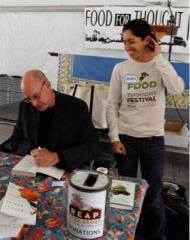
Your assignment, should you choose to accept it, is this: Come up with a caption for the photo above.

Historical note: It marks the first (non-photoshopped) photograph of me with one of my heroes, Michael Pollan. As you can tell, I was looking pretty menacing as the crowd control person at the book signing following Pollan's talk at the Food For Thought festival this past September.

So, put on your thinking caps and don't give in to the seratonin-induced food coma! I'll choose a winner on Dec 1 and send the victor a little care package from the west coast....

Sent from my Verizon Wireless BlackBerry

Wednesday, October 28, 2009

Surrogate gardeners

While in Minneapolis, I attended an informational meeting about a newly formed group called Backyard Harvest (a subsidiary of the Permaculture Research Institute, Cold Climate project). While they refer to themselves as a nonprofit, it seemed awfully like a regular small business: homeowners (or, in theory, renters could as well) hire professional gardeners to convert their 80 to 120-foot residential yard into seasonal organic vegetable gardens. The cost is roughly double the price of a CSA share, and the produce is just as fresh and diverse. Imagine having a year-round professional team designing, planting, mulching, weeding, and harvesting your backyard for you!

Me, I would do the gardening myself. That's part of the point. Initially, I was pretty suspicious of the program that in some crucial ways maintains the disconnect between eaters and their food by letting them off the hook of having to *do* anything to get organically grown, seasonal food; that once again money seemed to "solve" the problem; and the wealthier, as usual, are the ones who could access it. But upon further reflection, I revised my first impression: this may be a viable alternative for some folks who have money but not time to support sustainable agriculture. It's reaching a different demographic, one which would otherwise not be engaged at all in the Great Food Reformation. As such, when I think about it, this is a pretty good program.

On the one hand, Backyard Harvest seems to cater to those wealthy and busy enough to "not have time for that sort of thing" but who for whatever reason -- they read something by Michael Pollan in the NY Times or saw an article in Oprah's magazine that convinced them that organic gardening and eating are the keys to happiness -- want someone to grow good food for them at home. They're missing out on a large part of the joy of the food: getting to know their gardens and the seasons, or at least getting to know their neighbors at the farmers' market or food co-op or CSA pickup.

On the other hand, at least they're supporting organic agriculture and local business. And they're (by proxy) enriching the soil for the future and using their green space for more than just a useless lawn (that they probably rarely even have time to look at or care for anyway). On a personal level, they're eating a wide variety of fresh food and they're not spending their food dollars to support the gargantuan chemical companies or food processors. There is a contribution at the community level as well, I learned during the info session: each customer is encouraged to donate 10% of their garden's yield to a local food pantry. According to Stefan, the lead farmer, every single one of his customers opted to make this donation. So it isn't just the rich hoarding all of the organic brussels sprouts.

One thing that I have come to realize about sustainable agriculture as I've been making my way around the country is that it is by its very nature not a "one size fits all" kind of thing. Different programs are successful -- and necessary -- in different climates, and the communities and regional systems will determine for themselves what works best for them. Generally speaking, communities with a variety of food options -- such as farmers' markets, community gardens, co-ops, CSAs, Market Baskets, Slow Food group meals -- seem to work best. This way, as we collectively work toward more equitable access to seasonal, fresh, regional food, folks can find a way to eat in line with their budget, lifestyle, and schedule. For the Twin Cities, I hope that groups like Backyard Harvest -- just now wrapping up its first year -- continue to be a part of the solution.


Sent from my Verizon Wireless BlackBerry

Monday, October 26, 2009

Local yokels

My friend Sheffy brings up a good point, and it's something I've been trying to work out for myself for some time: what does it mean to eat locally? Here are some of the explanations I've encountered....

Geographical

When I went through Ithaca, NY, a few months back, the local farmers' market had a requirement that farmers could only sell things they grew themselves, and there was a 50 mile radius from the market within which the farms needed to exist. At the Seward Co-op in Minneapolis, MN, some items in the produce section with 'local' tags listed not only the farm and town but also the number of miles the food had traveled. In my quick survey, most of these were under 50 miles. (In case you're wondering, the items from California, Hawaii, and Chile did not have mileage listings.) In a chapter of "Deep Economy," Bill McKibben attempts to 'eat locally' for one year as an experiment. The criteria were largely geographical in nature: he tried to purchase and consume seasonal foods from Vermont for an entire year. Barbara Kingsolver, in "Animal, Vegetable, Miracle," attempts a similar feat in her year of growing (or buying within a short drive -- 10 miles, was it?) food for her family. Distance that the food travels from its origin (generally under 150 miles) seems to be the focus of 'locavore challenges' around the country.

Philosophical

A number of farmers I spoke with explained that 'local' is a term that is used as shorthand for a set of values, much like 'organic' as a category used to have certain associations back in the day. Like 'organic,' what defines something as 'local' varies depending on the values held by the person you ask. (What 'organic' actually means technically, since the USDA has established a checklist, is a far cry from the Back to the Land organic farming philosophy of the 60s. Some of the early principles have fallen to the wayside with the rise of what Michael Pollan calls 'industrial organic' -- operations that don't use lab-manufactured chemicals or seeds in their fields but who do not espouse the focus on land stewardship, natural resource conservation, or seasonal polycultures that the early organic food movement advocated.) 'Local' actually seems to be more about knowing how your food is grown -- having a relationship with the producer -- and eating seasonally (which implies that the food is seasonal where, or near where, you are living, so it's also still somewhat linked to geography).

Economic

There is a commonly held understanding that the food money spent within a local community largely stays within that community, changing hands multiple times to support a number of small businesses. (Whether 'community' means the village, the township, the region, the state, the country... it depends on who you ask.) I am not against a global economy, mind you -- some of my favorite wines are from South Africa, France, and Australia; I buy Italian olive oil and balsamic vinegar -- but I want the majority of my food dollars to go into the pockets of the hardworking farmers in my area. Not giant food processing conglomerates. Not Walmart.

Thus, in my mind, what it means to be 'local' is partly geographical, partly philosophical, partly economic in nature. These are fluid categories, interconnected and complementary like a functional ecosystem. But I don't claim anything close to the final word on this. And so, as the blog readership now appears to extend beyond my parents and former students, I'll stop here and pose the question: what do *you* think it means to buy and eat locally?


Sent from my Verizon Wireless BlackBerry

Wednesday, October 14, 2009

Show me the movement


I have come into contact with a lot of inspirational people so far in my journey to learn about food. Many have been the farmers who have chosen to devote their lives to sustainable agriculture, to growing good food for others in their community because they feel it's the right thing to do. Some are folks I have read about for some time, who have emerged as voices speaking powerfully on behalf of the movement toward better food in our country, those changing the way we interact with food. There's Michael Pollan, whose books and articles continue to examine the bizarre animal that is the American consumer of foodlike substances in an effort to inform and advocate for a food system overhaul. (I really did get kind of giddy listening to him speak, and found myself entirely too shy to introduce myself when I was within 3 feet of him during the book signing at the Food For Thought festival back in Madison.) There's Will Allen who is fostering relationships within his local community and beyond while he produces massive amounts of chemical-free food and teaches folks how to grow their own. (I was also too awestruck to introduce myself to him when he gave a talk at the local community center during my time in Madison.) And there's Dave Murphy, the food activist I finally worked up the nerve to try and contact and subsequently had the pleasure of meeting at the recent conference on food security in Des Moines.

Dave, who founded Food Democracy Now in an effort to promote more sustainability-minded Secretary of Agriculture candidates for appointment under the new White House administration, comes to food from an entirely different angle than many at the conference. Some folks work on community organizing, some on food production, some on establishing connections between farms and buyers, some on nutrition education. Dave works on policy. It's important for folks to know how to produce and consume food responsibly, he conceded, but for real change to happen on a larger scale, what he argues for is a change at the policy level. In short, we need legislation that shifts state and federal funds to encourage more sound agricultural practices, and which ceases funding to programs that are destroying farmers and their livelihoods (not to mention the planet and our national health).

While he casually references the ridiculous number of miles he's put on his car going around to talk with farmers all over the state, it's evident that he really does his homework: talking with people who make the policies and those affected by them to get a real understanding of what's going on. (And talk about smart. I swear he eats those indecipherable proposed House bills and regulation documents for breakfast.) From Dave, I learned about the horrific state of large-scale animal food production in our country, and in Iowa in particular. There are more humane ways to raise animals for food than on confined animal feedlots (or as they are known in the business, CAFOs) -- I have visited farms all around the eastern half of the country, so I know there are alternatives. Dave told me of a pending proposal to give millions of dollars to perpetuate a failing (and, in my opinion, ethically reprehensible in its treatment of animals) factory farm system to stem the farmers' record losses resulting from high feed costs and massive overproduction. Another bailout?? Rather than amending their practices, these farms who are sitting low on the hog (for a change) are asking for more government money to continue (subsidized) business as usual. What will be done with all of the excess pork that can't be sold? Most likely it will end up in some fried pork foodlike substance on your kid's styrofoam school lunch tray.

"Show me the movement": I've heard the now famous instance of President Obama -- well, it's famous in the local food movement world, anyway, since Pollan has bandied it about in a few of his talks by now -- claiming that in order for the White House to get behind the relatively small but growing call for sustainable, regional food systems, people were going to have to get louder about it. There needs to be a public outcry against the current system that is slowly but surely making us poorer and then killing us earlier. Our current food system, like our healthcare system, is broken. (And you thought I could make it a whole post without ranting about healthcare, which, incidentally, was another hot topic at the food security conference. Well, as I've said, they're related.) The fact that Ag Secretary Vilsack gave a talk at breakfast during the final morning of the food security conference means that Washington may be starting to listen. But we're not loud enough yet.

Change. Michael Pollan may write about it, but it's people like Dave who will make it happen. Right now, he is part of a campaign that is gathering signatures to protest the pork bailout package. You can add your voice to the petition here. It is a small but important step toward the long overdue overhaul of our country's food system.

Saturday, October 10, 2009

The Great (Food) Reformation

As my friend Martha and I wandered about the World Food Festival and nibbled on cuisine from Ethiopia to Ecuador (not at all local but certainly delicious) yesterday, we invariably began to talk about food policy. I mean, we're both in Des Moines to attend the Community Food Security Conference, so even more than usual we both had food politics on the brain. Something that Martha mentioned that really resonated with me pertained to the idea that we are in the midst of what many -- including me, just ask my parents -- have been calling a Food Revolution. (Yes, with a capital R.) Change is coming, to be sure, but really what *needs* to happen, she suggested, and what is beginning to happen will more closely resemble a Reformation. "Like the Church?" I asked. "And Martin Luther?" Well...yes. (I get Church metaphors. I was raised Catholic, after all, though I don't go to church much these days. Sorry, dad.)

The metaphor is not mine, or Martha's, or even Michael Pollan's (though he is something of a godfather of the increasingly vocal local food movement), but one coined by Joel Salatin, and via Michael and then Martha has trickled down to me. It's a brilliant metaphor, though. The statements nailed to the door of the Church of Conventional Agriculture -- which brandishes most of the money and power and control over the food system -- are documents like Pollan's "Open Letter to the Farmer in Chief" and Dave Murphy's petition for President Obama to appoint a more sustainability-minded Secretary of Agriculture. The Church's splinter groups are programs like Growing Power, farmers' markets, organic farms and CSAs, even home gardens and food co-ops, that offer alternatives.

Joel didn't articulate the hyperbole so specifically, but I think there's something to these parallels. Like it or not, large-scale farming is not going to disappear any time soon. It's too ingrained in our culture, in our economy. I suspect that the face of industrial agriculture will continue to change, perhaps it will evolve into a more resource-conscious and humane system. But even now, instead of one Church of Food, if you seek it out you can choose the version you want to support with your food dollars. Amen to that... now let's eat!


Sent from my Verizon Wireless BlackBerry
Tuesday, September 29, 2009

Then they fight you

Michael Pollan's first speaking engagement in Madison last week centered on why so many Americans make poor food choices and what we as individuals can do to change things in our own lives as eaters. His second talk -- at the well-attended Food For Thought Festival on Saturday -- focused more on the need for major policy changes that influence food and farming across the country. In particular, diversified organic farms need more support.

Invoking such inspirational figures as Wendell Berry, Alice Waters, Martin Luther King, and even Gandhi, Pollan's talk was a call to arms. Or rather, a call to farms. It is not that we should get rid of farm subsidies, he argued, but rather than perpetuate the massive production of, say, feed corn for cattle, the money should be used to support small and medium-sized farms who grow a variety of crops and animals for human consumption. It's hard work -- I've only been doing it for 5 months, and with biking breaks periodically (and, yes, cycling is often less exhausting than farming, though perhaps it's a toss up since I've started biking into midwestern headwinds) -- and they need help. We will need many more of these farms and farmers to support a diverse network of foodsheds around the country as we wean ourselves off of the current, petroleum-dependent system of food production. This kind of farming -- without tons of fertilizers and pesticides and giant machines -- takes more people and more thought. And, contrary to the reigning propaganda out there, organic farms *can* feed the world. Look at the amount of food that programs like Growing Power (in Milwaukee) or City Farm (in Chicago) are producing, and doing it pretty much year round. (Contrary to some critics' assertions, I do not believe Mr. Pollan is pro-starvation.)

Our country and our world will be safer when people everywhere have access to fresh, responsibly-grown and regionally-distributed food. These are the sorts of things that folks at next month's Food Security Conference in Des Moines (that I am still trying to talk my way into) are convening to discuss. We are in the midst of a food revolution. The battle has begun in earnest to take back the land, to grow healthy food for all, and to do it in a way that doesn't destroy the land. The backlash from the Farm Bureau and large agriculture interest groups, Mr. Pollan pointed out, means that we, as food advocates, are now in the third stage of a revolution. As Gandhi once said, "First they ignore you. Then they ridicule you. They they fight you." Bring it on.


Sent from my Verizon Wireless BlackBerry

Sunday, September 27, 2009

Better than donuts

Michael Pollan touched on a number of food culture and policy issues at his two lectures in Madison this past week. He brought up so many great ideas, not to mention hilarious observations and quotable quotes, that I suspect my next few blog posts will be peppered with Pollanisms.

[Gushing aside: I anticipated the talks in much the same way my dad would a papal audience, to give you an idea of the excitement level leading up to my first in-person, shared airspace with one of our nation's greatest contemporary minds. Sitting in the Kohl Center -- yes, they used half of the giant hockey arena as a venue, so clearly I am not the only Pollan fan in Madison -- waiting for the Thursday night talk to begin, I was worried that I'd built up the event so much in my head that I would surely be disappointed. Oh, no. Smart, funny, thoughtful, and with just a touch of irreverence, Mr. Pollan builds arguments like a french master chef builds a chocolate souffle: with both art and skill...and both are a pleasure to witness.]

He started with the basics: why is it that we eat so poorly? Largely, he suggested, it is because we have become so disconnected from our food -- where it comes from, how it grows, when it is in season, what it should taste like, and forget about taking pleasure in it or valuing it as more than a collection of calories -- that we have come to rely on experts to tell us what to eat. Well, it turns out they're often wrong. (And thank goodness: I feel vindicated to know that my predilection for butter is now back in fashion. At least this year.)

In the food industry as in healthcare, there always seems to be a new magic bullet that will solve all of our problems: a breakthrough medication or procedure, a novel diet that praises some food group or nutrient while demonizing another. Fat, sugar, butter, carbs...all have been vilified at some point. "High fructose corn syrup seems to be the satanic nutrient of the moment," Mr. Pollan joked, and food packages are starting to highlight "real cane sugar" on their labels. Sugar. You know, that stuff that was more evil than communist Russia back in the late 80s.

"Nutritionism," as it is termed in Pollan's latest book, "In Defense of Food," is a relatively new field... "Much like surgery in, say, 1650," the author posited. "It's interesting, sure, but are you ready to get on the table?" It is a complicated field, and no doubt nutritionists are doing their best, but when things like Froot Loops get a healthy choice checkmark, you know something's amiss. "Instead of 'a healthy choice' label, how about 'better than donuts?'" Pollan quipped. How about getting to know food -- real food, not foodlike substances -- again? Grow it, cook it yourself, share it. I concur with his proposal that we as a culture move away from the "American Paradox" of nutritional obsession amid our collective decline in health and pursue something more akin to the "French Paradox" that embraces the pleasure and cultural richness surrounding food. We'd likely be happier -- and healthier. Now bring on the red wine and creme fraiche!


Sent from my Verizon Wireless BlackBerry

Friday, September 25, 2009

Strange bedfellows

I've been hearing quite a bit about healthcare reform and local food these days. Believe it or not, they're related. Some have proposed the idea that foodies and health insurers may become allies in the push for local, sustainable food systems in the near future. Talk about strange bedfellows....

From local food activists in Wisconsin to Michael Pollan (one of my heroes) all the way up to our president (one of my other heroes) in a recent speech on healthcare reform, folks are beginning to make connections between improved health and eating more fresh, locally-sourced and chemical-free produce, meat, and dairy. In his recent op-ed in the NY Times, Mr. Pollan links an increasingly unhealthy American diet and rising healthcare costs, speculating that if insurance companies in our country are mandated to cover *everybody* -- no more of the denials and pre-existing condition loopholes leaving hundreds of thousands of Americans suffering and deeply in debt -- they would become strong allies in the effort to promote healthier eating habits.

With 1 in 3 Americans born after 2000 projected to develop diet-related diabetes, it will be in the interest, at long last, of the healthcare and insurance industries to educate people about the importance of food choices rather than perpetuating -- some conspiracy theorists might even say encouraging -- poor dietary habits. "As things stand," Pollan writes, "the health care industry finds it more profitable to treat chronic diseases than to prevent them. There's more money in amputating the limbs of diabetics than in counseling them on diet and exercise." What the...?? He's right! If insurers are required to pay for all treatment, suddenly more cost-effective preventive (never mind conscientious) steps like counseling about food and exercise will emerge as the better method.

In the meantime, I propose this: how about while Congress, the president, and interest groups are battling it out to "fix" our healthcare system we make an effort to buy more fresh, local food and reform both the food and healthcare industries simultaneously, one forkful at a time? What a delicious solution....


Sent from my Verizon Wireless BlackBerry

Thursday, August 13, 2009

"Why am I doing this?"

I've been talking with a lot of farmers these days. Mostly (I think) I've been doing a lot of listening. Except when topics like cooking, science fiction, or domestic healthcare policy (not to be confused with science fiction) come up, I like to let conversations drift and see where the farmers take them. One thing that has come up many times is a farmer wondering how -- and sometimes even if -- his or her work matters in the grand scheme of things. I mean, can a sustainably grown tomato change the world? "Why am I doing this?" This very point came up a few days ago when I stopped in for a spell at J. Faulkner Farm in Portville, NY, just ahead of storm number two (of three) that afternoon.

It was an unanticipated stop, for the most part. I'd been chatting with Elaine the postmistress (in I believe it was Bolivar, NY) as I bought yet another sheet of postcard stamps -- I may be single-handedly keeping the US Postal Service in business these days -- and she suggested that since I would be passing through Portville later that afternoon I might stop and chat with a man named James about his organic farm -- a pesticide-free oasis amid the surrounding farms with happy chemical trigger fingers. So I did.

Michael Pollan has Joel Salatin; I have J. Faulkner. A rare balance of patience and caution with enthusiasm and curiosity became evident pretty quickly as James showed me about. The farm is run by the thoughtful but softspoken farmer and his mother and boasts an amazing diversity for such a small area (4 acres, I think he said): at least 5 varieties of heirloom corn, rows of leeks, tomatoes, tomatillos, peppers, squash, carrots, lettuces, blueberries, beets, potatoes, broccoli, and several other crops he is tinkering with, all grown from seed. Oats, clover, and rye cover the other fields, enriching the soil and keeping them ready for planting if the farm expands one day. In spite of the two farmers markets he sells at locally, James admitted that the operation itself wasn't enough to support the family, that his wife had a regular job. And yet he feels compelled to grow things, and grow them the *right* way, enrich the soil, give people an option to buy good, local produce.

He quietly lamented the slow acceptance of his work. "People ask me why they should pay two dollars for a head of organic lettuce at the farmers market when they can get regular lettuce at the supermarket for a dollar fifty. Then they walk away. But I keep bringing it and slowly more people are buying it." He's thinking about a larger spinach crop, for sale rather than just personal consumption since a friend mentioned his wife had stopped eating supermarket greens after a series of national e. coli contamination scares. He's trying out a few longberry bushes to see how they fare in the area. Longberries, he'd heard, have an even higher concentration of beneficial antioxidants than blueberries and they're pretty hardy in colder climates. (Maybe they'll be the new pomegranate or acai berry craze in a few years.) Slowly, slowly he tests out new crops, new varieties, new ideas. He grows everything organically, but hasn't been certified, at least not yet. Instead, he told me, his produce is "certified naturally grown" -- an honor-system-based designation which has farmers (rather than some USDA employee) periodically checking up on each other's farming practices. Pretty cool, and in my humble opinion much more true to the spirit of local, organic farming in its purest form.

Ollie and I headed out soon after the storm subsided, bound for Allegany State Park. James insisted that I take a tomato and a bell pepper -- "You don't even need to cook 'em. Oh, but I wish it were a better season for tomatoes!" -- and conceded that I didn't really have space for a few squash. I tell you, after storm number three blew through about two hours later, I couldn't resist nibbling on the perfectly red, tantalizingly juicy tomato. Did I say nibble? It was amazing: I devoured it right there on the sidewalk in front of god and everybody. It may be a drop in the bucket, but I'll bet if more folks tasted tomatoes like that they won't deign to put one of the round, supermarket tomato-shaped imposters to their lips. Keep doing what you're doing, J. Faulkner, we'll catch on. A tomato may yet change the world.


Sent from my Verizon Wireless BlackBerry

Tuesday, August 11, 2009

Appetite for distraction

I am, admittedly, a bit zealous about food. I am also pretty excitable when it comes to books and movies, especially those about food (go figure). While I haven't yet seen "Julie & Julia" -- what looks to be quite a fun adaptation of the book (which I'd enjoyed a few years back when my best friend Felicity gave me a copy) of the travails of a young would-be foodie stumbling through "Mastering the Art of French Cooking" in her cramped NY apartment interspersed with anecdotes about the fascinating life of Julia Child -- I hope to catch it, maybe when I manage to get myself and Ollie to Chicago. The upcoming release of the film provided an excuse for my man Michael Pollan to take a hard look at the disconnect between people's fascination with cooking shows in our country and the decline of actual cooking in their kitchens. I do have a bit of an inexplicable soft spot for Iron Chef, but otherwise I agree pretty heartily with his arguments. I mean, how is it that people claim to have no time to cook but can plunk down and watch TV for some 2 1/2 hours each day? Psh. It takes me less time than that to put together a full curry dinner for 6 people from scratch (provided I've already done the shopping)!

If you're looking to learn more about food, get yourself to the nearest farmers market (if you don't know where that is, you can find it here: http://www.localharvest.org/) and get yourself into the kitchen. Bring a friend (or, as I like to call them, a sous chef). Should you want to sit and watch a worthwhile film about food afterwards, I'd recommend any of the following:

Food, Inc.
This is a documentary out in theatres now and, should you not have the attention span to read The Omnivore's Dilemma or Fast Food Nation, the movie covers many of the key points from both books. You'll not look at the supermarket the same way again. Guaranteed.

King Corn
This is another documentary, albeit a more fun one. Or rather, it brings up a lot of serious issues in an openly curious and entertaining way. It's the story of two best friends who, knowing little about corn or farming, decide to grow an acre of corn in Iowa. While waiting for their corn to grow, the guys explore everything from government subsidies to the history of corn cultivation to where their harvest is likely to end up. We had a screening of this and a local food potluck at Evolution Yoga in Burlington while I was there and folks agreed that the film, in spite of its playful tone, really makes you think. (The guys, men after my own heart, became food activists: www.kingcorn.net.)

The Future of Food
Mark and I watched this anti-GM (genetically modified) food documentary one cloudy afternoon in Burlington. While parts of it felt like viewing an educational video in high school health class, it did propose some pretty shocking ideas on the lack of testing or dispersal of information on GM foods. There are elements of some interesting conspiracy theories as well, ranging from GM crop and chemical supply companies planting (haha) evidence and suing small farmers to surprising ties between these companies (mostly Monsanto) and fairly high level positions in the Dept of Agriculture and regulatory organizations. Not fun, but worth a watch.

[Rant interlude: Very likely most of these genetically-modified foods aren't dangerous, but they should at least be labeled so people can choose whether or not they want to consume, say, GM corn. Then again, if you've seen King Corn you know how ubiquitous GM high fructose corn syrup is, and you might agree that perhaps it would be cheaper and easier to label anything that does *not* contain any GM ingredients. Oh, wait, I think that's what "organic" is supposed to denote. So then is everything not strictly certified "organic" in the supermarket pretty much steeped in GM corn products? Pretty much, unless you count the perhaps equally scary, chemical-laden low fat and fat free aisle. Get yourself to a farmers market. At least you know what's in the food there! This concludes my rant...for now.]

Finally, if you're looking for a few fun, non-documentary flicks about food, I highly recommend "Eat, Drink, Man, Woman" (the original in Chinese with subtitles is far superior to the later knock-off "Tortilla Soup"), "Like Water for Chocolate" (in Spanish with subtitles), "Mostly Martha" (in German with subtitles), Ratitoille (thanks for recommending this Pixar gem set in Paris, Julius!), and "Chocolat" (in English and starring my boy Johnny Depp). Funny how many of my favorite food films are from other countries where they haven't abandoned the kitchen for the couch....


Sent from my Verizon Wireless BlackBerry

Sunday, May 17, 2009

Certifiable

I've been reading about some of the complications surrounding what it means for food to be certified as organic. Now, with produce, to be "certified organic" seems to mean that no synthetic pesticides or genetically-modified seeds have been used. There are also some guidelines addressing harvesting and packaging, but things get a little hazy when it comes to what counts as natural preservatives (or whatever the heck "food stabilizers" are). There have been lots of studies to support the environmental benefits of organic farming methods, as well as strong evidence for the nutritional superiority of food raised this way. I'm still reading up on a lot of this and trying to engage folks in conversation to better my understanding of why organic is better than conventional. Some farmers feel that our government's rather recent acknowledgment and standards pertaining to organic certification go against the spirit of what organic production means. Terms like "agribusiness" and "mega-organics" are bandied about by some of the more vocal critics of large-scale organically-certified operations. Isn't a large, organic operation better than a large conventional one? I suspect it is. I don't think, however, that "organic" necessarily trumps "local."

I'm not just talking about supporting your local food economy by keeping your dollars in the area, or the carbon footprint bit -- all of the fossil fuels used to process and transport produce from large-scale, so-called "industrial organic" operations -- that might recommend more local food acquisition, though both are very valid reasons. I mean that when you are presented with organically grown stuff from somewhere far away, it may not be in line with the kind of practices you want to support: wasteful growing, harvesting, and packaging. Take Trader Joe's, for example. I love -- love! -- their stuff, and much of it is organic, even free trade, but it is shipped in from all over the place (and "organic" -- never mind "sustainably grown" -- in one country more than likely means something different in another) and there is the issue of packaging. Oh, the packaging! I shudder at the image of the tons of saran wrap and styrofoam they contribute to landfills each year. (Then again, if TJ's didn't shrink wrap everything, the dumpster diving culture would probably wither and die of malnutrition.) I try to stick to farmers markets and food co-ops as much as possible, as they tend toward high quality, seasonal stuff without all of the packaging, and the pricing is comparable. (I do make the occasional stop into TJ's -- but not for produce, if I can at all avoid it. Nobody's perfect, certainly not me. Hey, even Michael Pollan buys Fruity Pebbles sometimes....)

More to the point, though, is the sketchiness surrounding what it means for meat (and animal products such as milk or eggs) to be "certified organic." It apparently *doesn't* mean that animals are raised or slaughtered humanely. It doesn't mean they're any less crowded or stressed than their conventionally-raised counterparts. What it means is that they are fed organically-grown corn and are not pumped up with hormones. This is a good start, but it's not good enough. What's better? Talking to the farmer or rancher directly, asking questions about their practices. If you can, visit the farms, see how the animals live. Do they have a place to roam, walk in the grass, feel the sun on their faces? This -- a happy animal life and a humane death -- is the best a meat eater can hope for in her food. I am grappling with issues related to eating meat again these days, so I suspect there will be future posts as I try to flesh things out. (Oy.)

Sunday, May 10, 2009

Grow, Pittsburgh!

The past few days here in Pittsburgh have been packed. The weather has miraculously held out for the most part, allowing Ollie and I to venture all over the city exploring farms, gardens, fairs, and markets. Okay, and a few coffee shops. (What can I say - the 'burgh has a ton of fabulous independent java joints and I feel I would be remiss if I were to neglect these cultural centers. Also, they have free wifi and Will had kindly offered the use of his laptop for a few hours so I could do some online research without suffering thumb cramps trying to surf the web on my blackberry.)

Friday's action included an extended stop at the annual May Market, held on the grounds of the impressive Phipps Conservatory. There were dozens of garden clubs and urban farmers selling all manner of seedlings to throngs of local greenthumbs. It was also where I had a chance to meet Susanna, one of the Grow Pittsburgh movers and shakers, who gave me a rundown on some of the local gardening programs around the city. There's some great work going on here, including a fledgling Edible Schoolyard program (modeled on Alice Waters' famed Berkeley pilot project that integrates growing and eating healthy, sustainable food into the public school curriculum). Good stuff.

Saturday provided a chance to check out "Farmers at the Firehouse" - the farmer's market in the hip and happenin' downtown Strip. Unfortunately, my morning dilly dallying meant that Will and I arrived too late to get in on the wild mushrooms, which had sold out hours before our arrival. And my chat with the 2 Jonathans at the mushroom booth has not yet yielded an invitation to go morel hunting with them. I guess I shouldn't be surprised: Michael Pollan alluded in The Omnivore's Dilemma to the secret-of-life degree of guardedness among avid mushroomers. C'mon, I can keep a secret. Just toss me a few chantrelles and mum's the word.

After a sandwich and a stop by REI for the much-needed rain cover for my bike helmet and shoes (I had foolishly mocked helmet cover wearers in the past, but 6 days of biking in pouring rain changed my tune), Will and I poked around the Friendship neighborhood's Folk & Flower Fest. Here at last I met Barb, one of the founders of Mildred's Daughters, and managed to snap a picture of her and a few of the other workers and volunteers at their seedling stand. I had been to the farm earlier in the week and learned about the rare history of the 5 acre plot (which has been farmed since the late 19th Century) and working group alternative program to traditional CSAs. From here, we walked to the nearby Montessori school to check out their vegetable patch and then it was off to the Frick Greenhouse, where we encountered a good variety of seedlings and seasonal produce.

Ah, but the story of Pittsburgh was not over yet. Sunday morning found Ollie and I pedaling back to the Landslide Community Farm for - you guessed it - the brunch. Really, can I resist an opportunity to be around good people and good food? No, clearly I can't. They even let me into the kitchen, where I proceeded to sneak garlic into just about everything but the french toast. And I'm glad I loaded up on carbs because I needed them for the cross-town, hill-laden trek to Braddock Farms. (Oh my, did I say hills? I think I looked *down* and saw Mount Olympus from my vantage point on Forward Avenue.) The farm was alive with asparagus, garlic, lettuce, tomato plants, and strawberry shrubs. Pretty sweet, and oddly, but somehow fittingly, ensconced next to one of the city's few remaining steel mills.

I managed to navigate a different route back, with considerably fewer hills, that took me once more past the fantastic East End Food Co-op. I picked up a few last goodies and headed back to Steve's apartment. After dinner and a hot bath, I think it's time for a mug of tea and some flannel pjs. My legs are going to be sore tomorrow - I can tell.


Sent from my Verizon Wireless BlackBerry

Friday, March 6, 2009

You say you want a revolution

Well, you know, we all want to change the world. With food, we can. And it starts in our kitchens and our gardens. No guns, just forks.


So, there are a few things on my mind these days. One is something I came across in my recent reading of "In Defense of Food," by one of my favorite authors ever, Michael Pollan. (To be honest, it is not his best work, and I kept putting it down as I struggled through the first 2/3 of the relatively short work -- dry and academic, this section, if shortened, might have fit well in a medical journal. Oh, but the last 1/3 of the book makes it all worthwhile. There was the writer I knew and loved.) Near the end, Pollan touches on the Slow Food movement and pitches the idea that to spend the time and money to prepare good food is just the ticket we need to reform the disaster which is the widely accepted American view of food. Don't get me wrong, I love America and Americans, but I also love food and it needs a bit of a leg-up in the cultural appreciation department these days.


Of course the Slow Food movement was started by the Italians (who else?) in response to this very thing: fast food and the attendant decline of culture. (And, yes, at the risk of sounding like a foodie, I do agree with Pollan and others that the decline in the value placed on food in our country is nothing short of a national tragedy.) It will take deliberate -- and, fortunately, delicious -- action to transition the dominant American perception of food as nothing more than cheap, fast fuel for our bodies into something we relish with all of our senses and enjoy with others. (I'm getting hungry just thinking about it.) When and where did we lose sight of the connection between the land, our food, and ourselves (our culture)? Pollan offers some theories and, thankfully, some solutions. Most of his recommendations are pretty sound. (While I don't agree with the anti-snacking -- I am a lifelong proponent of grazing -- I think I understand the reason it was included in the "How to Eat" section: too much snacking on low quality "food products" is a bad idea. Well... yes.)


Slow Food is "precisely the wedge that can begin to crack the whole edifice [...] To reclaim this much control over one's food, to take it back from industry and science, is no small thing; indeed, in our time cooking from scratch and growing any of your own food qualify as subversive acts." Now, I wonder if he is going to wind up on the list of most dangerous Americans for a statement like that, much as Barbara Kingsolver did when she promoted a similar idea in "Animal, Vegetable, Miracle." (Wait, will this post get me on that list? Shoot. I can see the headline now: "Food-obsessed Gardening Cyclist Sows Seeds of Discontent Across America." Kind of catchy, actually.)