Showing posts with label farming. Show all posts

Monday, February 26, 2018

De la chacra a la mesa

Many thanks to my oldest and dearest friend, Becky, for setting up one of the most memorable days we had during our trip to Cuba. After pulling myself out of bed before the crack of 7am on a drizzly Wednesday morning -- hey, this is vacation, and that's earlier than I get up for work! -- we packed a jumble of breakfast foods into tupperware containers, grabbed bottles of water, and stumbled out to our waiting taxi that promptly whisked us off to Caimito, where we would be volunteering on an organic farm for the day. (Interestingly, our friendly cab driver was the ONLY person in the entire island nation who, rather than being multiple hours late, was actually a half hour early.) As we zoomed through the rainy morning, the day became sunnier and the air clearer. I hadn't noticed how thoroughly diesel fumes had infused my time in Cuba until they were almost gone in the rural quiet of the countryside....

Upon arrival, Farmer Annabelle welcomed us with coffee, juice, and some delicious yogurt made by her neighbor. Then we pulled on some rainboots, squished out to the field, and started transplanting tomatoes and onion starts. The sun came fully out, and both Becky and I marveled at how lucky we were to be in this beautiful place with our hands in the earth, helping good people do good work. We chatted as we tucked the seedlings into their new homes, following behind the quiet older Cuban farmhand who marked out holes for us to dig and plant into. After some water and a bathroom break, we were tasked with adding soil and seeds to rows of starter trays in the open-sided nursery. Meanwhile, divine smells began to emanate from the kitchen....

Over a fabulous, lingering lunch, we learned that Farmer Annabelle, a Nicaraguan transplant, had studied and worked in a number of fancy Parisian restaurants. She had learned a lot about the need for quality ingredients during her time in France, and had developed a passion for the delights of food's seasonality. Upon reflection, she and her husband Alfredo decided that what they really wanted to be doing wasn't cooking in fancy restaurants (or working in IT, as he was doing) but helping to grow food and teach others how to improve the land through sustainable farming. They just needed some land... and to learn how to farm.

After visiting Alfredo's parents in Cuba, they decided to put down roots there. With help from family and the government, they took over an old house and began to fix it up while they cleared space to grow food. The plan was to start with planting trees and row crops, and eventually expand to more growing space and adding in livestock. Rather than burning down the existing foliage, as their neighbors had done for generations, they researched ways to more sustainably prepare the land and build up the soil's resilience and nutrient content. They composted on site, collected local seeds and introduced little known crops (like broccoli and leeks) to their planting plans, and shared with others as they learned. Now, four years later, they've built a community of sustainable farmers who share knowledge and seeds... and, in the case of the day we were visiting, a friendly meal around the farm table.

I'm still trying to decide which was the best meal of the trip: this unconventional one that featured white bean hummus and a veggie and free-range pork stirfry, or the traditional Cuban lunch from our cooking class. I daydream about both of them still. If you go to Cuba, dear reader, you might have to try both!

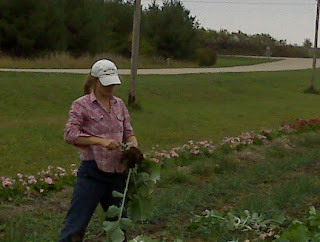
[Here's Annabelle harvesting a broccoli that she sent us back into town with that afternoon. Boy did we scarf up that hard to find vegetable with our dinner that night!]

Tuesday, July 14, 2015

For the birds

Ultan Walsh took one look at my floral print rolling suitcase when picking me up at the bus stop in Belgooley last Saturday and shook his head. "This country is not made for bags like that, you know. Did you not have a backpack? Oh, you have one of those, too." Thus began the good natured teasing that would characterize the next few days.

(You'd think I'd be a better packer after the original, self-supported bikeable feast, but no.)

During my first afternoon at Gort Na Nain farm, I hand weeded asparagus beds with a local carpenter doing a weekly work share, spent the next rainy morning with a digging fork ripping up grass and prickly weeds in one of the tomato high tunnels, then chatted away the afternoon with a Romanian cook visiting from nearby Cork City as we meticulously cleared everything but the Tuscan kale and onions in another of the eight high tunnels. No pesticides or even black plastic here, which means the real deal organic farm constantly has lots to weed. Fortunately, weeding is one of my specialties.

Though he swears he doesn't have time for inexperienced help in the form of traditional WWOOFers -- I managed to talk my way into being working on the farm through connections with mutual friends -- Ultan and his partner Lucy have loads to teach. And not just about farming. During my non-weeding time, as we shared beers and meals in the gorgeous vegetarian guesthouse, I got a primer on creative cooking, the subtleties of potato varieties, local sports and politics, music, history, the troubled economy....

Most especially, I learned about birds, on the farm itself and during a stunning hike to Barry's Head before dinner on my final night there. Who knew that city pigeons actually descended from cliff-dwelling doves? Both Ultan and Lucy are avid birders. So much so that their farm's name translates to something like "Field of the Birds." (Please pardon any mistranslation there: the only thing worse than my packing skills may be my mastery of Gaelic.)

Like Eoin, Ultan hadn't planned to be a farmer. He, too, had been in a PhD program, in his case finishing a doctorate in microbiology and then deciding after a few years of being pigeonholed into grant writing that it wasn't his bag. He'd met Lucy, lured her from England to Cork, and somewhere along the line they came upon the big field that now houses a beautiful B&B and burgeoning organic farm that the two built and manage mostly on their own, complete with bird-friendly hedgerows and trees that act as both habitat and windbreaks amid the blustery landscape.

I hope to make it back to this amazing place some day...partly to see if my take on (vegetarian) chestnut sausages turns out half as good as Lucy's. Because I'm kind of obsessed with them now, and discovered her recipe is now available in one of Denis Cotter's cookbooks.

Thursday, July 9, 2015

Eco-farming in Cork

I continue to be inspired by small farmers, including ones I worked with during my travels through County Cork. (Yes, I am technically on vacation, but that's hardly going to keep me from seeking out cool food producers in Ireland.) When he collected me from the bus stop in the small town of Carrigaline last Thursday, I had no idea yet what an amazingly kind person and thoughtful farmer Eoin was -- all I knew then was that he farmed about an acre of organic vegetables and had some great pics on Instagram.

Over the course of a couple of days, I worked alongside this young farmer to harvest and deliver produce for his box scheme operation -- kind of a variation on a CSA, where clients get a list of what will be available for the week and opt for whichever items strike their fancy, which that week ranged from freshly dug potatoes and carrots to all kinds of greens and alliums. Plus a few special requests from long-time customers or family friends for beets and the season's very first cherry tomatoes. (Well, the pint of sungolds I managed not to eat while digging up the nearby garlic, that is.) Next season, they may be treated to some new varieties, including an Ark of Taste lettuce that I am growing myself back home. I'm sure the heads growing here will be larger and more lush, as everything seems to be in these parts. Is it the soil? The rainfall? The gentle souls of the land stewards? My garlic and carrots pale in comparison....

As we worked and cooked up meals together -- including beet burgers, inspired by one of his customers who'd made them three times with Eoin's beets the previous week (recipe to come later) -- Eoin shared a bit of his story. Here was yet another example of someone who never expected to become a farmer, but is damn good at it. Part way through a PhD program in ecology, Eoin had become disillusioned with the research process. While finishing up a Master's degree and publishing a paper on the discovery of a rare water beetle, he stumbled upon a certification program in permaculture. He and his then girlfriend happened upon Moloney's Cottage not long afterwards, and now, less than 3 years later, he raises laying hens and vegetables enough on the 1-acre leased plot to support himself and a couple dozen customers. Like many farmers, he supplements his income, in this case with teaching at the nearby college in Kinsale. If his formal classes are as thoughtful and practical as his conversations were with me, those are some lucky students. Though I'd think local restaurants would be just as lucky if Eoin devoted himself fully to farming so he could supply a few of them. I'll be interested to see where things go...perhaps when I return for a visit in coming years.

Tuesday, July 23, 2013

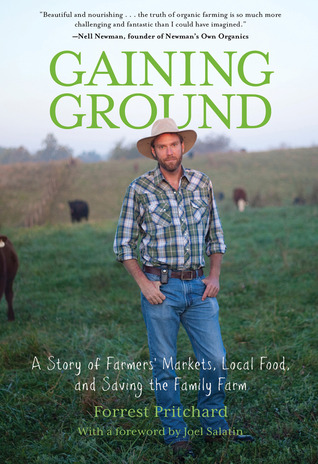
Gaining Ground

I ran into my friend Forrest again at tonight's Eat Local First Week kickoff event. It reminded me that I have yet to write a proper review of his wonderful book, which I devoured over two months ago. And I call myself a friend... And a lover of good writing... Here it is (na endlich!):


"[My father] looked at me as though I had just told him I wanted to push helpless old ladies down long flights of stairs."

A handful of pages into Chapter One, Forrest describes the day he told his parents he wanted to quit his teacher training and become a farmer. "Farming? Are you kidding me? You don't even know how to grow a turnip!" He could well have described my own dad's reaction the day I told my own parents I was going to bike around the country by myself. ("Biking? Around the country? But why? You don't even ride a bike!") It is one of a number of instances with which I suspect many of his readers (and if you are not yet one of these readers, you should be) can identify. It is a book written for dreamers and doers alike, a story of passion and determination and deep love for land and family.

I can't help but laugh out loud at the hilarious turns of phrase throughout, the way this up-and-coming author finds humor and chooses to learn from things that could easily make a lesser man (or woman) throw in the towel. Freshly repaired fences knocked down by 1500-pound cattle again? "I can honestly credit cow butts for helping me to become the carpenter that I am today." Time and again, the newbie farmer gets knocked down and gets up again, wiser each time, and now it's been about 17 years since he went into farming -- still a young farmer by many standards, but a good one and among the most eloquent and thoughtful ones I know.

So much of what I love about this book is the way that anyone -- no matter what their background -- can identify with moments of frustration at ridiculous situations (such as the early attempts at constructing and moving chicken tractors or building cow fences) as well as those moments of giddiness at small but important victories (a slow and steadily growing customer base, financial solvency at last). Lord knows his recounting of the abysmal early days at farmers' markets is encouraging for me amid the slowly growing Suitland market that is absorbing more than its fair share of my waking (and supposedly sleeping) hours. If we pay attention and put our hearts into it and work hard, things will fall into place. Despite many bittersweet moments along the way, Forrest tale of reclaiming the family farm has a happy ending. It gives me hope for what many of my other friends venturing into rural and urban sustainable farming are trying to do: fix our food system one farm, one community, at a time.

At the end of his book, as at the end of his presentation at tonight's Eat Local First event, Forrest gives us hope for the next generation of farmers, if we are brave and determined enough to show them that farming can be a noble and viable profession: "Potential. Respect. The sweet simplicity of toil, the satisfaction of working in harmony with the land. Bounty, and the grateful reward of harvest. These phenomena are both timeless and contemporary, deeply and constantly present. Over the course of a lifetime, farmers grow straight out of the soil, wizening into abstractions of their former selves[...] Somewhere, another farm awaits its farmer."

Monday, July 4, 2011

Garlic on the brain (and in the blood)

With the last of the fireworks exploding and the final dishes washed for the night, I'm snuggled up in the guest room at cousin Caroline's on this 4th of July. It's a beautiful cool, clear evening, and tired as I am -- and early as I need to wake up tomorrow to catch a series of rides to get myself home again (5am? Really? I'd gone *to* bed later than that back at the height of my salsa dancing days) -- I find I have a lot on my mind. As usual, my visit to the 3rd-generation farm tucked up in the Poconos has reminded me of how rewarding (oh, the food!) as well as how challenging (grow, dammit!) sustainable farming can be. Take this year's garlic crop....

Unlike the drought much of the country has been facing, poor Gary and Caroline have been battling constant rain here in rural PA. At one point yesterday morning, just after another crack of thunder followed by pouring rain, we started joking about growing rice here instead. Lord knows the ground has been wet enough these past few months. I believe this is when we were tying up the previous day's harvest of braiding (softneck) garlic in the barn. A bit later, fearing that another bout of rain would surely result in root rot overtaking the bulk of the main crop if we left it in the ground much longer, we all trudged around in rubber boots and silly hats and jackets and pulled up some of the porcelain hardneck variety. Too small. Shoot.

Plants need rain to grow, sure, but they also need lots of sunshine. Allium crops all over the region are stunted and behind schedule because of the freak weather patterns, we learned from Gary's series of conversations with other farmers in the area. With one's main cash crop prone to rotting amid excessive moisture, what is an heirloom garlic farmer to do with 12,000 heads in the ground? Harvest too-small bulbs? Risk disease while waiting for the sun to show its face and encourage the plants to grow to normal size? Frankly, it's kind of a crapshoot, and I wonder how farmers aren't nervous wrecks.

(Another sign that I'm not cut out to be a farmer: I almost lost my cool after accidentally ripping three or four softneck garlic plants in a row while trying to pull them the other day. I had to go pick some raspberries -- conveniently located at the edge of the garlic field -- and scarf a few handfuls before I managed to calm down. Bah. Who wants braiding garlic anyway?) At least we pulled in a decent load during Saturday afternoon's harvest, when we had a bit of sunshine, but really, this weather has got to stop.

It's not all doom and gloom. I mean, they eat well. (Consider tonight's grilled venison, cilantro soup, roasted potatoes, and strawberry rhubarb bars.) And the small CSA seems to be going well, with diversified crops and maple syrup picked up weekly by their 7 shareholders. And there should be some sunshine this week (when, alas, the extra hands to help harvest will be back at their day jobs in New York and DC). If there's one thing I can say about Gary and Caroline, it's that they don't give up. Sure, there are losses and frustrations and (somewhat frequent) changes of plan, but they're still growing some beautiful, delicious stuff up here at Mountaindale Farms. And if the final crop is anywhere near as tasty as what I sampled tonight -- in the form of roasted, dark-chocolate-covered garlic and a post-dinner shot of youth-preserving "garple elixir" -- I think everything will turn out alright.

Sent from my Verizon Wireless BlackBerry

Wednesday, June 1, 2011

Perspire under the elms


Due to some recent changes to my employment status, I have significantly more time on my hands of late. As such, I have spent the past couple of weeks catching up with those people and activities I was forced to neglect during my 4-month tenure with Arcadia: friends, family, writing, gardening, dancing, and going on bicycle adventures. Most of this has taken place around The District, but I had the good fortune to spend the past week visiting my friend Nathan on his family's farm -- the only organic plot for hundreds of miles -- tucked away below stands of cottonwood and elm in the windy southwestern corner of Nebraska.

While farm laboring wasn't my primary reason for visiting -- among his many fine qualities, my gentleman friend is a fantastic cook and salsa dancer and it was high time we spent some time together tackling the NY Times crossword puzzles (and it *was* the tail end of morel season) -- I couldn't help myself when the inevitable outdoor activities got underway each day. Planting, weeding, laying irrigation line, mulching, watering, and, my favorite, harvesting. ("One asparagus spear for me, one for the soup....") Needless to say, we spent quite a bit of time in the kitchen, and the culinary highlight of the trip was a fairly authentic Coq au Vin made from scratch. While the dish did not feature the usual french wine, we made up for the omission with the inclusion of multiple bottles of a tasty red zinfandel, a hefty handful of morels, and two rather bothersome roosters that Nathan and his brother Brian butchered themselves on Wednesday night. True, the two-year-old birds were a bit tough, but, oh, that sauce! Such flavor! And you'd better believe I made a giant pot of stock with the leftover carcasses. You know, for the creamy asparagus soup. And some chicken soup. And a big pot of risotto. (Well, I couldn't let it go to waste.) I had a chance to sleep in the following morning without that 5am cockadoodledoing, which was another side perk....


I've never been to Nebraska before. I was equally alarmed by the lack of food options in local grocery stores as by the bounty and variety of food grown on the windblown farm where I was staying. [No, seriously, that wind is like nothing I've ever seen. The gales were so intense I half expected a tornado to form during the latter part of Monday's barbecue. I don't know how the little bitty baby bok choy that we'd planted the day before were still in the ground.] Nathan's mom has quite the green thumb and was definitely in the lead during much of my time at the homestead -- planting and weeding and directing various menfolk on where to rototill -- but it was her son who decided last year to start a small CSA on the property. The brother who started the project left town, disgruntled, near the end of the first growing season, but there was enough demand among their neighbors that Rylan and a few other members of the family decided to continue, even expanding a bit. In its second year, Green Elms Community Farm is offering 10 shares of tasty, organic produce plus pastured eggs from their hens, if folks want, and potentially mushrooms as well, if Brian's winecap growing scheme proves fruitful. (Personally, I think Nathan should offer beer shares -- his homebrews are darn tasty, and they are growing hops -- but for now production is limited to family-only consumption levels. But imagine: a beer CSA! I'd sign up.) Yep, community supported agriculture is growing in some of the most unexpected places. I mean, rural Nebraska??

Okay, well, I'm just now back in DC. Guess it's time to get unpacked and do some laundry (after a *very* thorough check of all clothing and body parts following my week in Tickland). Stay tuned for posts on other small organic produce operations starting up, including a collaborative market stand with offerings from DC's urban growing spaces....

Saturday, March 26, 2011

An irresistible fleet of bicycles is coming through DC on April 16!

It's really happening. I have been enamored with The Greenhorns for a few years now. The posse of like-minded young, sustainable farmers and food advocates kindly helped to promote my bikeable feast project from afar and now, at long last, I'll get to meet a few of them in person because they are coming to my hometown! Oooh, I can't wait to show 'em around....

For those of you readers with ADHD, here's the short version:
(Hey, pay attention! Hey, over here! Stop looking at that shiny thing!)

WHO:
The Greenhorns
and you!
WHAT:
DC Urban Farm Bike Tour, Greenhorns documentary screening, and reception
WHEN:
Saturday, April 16th, 2011
Bike tour/workshops from 1:00-6:00pm
Film screening and reception from 6:30-9:00pm
WHERE:
1pm meet @ Mamie D. Lee Community Garden, 100 Gallatin St., NE (Fort Totten)
6pm @ Letelier Theater, 3251 Prospect Street, NW, Upper Courtyard (Georgetown)
COST:
$10-30 sliding scale for film and reception (bike tour/workshops are free)

RSVP to my friend, Farmer Mo (only necessary for film attendance, as seating is capped at 90). If you have questions about the biking part of things, drop me a line. Otherwise, just show up. Those of you cyclists who have been following this blog KNOW not to show up without a helmet. I'd bring a bike lock, too. And a water bottle. And maybe some sunscreen. (And I'd pray for sun that day.)


Isn't this poster gorgeous? Kudos to Laura Cline, who does all of the Greenhorns' fantastic artwork, and who teamed up with local artist Karri Roberts on this project. Just need to add on a few more logos for additional groups who recently contacted me about donating tasty, local food.... Oh, this is going to be good.


Even Ollie's excited. Look, she's donned a new sticker for the event (freshly painted over with clear nail polish so it lasts more than 5 minutes...). Come join us on April 16!

Thursday, December 31, 2009

One year ago


It's a cool, clear evening here in San Francisco on the eve of 2010. Rather than dancing at a salsa club or passing the wine at a dinner party in this most vibrant of cities, I'm in flannel pjs at my friend Erica's apartment and in a particularly pensive mood. Over a steaming mug of herbal tea, I find myself reflecting on the night in early January, just shy of a year ago, when I returned from a visit to Burlington, where I'd spent a few days with friends ringing in the new year. It was the night I told my parents and my uncle Clarence about this project. (It was still in the early stages: Becky and I had come up with the general farming-cycling-writing scheme at her dinner table one night in Montreal, but Meghan had not yet coined "a bikeable feast.") Mom was excited; dad looked like he had just been diagnosed with a terminal illness. Why, he asked, was I choosing this path? I had gone to graduate school for literature. I had gone back for a second graduate degree in education. I had worked in the nonprofit sector for years on child and maternal health issues. What about teaching? Global health? Writing? So, okay, making the world a better place through food: couldn't I just work at a soup kitchen and stay in the DC area? Now I was going to be a nomadic farmer? No, daaaad -- I was suddenly 15 again -- I want to learn about how to grow food in a way that's healthy for me, for all of us, for the planet. You know? Me? Food? How I can't stop thinking about it and reading about it and talking about it? Ever?? (Remember Thanksgiving dinner?)

While certainly a shift from my previous professional endeavors, the move was not entirely out of the blue. And I was not completely without skills or experience. I had come in contact with farm equipment before: I'd learned to drive a tractor while on a wetland restoration project during my time in AmeriCorps, I recounted. I knew a bit about plants: I planted trees during my national service work, too, and in the process learned to distinguish between bays (related to the leaves I use in soups and stews) and maples (mmm, maple syrup) and poison ivy (in its very different, more potent vine form, while I was doing a Tarzan impression... and here I'd been told all my life to keep an eye out for "three shiny leaves" and thought I was safe). I actually kind of like yard work and am not too shabby with the pruning shears, I pointed out. (But keep the chain saws at a distance, they make me nervous.) I could grow things: I had successfully started seeds for various windowsill and balcony gardens and managed to keep most houseplants alive. I knew a bit about sustainable agriculture: I had worked for a global sustainable crop program in Mexico for more than a year (though it was, admittedly, for the communications department; the only crops I saw were in the field I jogged around while training for a marathon... and it was a small field, so I saw the same few stalks many, many times). True, the actual farming was relatively new to me: my first formal experience was less than a year before Ollie and I hit the road, when, while backpacking through Latin America for a few months, I volunteered for a week at an amazing sustainable working farm up in the mountains of Costa Rica. (Incidentally, it was at this very farm where I met my friend Erica, on whose laptop I am now typing.) It's not a degree in agricultural science, I suggested, but it's a start. I already knew how to cook and how to write, though I'd been more focused on the former than the latter in recent years. Eh? Eh?

But why on a bike?? Dad was perplexed. (Anyone who has uttered the word "bicycle" around me in the past twenty-five years would have noted the look of panic that invariably appeared on my face. Dad knew this.) Because bikes aren't dependent on petroleum or coal or even electricity or ethanol. Because part of my project is about finding sustainable solutions. Because the maintenance cost is relatively low and I have limited funds at my disposal. Because it's a different way to see my country. Because I want to live at a different pace. Because it's time to get over my fear of bikes. Just because. (Is the offspring allowed to say that to her parent? The floor did not open and swallow me up, so I have to guess "yes.") I want to work with folks to help grow healthy food in different parts of the country, I insisted, and I want to bike to get there.

Because I can. Few people have the luxury of the kind of time, energy, and relative lack of commitments that I do (so long as someone takes my houseplants -- thanks, Jeanne!). I have grown up with a loving family, been well fed, and gotten a good education (the federal loans for which I'm hoping to pay off by the time I am 80). I have an amazingly supportive network of friends. I am lucky, I know that. I am not a trust fund baby, either, and I know that, too. There would be challenges, I admitted, but I was choosing this path because I felt, deep down, that it was the way I could best learn: by seeing, by listening, by doing. I was (and still am) willing -- even hoping -- to work. Dig holes. Weed. Shovel compost. Milk goats. Haul around large bales of hay. Walk through tall grass to find wild mushrooms in spite of my deathly fear of snakes and ticks. (Let's see, that brings the list of neuroses up to: biking down steep hills, skiing, jellyfish, chainsaws, exploding camp stoves, tripping while walking down the sidewalk and gouging my eye out on a fence spike, scorpions, snakes, and ticks. Yep, that about does it.)

Once it was established that I was really going through with the project, there continued to be a lot of questions. There was a lot to work out, logistically speaking. (Heck, there still is. I've got half the country left to navigate on my way back home.) I started planning like a madwoman, but somehow, even then at the beginning, felt that when all was said and done and I'd planned-planned-planned, in the end the success of the project would come down to determination, faith that everything was going to work out, and the kindness and patience and openness of my countrymen. And I'm not just talking about the farmers. This journey was meant to be as much about food as about connecting with each other. Talking. Listening. Thinking. Sharing. Helping. I wanted to be a part of this peaceful revolution, working with those committed to fostering more equitable and sustained access to healthy food. I can do this, I insisted. And, slowly, my parents began to believe I could, too. Sure, they still worry from time to time -- if they didn't at all, I'd think they didn't love me (I mean, for crying out loud, I'm traveling around the country by myself on a bicycle, what parent wouldn't worry?) -- but the fear is tempered by excitement. I'm excited, too, even now, nearly 12 months after I left my job to devote myself to learning about sustainable food. One year in and I still look forward to each new farm, each town, and each chance to learn and help. (For the record, I still dread some of the hills, cold nights of camping, and the impending date with scorpions on my way through the southwest in coming months.)

Here's to an equally fulfilling 2010!

Monday, December 7, 2009

In training

Last week at Lost Creek Farm, as we were cramming freezing cold hoophouse poles into the muddy ground and shivering in the morning fog, David made a passing comment about how bike touring was good training for farming. (Okay, he's way tougher than I am, he probably wasn't shivering. Meanwhile I thought my hands and feet might never thaw and I tried to control my chattering teeth while he spoke.) As a true farmer, he pointed out, you need to be able to withstand all kinds of challenges: extreme weather, hunger, fatigue. Just like biking, which he'd done a fair bit of himself. I've been chewing on that idea for the past few days as I've faced some of the most intense biking to date.

I see his point, but I think the parallel goes much further (as good metaphors often do). Long-distance cycling has pushed me farther than I thought I could go -- I mean, heck, my first ride was down the hall of Ben's apartment building and then I took the bus home, and now I'm nearly 3000 miles along! I've had many run ins with hunger, exhaustion, and less than ideal weather. Farming takes a heck of a lot of mental and physical strength and, to a degree, a denial of pain to push through the tough parts. I certainly am physically stronger than I was when I started. I know this for a fact because I didn't walk any of today's many long hills, including the 3.5-miler (who designs a 3.5-mile long uphill road??) and a few other substantial inclines along the 50-mile stretch. (Remember the days of the 0.8 mile high club? Ha!) Highway 101 does not kid around on the hills. So I'm stronger, maybe I will be less worn out baling hay or hauling bushels of carrots than before.

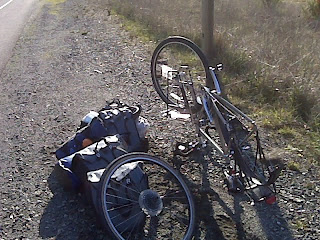
Farming is also about noticing things. The weather. How things grow. Pollinators. Pests. Sensing if something needs attention. Listening. To things like the thumping sound of a rear tire for the two or three seconds before it explodes as you're flying down the first big downhill stretch of the day. And being able to fix things when they break down. (Flat #8 of the trip is immortalized in the photo above.) I find myself noticing other things, too. Birds, wild onions, constellations. There's a quietness of mind needed, I think, to truly observe and listen, to be a good farmer. And the same is true of cycling.

A lot of people have asked me if I see myself on my own farm some day. Maybe. Frankly, I don't know if I'm tough enough. I've woken up with frost on my tent and frozen toes for the past three mornings and whimpered. I made my first phone call -- to my parents -- this morning from inside the sleeping bag. (It was so cold when I even poked my nose out that I snuggled back in for another half hour before I could work up the hutzpah to haul myself out into the frigid morning.) Tonight, with a forecast for freezing rain and 2 more days of serious biking until the next farm, I decided to dip into the slush fund and get myself a motel room (#6 of the trip). Would a real farmer do that?

Sent from my Verizon Wireless BlackBerry

Monday, September 28, 2009

Young MacDonald had a farm

Yesterday and today were spent biking through southwestern Wisconsin. The weather has been a challenge -- 3 rainstorms yesterday alone and winds so strong that my main fear at the campsite last night was not the usual getting eaten by a bear or being struck by lightning but that a tree was going to fall on my head -- so I have not been encountering the usual number of bikers or woodland creatures with whom I might converse. (Also, with the fear of impending skull crushing, I laid awake most of the night.) I've had lots of time to think.

During one of these extended musing sessions, I got to thinking about how farming is simultaneously ingrained in our culture -- just look to children's songs like Old MacDonald, B-I-N-G-O (sorry if it's in your head now, too), or The Farmer in the Dell -- and devalued by it in recent years. I've been hearing about the "brain drain" from a few folks lately: how school counselors (and parents) are encouraging the best and brightest from farming communities to pursue non-farming careers. I mean, farming is hard work, who can blame them for encouraging a path that is physically less taxing, more highly respected, and often better paying than farming?

On the other side, many of the folks coming *into* farming don't come from agricultural backgrounds. In fact, most seem to be coming out of liberal arts colleges, young farmers drawn to sustainable food production because of a philosophical ideal -- maybe they harbor a pastoral vision of life as homesteaders or perhaps they pursue farming as a political act, an attempt to address food inequities. There is a sizable group of young farmers who actually grew up on farms, left, and have found themselves returning to the land, longing for a chance to grow things and feed people. This last group describes the majority of women farmers I spoke and worked with last week in the greater Madison area.

April (of West Star Farm), Kristen and Dawn (of Blue Moon Farm), and Diana (who runs Dreamfarm) each admitted to a desire to return to rural roots as the driving force behind her decision to farm. All wanted to live somewhere green, grow things, raise food for themselves and their communities. And they're succeeding. There is a thriving local food culture in Madison, with many small farms and CSAs. And yet, instead of being in competition -- as a traditional market might dictate -- the producers support each other, sharing the idea that the more the collective farms succeed, the more able they are to feed everyone. (Including me: both April and Kristen loaded Ollie up with produce before I left each farm. It's hard to turn down farm fresh produce....)

Farmers are notoriously independent and isolated. Not so with the young (and not so young) farmers around Madison. There are a few things that might explain this anomaly, but I think it comes down to community support. First, there is MACSAC (Madison Area Community Supported Agriculture Coalition) -- a group that works on everything from building farmer customer bases to subsidizing low-income CSA shares to facilitating internships at CSA farms. There are also groups like REAP (Research, Education, Action, and Policy) Food Group -- a coalition that works to build a stronger regional food system and better-educated eaters through programs like Homegrown Lunch and publications such as the Farm Fresh Atlas. (REAP also organizes events like the Food For Thought Festival, meant to highlight food issues in the region and which this year brought me in close proximity to Michael Pollan for the first time. I mean mere *feet* away: I had volunteered to help with crowd control during his book signing session following his talk on Saturday.) And, finally, there are educated consumers -- CSA shareholders, restaurants, farmers' market shoppers, co-op members -- who support these devoted farmers. If only we could mimic similar food system development in other parts of the country!


Sent from my Verizon Wireless BlackBerry

Tuesday, June 9, 2009

Final days in PA


I spent most of Friday at a workshop on transitioning from conventional to organic farming at The Rodale Institute (something of a Mecca for farmers and gardeners on the east coast, and one of the groups consulted by the Secretary of Agriculture during the drafting of plans for a garden on the National Mall). It was another cold, damp day, and we all clutched cups of coffee and folders in our shivering hands, but the presentations and discussions were totally worth it. Speakers filled us in on the practical concerns -- what organic certification means, what to expect during the process, how long it takes, how to apply -- as well as federal and state (PA) financial assistance options, online resources, and various programs that can help farmers begin, convert, or expand their land to an organic operation. All of the speakers were great and many fielded some pretty tough questions. I learned a ton.

After a wonderful dinner, hot bath, and solid night of sleep in a comfy bed at the home of some dear family friends in (relatively) nearby Kintnersville, my cousin Caroline and friend Jim came by Saturday afternoon and joined us for an impromptu picnic before whisking Ollie and I up to Stroudsburg for a few days. Jim, my unflagging guide to the sustainable farming community here, brought me first to Josie Porter Farm, where veggies for the 100-family-strong Cherry Valley CSA are grown. Heidi and I planted flats of tomatoes and tomatillos as she told me about the history of the formerly biodynamic farm and some of her aspirations for the future of the place. Apparently I couldn't get enough of Josie Porter because I found myself back there on Sunday morning planting nearly an entire row of peppers with Heidi and weeding the onion patch with her friend Somaili visiting from West Africa. Sunday afternoon found me planting sunflower and loofah seeds and weighing garlic scapes with Caroline, Gary, Eric, and Jessie at Mountaindale Farm, followed by a dinner of venison weinerschnitzel, homemade applesauce, and asparagus/garlic scape salad. (Talk about a local meal: I think the bottle of Malbec was the only thing on the table that had traveled more than 200 yards from where it was grown.)

Monday morning found me once again back at Josie Porter Farm, but only for about 2 hours of planting and weeding before Jim transported me to Henry's Homestead Farm in Cresco. I chatted with Jeff and Mary Jean while they harvested mushrooms (part of Jeff's research project for his herbalist certification) and prepared for their 21 members' weekly CSA pickup. Theirs was an amazing and unique farm, with about a dozen small (150 foot or smaller) plots of beets, chard, garlic, onions, lettuce and more scattered about the property. After some conversation with the pair (exchanging recipes for yoghurt, cheese, garlic scapes, and broccoli rabe), Jim and I checked out the state-of-the-art greenhouse, were greeted by packs of truly free-range chickens in the forest (they made me a bit nervous, actually, with their complete disregard for human notions of personal space: about 2 dozen birds sidled right up to me, but Jim insisted they were harmless so I tried to dispel Hitchcockian scenarios from my mind), admired the creek, and learned a bit about the history of the land which had been in Jeff's family for generations. And I even had a chance to try my hand at milking Delilah, their lovely, infinitely patient cow. We left soon afterwards and I departed with the distinct impression that this farm was a place teeming not only with healthy food but also curiosity and joy. As Jeff and Mary Jean expand their efforts in coming years, I hope others seek out a similar model of sustainable food production.

Sent from my Verizon Wireless BlackBerry