Sunday, January 6, 2013
Kiss the cook
Wednesday, November 24, 2010
My second favorite holiday
My favorite Thanksgiving celebration ever was six years ago. At the time, I was living in the most beautiful house I will probably ever inhabit, up in a tiny mountain village in central Mexico. My boss, Jenny, and I were two of only about five Americans working with the crop research program, and we thought it only proper that we introduce our international circle of friends to a true American tradition. No, not the holiday celebrating imperialism, the subjugation of native people, and the spread of disease and violence -- that's Columbus Day. No, I mean the one about sharing good food and spreading goodwill among different cultures. You know, the holiday with the pilgrims and cranberry sauce?
Jenny and I manhandled a rather large frozen turkey for much of Thanksgiving morning and tried desperately to quickly defrost it in a bath of cold water, finally marinating it and cramming it into my rather small oven for about half a day. (It wasn't technically a holiday, but if my boss is in the kitchen with me, it's not really playing hooky, right?) Everyone else brought food from their country: Maru cooked up some Mexican tlacoyos (little masa canoes filled with cheese and beans and topped with sauteed cactus), Eric and Christelle supplied some French salt cake (by special request -- I am hooked on that stuff), Guy and Gianina arrived with a bevy of pecan pies (which are neither English nor Peruvian pastries, but they were delicious), Kaitlin brought a broccoli and cheese casserole (thus identifying herself as one of the other Americans in the crowd), Nick supplied the homebrew, Alessandra arrived with a pan of fresh focaccia, bottles of wine and tequila seemed to materialize out of thin air.... It was lovely. I have vague memories of sacking out sometime around 11pm, well before Nick ushered the remainder of guests out of the house. (Falling asleep at my own party? Who am I, my mother?) Well, I had been cooking all day.
The runner up for the Favorite Thanksgiving Award was in 2003, which I celebrated with my family and the Zeiglers at my Aunt Martha's home in Queens. That was the year of pumpkin homebrew, wild mushroom soup, and the first time I'd ever had a bacon-wrapped turkey. Looks like mom, dad, my brother, and I are trucking back up to Queens for the holiday this year. Bummer there's no pumpkin ale this year, but I'm looking forward to trying out a new recipe for roasted chestnut soup.
Anyhow, as we all gear up for the culinary extravaganza that is Thanksgiving, I just wanted to take a moment to say thanks. Thank you to friends and family and even the total strangers (now friends) who have helped me along this journey toward a life devoted to food. Thank you for the continuing hugs, advice, job leads, recipe ideas, fodder for my compost bins, and general encouragement. (Don't think this means I'm sharing my tamales, though....)
Thursday, August 13, 2009
"Why am I doing this?"
It was an unanticipated stop, for the most part. I'd been chatting with Elaine the postmistress (in I believe it was Bolivar, NY) as I bought yet another sheet of postcard stamps -- I may be single-handedly keeping the US Postal Service in business these days -- and she suggested that since I would be passing through Portville later that afternoon I might stop and chat with a man named James about his organic farm -- a pesticide-free oasis amid the surrounding farms with happy chemical trigger fingers. So I did.
Michael Pollan has Joel Salatin; I have J. Faulkner. A rare balance of patience and caution with enthusiasm and curiosity became evident pretty quickly as James showed me about. The farm is run by the thoughtful but softspoken farmer and his mother and boasts an amazing diversity for such a small area (4 acres, I think he said): at least 5 varieties of heirloom corn, rows of leeks, tomatoes, tomatillos, peppers, squash, carrots, lettuces, blueberries, beets, potatoes, broccoli, and several other crops he is tinkering with, all grown from seed. Oats, clover, and rye cover the other fields, enriching the soil and keeping them ready for planting if the farm expands one day. In spite of the two farmers markets he sells at locally, James admitted that the operation itself wasn't enough to support the family, that his wife had a regular job. And yet he feels compelled to grow things, and grow them the *right* way, enrich the soil, give people an option to buy good, local produce.
He quietly lamented the slow acceptance of his work. "People ask me why they should pay two dollars for a head of organic lettuce at the farmers market when they can get regular lettuce at the supermarket for a dollar fifty. Then they walk away. But I keep bringing it and slowly more people are buying it." He's thinking about a larger spinach crop, for sale rather than just personal consumption since a friend mentioned his wife had stopped eating supermarket greens after a series of national e. coli contamination scares. He's trying out a few longberry bushes to see how they fare in the area. Longberries, he'd heard, have an even higher concentration of beneficial antioxidants than blueberries and they're pretty hardy in colder climates. (Maybe they'll be the new pomegranate or acai berry craze in a few years.) Slowly, slowly he tests out new crops, new varieties, new ideas. He grows everything organically, but hasn't been certified, at least not yet. Instead, he told me, his produce is "certified naturally grown" -- an honor-system-based designation which has farmers (rather than some USDA employee) periodically checking up on each other's farming practices. Pretty cool, and in my humble opinion much more true to the spirit of local, organic farming in its purest form.
Ollie and I headed out soon after the storm subsided, bound for Allegany State Park. James insisted that I take a tomato and a bell pepper -- "You don't even need to cook 'em. Oh, but I wish it were a better season for tomatoes!" -- and conceded that I didn't really have space for a few squash. I tell you, after storm number three blew through about two hours later, I couldn't resist nibbling on the perfectly red, tantalizingly juicy tomato. Did I say nibble? It was amazing: I devoured it right there on the sidewalk in front of god and everybody. It may be a drop in the bucket, but I'll bet if more folks tasted tomatoes like that they won't deign to put one of the round, supermarket tomato-shaped imposters to their lips. Keep doing what you're doing, J. Faulkner, we'll catch on. A tomato may yet change the world.
Sent from my Verizon Wireless BlackBerry
Sunday, August 9, 2009
The birds and the bees
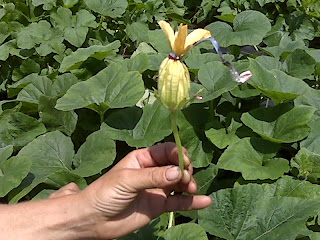
Karl is quite the wine, cheese, and yoghurt maker. (Needless to say, we all ate and drank well.) One of Alison's passions, it turns out, is herbal medicine. Another is plant breeding, especially using open pollinating varieties. She'd worked with some programs that bred and field tested varieties of vegetables now and again and had developed quite a knack for hand pollinating squashes and zucchinis. As we finished up our barbecue on my first evening on the farm and sipped beers while admiring the fading sunset, a head-lamped Alison excitedly waved me over to see the blossoms she was flagging for the next morning's hand pollinating: male and female flowers tied with reflective tape to keep bees (aka would-be errant pollen carriers) out. The next morning after breakfast, and for the subsequent 5 days on the farm, I worked with her to meticulously pollinate a variety of gourds. Alison was an engaging and patient instructor, and we chatted away as we worked -- well, at least when we didn't have flower parts in our mouths. (Alison's solution to holding multiple stamen securely while preparing a series of them to pollinate the pistils was to hold them in her mouth, a technique I have not heard of elsewhere, but then few things are done traditionally here, and it worked so I did it, too.)
Now, there is something to be said about the birds and the bees here. No wonder parents use those euphemisms: the process of hand-pollinating, for example, was very...intimate. This was way different than I'd imagined while studying my genetics textbook in college. There I sat amid the leafy tendrils and sunshine colored blooms, gently untying the slipknots and peeling back the delicate petals to reveal the bright yellow stamens and pistils which I was then instructed to rub gently but thoroughly against each other. For hours I couldn't get Marvin Gaye out of my head (except for the occasional Al Green reprieve -- not much better) and at times I actually found myself blushing. Must be that Catholic upbringing. It didn't help that the scent of nectar was mildly intoxicating....
By the time my friend Rob arrived to whisk Ollie and I away to Ithaca on Thursday afternoon, Alison and I had weeded a long row of onions, baked 3 dozen giant wild raspberry-blackberry scones (I must get that recipe!), and I was deemed by Alison to be practically an old hand at pollinating. I'm looking forward to learning more about plant breeding, seed saving, and heirloom vegetables along the bikeable feast. But first I need to get Love Train out of my head....
Sent from my Verizon Wireless BlackBerry
Sunday, June 14, 2009
I heart new york
It's been a busy weekend here in the city. Yesterday morning, Aunt Martha and I ventured over to the bustling Ft. Greene farmers market, picking up the most vibrant red radishes I have ever seen (and a healthy handful of arugula to make a salad at Judith's later that evening: I am beginning to accept radishes as a legitimate vegetable... slowly, slowly). There, too, I had the unexpected pleasure of learning about the NYC farmers market scene from the very knowledgeable but humble Justin (whom I later discovered founded the innovative Peaceful Ox program, matching interns with organic farms in the region) and friendly but quiet Tara (a volunteer from a local high school who helped out at the info booth on Saturdays). They happened to be handing out samples of luscious looking strawberries with locally produced creme fraiche, so I happily nibbled as they filled me in on the Greenmarket network of weekly farmers markets around the city, including quite a number of year-round locations in different boroughs, more than a dozen of which are equipped to handle EBT/food stamp credit. Very cool.
Next, I made my way to the Bed-Stuy neighborhood to help out at a food festival at the Hattie Carthan Community Garden. The event, organized by the lovely and culinarily inventive Just Food chef, Yonette, was the first of a handful of events at the garden being held over the next month or so to raise funds to cover the start-up costs for a much-needed farmers market in the area. I worked at the information booth/fundraising table, perfectly positioned between the live funk band and the food tent. Score. I met a number of resident gardeners over the few hours I was at the event, many of whom admired my temporary radish tattoo painted by Briana -- a first year design student working at the face painting booth down around the corner.
Sent from my Verizon Wireless BlackBerry
Thursday, June 11, 2009
C-O-M-P-O-S-T: find out what it means to me
I had the good fortune to meet Aurelia, educator and distributor for New York Pay Dirt's compost, potting soil, and at-cost compost bins while strolling around the Wednesday farmers market at Union Square yesterday. She filled me in a bit on the food scrap and vermiculture scene over the past couple of decades in the city. Who knew Manhattanites had been composting with worm bins for that long? (I certainly didn't, and I was living just over the Bridge in downtown Brooklyn for two whole years!) I bought a pound of compost (black gold for a $1.50) to prepare the soil for the heirloom tomato plant I'd picked up for my Aunt Martha's garden in Queens and a few informational materials on composting sites and other resources around town.
This morning Aunt Martha and I visited one of the nearby compost-related locations mentioned in one of the booklets: the Queens Botanical Garden. I ventured past the rose gardens with my bag of compost (veggie scraps from last night's dinner and eggshells from today's quiche) only to be brusquely informed at the visitor center that the garden was not a drop-off site for community members. Guess I should have read the fine print. I admit that I was rather disgruntled at this apparent disconnect between the garden and local community/ environmental stewardship ideal. People at the garden were not particularly friendly -- maybe nearly 6 straight weeks of dreary weather was partly to blame -- but at last one of the teachers in the educational center took a few minutes to explain that the QBG simply does not have the capacity to handle community compost drop-offs. I was told I'd have to bring my trash to the biweekly Union Square market. Really?? What a waste! (Pun intended, though this is not a laughing matter.) Come on, Mayor Bloomberg, you're a shrewd businessman, don't you see the potential here?
I am, admittedly, somewhat fanatical about composting. (You may have gathered this from some of my earlier posts.) Luckily my friends humored me when, back in DC, I would pack out my fruit and vegetable scraps after cooking dinner in their kitchens, gleefully biking my bag of rescued-from-landfill goods home to the backyard composter. But hang on to my bag of peels until Saturday and schlep it all the way from Flushing to Union Square on public transit? I can count on about three fingers the number of New Yorkers -- or anyone else, for that matter -- willing to do that.
There is hope, though. After a cup of coffee and lap around the Bluestocking Bookstore -- a great feminist/anarchist bookstore in the East Village and current organizational point for the small-but-growing NYC Food Project -- I put in a call to the Lower East Side Ecology Center. I spoke with Carey, director of the composting program there, who happily filled me in on the history of LESEC which began as a recycling center many years before a systematic urban recycling collection was in place here and which has since expanded to focus on promoting environmental education and stewardship. While a good chunk of the funding for city-wide leaf/grass collection, free compost distribution, and educational programs was recently cut out of the group's budget, the Center continues to run workshops, put environmentally-minded folks in touch with local resources (both around the city and online), and collaborate with schools and community gardens to green New York from the bottom up: a true grass roots approach. And interest is growing.(Here's a link to the petition to bring back composting to the city.)
Rest assured that there will be further posts on composting as my journey continues -- how we manage our waste is a big part of how we are beginning to account for ourselves amid the larger world of consumers. (I'm also hoping for an update on the backyard composter from my neighbors. Henry, David, Shelly: any progress on the bin activity? Eh? Eh?)
Sent from my Verizon Wireless BlackBerry