Showing posts with label farms. Show all posts

Friday, March 23, 2012

Still leaking after all these years


This week marked Ollie's and my 3-year anniversary! Yes, it's true: my longest, most stable relationship thus far has been with a bicycle. C'est la vie.

I marked the occasion -- I thought quite fittingly -- by visiting a local farm with my friend Jon, who invited me to tag along on his visit to High View Farm out in Berryville, VA for a White House Meats pickup. I myself picked up a beautiful, 7-lb bird (already processed, thank you) and a dozen eggs from Farmer Craig. Well, after we cavorted with his hens and Scottish Highland calf out in the pasture.


Ollie was not with me, and apparently decided that she had her own way to mark the occasion: a string of 3 flat tires this week. Just like old times....

Still Leaking After All These Years 

I heard that old air hissing
On my ride today –
It seemed nearly impossible
so soon!
But I checked and, sure enough,
There was a pinch in Ollie’s rear –
She's still leaking after all these years.
Oh, still leaking after all these years.

I’m not the kind of girl
Who tends to curse too much,
but my tires seem to deflate
quite a lot.
Yes, I always have a patch kit
So that we can persevere
When she’s leaking after all these years.
Oh, still leaking after all these years.

Three flats since Tuesday
(It’s hardly news today) –
I’m covered in grease again.
I pumped the tires
To the max
(It’s probably in vain….)

Now I sit by my Ollie
And I flip her right side up
I fear my pump will break
One day soon.
But to heck with it, it’s time for
Me to have a couple beers
With my Ollie, leaking all these years.
Oh, still leaking…
Still leaking…
Still leaking after all these years.


Sunday, June 6, 2010

Return of the native, Part 2

Link

During my time in Mississippi, I had a chance to visit a second young farmer -- Horton, the driving force behind Isis Gardens. Like Will, Horton recently returned to his native Tupelo after years of working on farms elsewhere. (In his case, he was returning from Colorado.) He, too, decided that home was calling, that Mississippi was in dire need of chemical-free, responsibly grown food. He, too, moved home and began cultivating a piece of land that had been in the family for years. And yet it was a very different operation from the town's other organic farm.

When Aaron and I stopped by the CSA farm on a Friday afternoon, Horton walked us around the rambling property, excitedly pointing out various cover crops, dozens of heirloom vegetable varieties, the insectary (a plot of land set aside to attract beneficial insects), purple marten houses (to attract bug eating birds), even the inside of the Depression era home he had recently come to inhabit. It was decidedly less structured, and perhaps overgrown in places, but the green space nurtured an abundance of plant and animal diversity quite rare in these parts.

As we took a little rest in the shade of the front porch to sip on cups of cool sun tea, Genevieve joined us and the couple graciously invited Aaron and me to stay for lunch. As we munched on leftover pasta and a giant salad, and sipped on cold beers spiked with chamomile flowers, Horton expanded on his passion for seed saving. As conventional American (and global) agriculture careens at a breakneck speed toward uniformity and productivity, this young farmer remains part of a small but persistent group of growers striving to preserve quality and diversity in our food system. Perpetuating strains of corn and potatoes and beans that are all but extinct. Nurturing tomato and melon varieties from places as far away as war-torn Iraq. (Consider the very real possibility that without heirloom growers like Horton, some of these treasures may be lost forever.)

Now, I know southerners have a reputation for hospitality. I have also found organic farmers to be more welcoming and generous than the general population. Horton espouses the best of both groups, with a ready smile and openness to sharing both food and knowledge. I was just giddy when he sent me away the following afternoon with a big hug and envelopes of heirloom tomato and melon seeds from my dad's native country. I can't wait to get planting, doing my part to keep some of these rare (and delicious) species around a bit longer...

Sent from my Verizon Wireless BlackBerry

Tuesday, June 1, 2010

Return of the native, Part 1

Link

I'd first met Will back at Deep Seeded Community Farm on my way through California last December. As we harvested kale and washed carrots, I learned that he had spent some years working on organic farms in Humbolt County, and now, at 24, the anthropology-student-turned-farmer was ready to start his own place. But rather than add another farm to the somewhat saturated organic produce market in coastal northern California, Will decided to move home to Mississippi, where comparatively little exists in terms of sustainably grown food. Modeled closely on the Arcata farm where he'd been interning, the goal was to provide fresh, clean food and build a sense of a food community. What I discovered during my days working with Will last week in Tupelo was that over the past five months he's managed to cultivate not only healthy plants but a healthy fan club. Organics taking root in Mississippi? Y'all better believe it.

He's something of a local celebrity, with a recent article in the local paper leading to dozens of calls from folks interested in buying fresh produce, seeking gardening advice, or sometimes letting the young farmer know he was welcome to come by to harvest their extra mulberries. People would stop him on the street, in a cafe, at the market, to compliment the work he has been doing. He seems to take it all in stride.

Cultivating a piece of land on his parents' property for vegetable farming, and with plans for a flower and animal operation on his own land soon, Will has already built up a strong group of supporters for his operation. (No, really, at the Saturday farmers' market the sole organic stand generally sells out by around 10am.) He welcomes volunteers and neighbors to come by Native Son Farm and chats easily about the different varietals, from the sweetness of the heirloom corn to the history of the "mortgage lifter" tomatoes. Folks coming to pick up their CSA-inspired produce box from the front porch on Fridays sometimes wander about the crop rows or seek advice on preparing unusual items. There's a woman in town with a penchant for kohlrabi who was the inspiration behind Will's planting of the delicious, alien-looking root vegetable. I suspect others will be stopping by with requests in coming months. People are talking; Will's listening.

It's a family affair, with dad assisting with equipment, mom reaching out to community members and sending out the weekly CSA notices, sister Lauren and girlfriend Amanda working alongside Will on the farm and at the Saturday farmers' market.

In addition to the CSA and farmers' market stand, there are plans for a series of farm dinners -- to celebrate local food and help supplement the farm's income -- featuring the talent of Will's friend David, a local chef. (More on David's amazing work in a future post.) The first farm dinner, with ingredients culled from a 30-mile radius (including fresh rabbit and goat cheese), happened to take place last Thursday, so Aaron ("the photographer from San Francisco" deemed, well, the official photographer) and I ("the woman biking around the country for over a year to visit farms" and happily designated as the evening's wine stewardess) had a chance to help out. The food was divine. In spite of a series of rain showers, the event was an overwhelming success, with gleeful, full-bellied patrons advising on dates for the next dinner as they departed. And there will be more: the farmer and chef team are looking to hold 6 or so each year under the stunning giant oak tree alongside the farm.

All in all, I was impressed by Will's insight and his success thus far. Soon hopefully other farmers will begin to provide fresh, clean food in Mississippi. Wouldn't you know that I met a second organic farming friend in town over the weekend. Check back soon for more on Horton's organic farm down the road....

[In case you're wondering about the higher quality of this photo, it was snapped by "the photographer from San Francisco" while Will and I washed veggies for the farm dinner. Yes, a real camera... and a real photographer, for once. ;)]

Sent from my Verizon Wireless BlackBerry

Friday, November 27, 2009

Make it the easier way


I love Portland. I'd heard quite a bit about the green city's devotion to all things sustainable before my arrival, and the rumors were confirmed during the 3 1/2 days I spent there. It was by far the most bikeable city I've encountered so far. It turns out, with the on-road bike routes and bike paths -- even designated lanes across most of the city's bridges! -- and racks scattered throughout all quadrants of the city, it is often faster and easier to cycle somewhere than to drive. Though currently only 1% of the city's transportation budget is devoted to cycling, it is a percentage the mayor's office is looking to boost in coming years, I learned from Amy, the advisor to the mayor on sustainability policy. During a chat and tour of the City Hall vegetable garden this past Wednesday, Amy told me about the city's green roofing requirements for newly constructed buildings and green roof retrofitting for many existing structures. I learned, too, of city government's investigation into the purchase of facilities to handle city-wide curbside compost pick-up. I didn't get the sense that there was much by way of residential recycling programs, which seems strange for so green a city in so many other ways. (Portland could take a few notes from Seattle and Olympia on that note; Seattle and Olympia could in turn take notes on the nicer weather here in Oregon.)

People seem to want to do the right thing here, but the trick is to make the "right" way the easier way. I have to admit that when I moved to Brooklyn a few years back, I was as much excited by the comprehensive city recycling program as I was about becoming a public school teacher, but the criteria for recycling was quite complicated. There were elaborate charts and color-coded bags. My landlord once chided me for not using the prescripted twine to tie my neatly stacked piles of old NY Times. We could have been fined. (This was mere months before the city suspended its recycling program for the meticulously rinsed and sorted plastics and glassware. I almost cried. Fortunately for New Yorkers, who generate a heck of a lot of trash, the program was restarted within a year.) Anyway, I get Amy's point and I agree with her: policies and processes need to be in place to make it easier for people to do things more sustainably. If it's too much extra work, most people, including the parents of certain food-minded cycling bloggers, won't do it.

The same goes for buying food: it needs to be relatively easy to support local, sustainable producers. While in town, I also had the pleasure of speaking with a few folks working at New Seasons, a local chain of grocery stores in Portland with a focus on local and organic products. It was something between a co-op and a Whole Foods, both in terms of products and pricing. I spoke first with Joey in the produce dept who told me of the cooperative nature between the 8-store-strong grocer and local farms. It's a delicate balance, I learned, to maintain a base of organic produce that is local and of a great enough variety to retain a steady customer base. I found myself seeking out primarily local produce, but the fresh ginger from Peru and the coriander from California also made it into my shopping cart. "People want to buy locally and seasonally these days," the produce manager pointed out, "But they also want things that don't grow in the region. We are still committed to local and organic as much as possible and we have strong ties to local farms." It's a challenge to maintain the quality and local connections at this scale, but New Seasons seems to be doing a pretty good job. I skipped the dairy section -- I didn't trust that I would be able to resist spending a pile of money on raw sheep's milk cheeses -- and next wandered over to the meat section, where I learned from Charlie that most of New Seasons' connections to local meat, poultry, and seafood farms are extensions from when the chain was a co-op, and all of the items they carry come from Oregon, Washington, and northern California. This is not somewhere I would have trouble shopping, though I'd have to live in Portland to do so -- the chain is determined not to expand to other parts of the country, though they do offer consultations on their business model to interested folks.

I spent my final afternoon and evening in Portland chatting and working alongside Abby of the awesome Abby's Table. The former personal chef had gone to a prestigious culinary school in New York and had worked for years concocting tasty, healthy meals for wealthy folks coping with serious medical conditions. Hence she does a lot of gluten- and dairy-free cooking as well as work with macrobiotics and raw food. (The raw crackers we nibbled on as we cooked and sipped kambucha were just scrumptious.) She'd moved to Portland fairly recently and had been on the lookout for an industrial kitchen out of which she could cater, host weekly communal dinners, and teach. "I realized that what I really wanted to do was empower people to find and prepare healthy food for themselves," Abby confided as we chopped leeks and pureed raw chocolate pudding. "It is possible to find fresh, healthy stuff to eat all year, but a lot of people don't know where to start. That's part of why I offer classes, to help show people the joy of cooking and eating. Sometimes they'll discover a new food at the market or they'll buy one of my sauces and get really excited to try a new recipe. They become more connected to their food."

Once they understand how easy it is to make delicious food, it opens up a whole new world. Abby belongs to a group of food specialists who teach courses for the Urban Growth Bounty series, an Oregon-based initiative that offers classes on everything from raising chickens and bees in your back yard to urban farming to cheesemaking and preserving tomatoes. The classes themselves range from about $15-40 -- a pretty accessible price -- though the series had ended for the year by the time Ollie and I rolled into town so I didn't have a chance to attend one. Now, if that isn't an example of the local policies making it easy to be active participants in sustainable city living, I don't know what is.

Sunday, August 9, 2009

The birds and the bees

After 4 1/2 days of intense biking across hilly northeastern New York, Ollie and I made our way to the Cazenovia farmers market, where we met up with Alison and her son Jason who gave us a ride back to Frosty Morning Farm in nearby Truxton, NY. Their farm, on the site of the Common Place Land Trust, was quite the model of sustainability -- from solar panels to a composting toilet to organic farming to homemade yoghurt. In everything they do, Alison and Karl reaffirm their dedication to living in a way that celebrates everything and wastes nothing. The final evening of my stay, Karl whipped up something of a kitchen sink pasta sauce that included some ground meat in the freezer, a couple jars of homemade pasta sauce, and whatever vegetables were around, including fennel, zucchini, and onions.

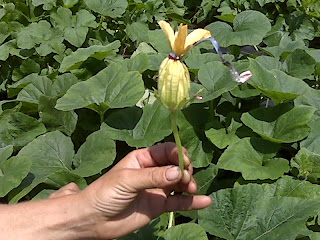
Karl is quite the wine, cheese, and yoghurt maker. (Needless to say, we all ate and drank well.) One of Alison's passions, it turns out, is herbal medicine. Another is plant breeding, especially using open pollinating varieties. She'd worked with some programs that bred and field tested varieties of vegetables now and again and had developed quite a knack for hand pollinating squashes and zucchinis. As we finished up our barbecue on my first evening on the farm and sipped beers while admiring the fading sunset, a head-lamped Alison excitedly waved me over to see the blossoms she was flagging for the next morning's hand pollinating: male and female flowers tied with reflective tape to keep bees (aka would-be errant pollen carriers) out. The next morning after breakfast, and for the subsequent 5 days on the farm, I worked with her to meticulously pollinate a variety of gourds. Alison was an engaging and patient instructor, and we chatted away as we worked -- well, at least when we didn't have flower parts in our mouths. (Alison's solution to holding multiple stamen securely while preparing a series of them to pollinate the pistils was to hold them in her mouth, a technique I have not heard of elsewhere, but then few things are done traditionally here, and it worked so I did it, too.)

Now, there is something to be said about the birds and the bees here. No wonder parents use those euphemisms: the process of hand-pollinating, for example, was very...intimate. This was way different than I'd imagined while studying my genetics textbook in college. There I sat amid the leafy tendrils and sunshine colored blooms, gently untying the slipknots and peeling back the delicate petals to reveal the bright yellow stamens and pistils which I was then instructed to rub gently but thoroughly against each other. For hours I couldn't get Marvin Gaye out of my head (except for the occasional Al Green reprieve -- not much better) and at times I actually found myself blushing. Must be that Catholic upbringing. It didn't help that the scent of nectar was mildly intoxicating....

By the time my friend Rob arrived to whisk Ollie and I away to Ithaca on Thursday afternoon, Alison and I had weeded a long row of onions, baked 3 dozen giant wild raspberry-blackberry scones (I must get that recipe!), and I was deemed by Alison to be practically an old hand at pollinating. I'm looking forward to learning more about plant breeding, seed saving, and heirloom vegetables along the bikeable feast. But first I need to get Love Train out of my head....


Sent from my Verizon Wireless BlackBerry

Thursday, July 23, 2009

Over hill, over dale, and around the Intervale

Monday was CSA (community supported agriculture) pickup day at the Intervale Community Farm -- the area's oldest (celebrating 20 years) and largest (with something like 500 shares, and a waiting list!) CSA. I arrived just after lunch to chat with Andy, Becky, and others for a bit before heading out to weed one of their outer fields. As we hand-weeded and thinned out a long row of beets, Aly filled me in a bit on the farm and how it fits into the larger Intervale scene of organic agriculture and education.

Around 3:00, we headed back to the CSA pickup area, just moments ahead of the first wave of eager local eaters. Had it not been so well organized, it would have been a scene of total chaos for the next 2 1/2 hours as a steady stream of people arrived to claim their weekly vittles -- collecting their veggie allotments, harvesting herbs and flowers, picking up any other items they'd requested, socializing. Whenever I could catch them for a free moment, Andy, Becky, or Aly would tell me a bit more about the food community they have helped to foster: regular community events, farming workshops (sometimes working alongside NOFA -- the Northeast Organic Farming Association), and partnerships with other local food producers (to round out CSA members' diets with minimally marked up dairy, eggs, bread, honey, and maple syrup). I meandered around until Mark and Susan showed up to pick up their share, then Susan gave me a lift to one of the local bike shops to pick up Ollie, who'd been getting some work done on her brakes in anticipation of our upcoming date with the Adirondack Mountains. (Eep.)

Wednesday morning began with lots of rain. (Par for the course, it seems, this biking in the rain....) It stopped just as Ollie and I got to the Association of Africans Living in Vermont (AALV) farm plot on the fringe of the Intervale, part of the innovative New Farms for New Americans project. There I met up with a group of resettled refugees from Burundi harvesting broccoli for the afternoon's North End Farmers' Market. Lots of smiling and gesturing ensued as we quickly realized a bit of a spoken language barrier breakdown (that is, once we made it past names and where we were from -- they beamed when I told them I lived in the same city as Obama). I played peek-a-boo with the kids, we mimed opinions on vegetable ripeness, and in general I think things went pretty well. My attempts at exchanging recipes seemed to puzzle them -- I learned later that broccoli is not a native food crop in Burundi, so perhaps it was unfamiliarity with cooking it that prompted the uncertain, polite smiles. They were kind and welcoming and proudly showed me their crops, and when we parted ways, Michel -- the man with whom I'd managed to communicate the most -- insisted that I take some of the broccoli with me. I'd asked so many questions about it, he probably thought I was a bit obsessed with broccoli. Okay, maybe I am a bit, and in the end I accepted the gift of the beautiful green bouquet. Few things are more humbling than being given food by a refugee.

The sun came out in the afternoon as Ollie and I arrived at Intervale's friendly Arethusa Collective Farm. We were just in time for carrot washing, but first Ben, Emily, and Ben's wife (a pox on my memory! I recall the entire conversation but have forgotten her name!) invited me to check out the property. Tom, the farm's founder, joined us as we cleaned and sorted carrots and the group engaged in an interesting discussion on the meaning of sustainability, farming as a political act, and the recent trends I've noticed ranging from the use of black plastic on organic farms to the pattern of well-educated young liberal arts majors flocking to farm life. They're a bright, friendly bunch who openly grapple with many of the issues I am trying to sort out for myself. (Only, of course, they're *living* the life I am only beginning to scratch the surface of.)

While no longer involved in a CSA, I learned, Arethusa remains committed to supplying farmers markets, restaurants, and City Market -- my all-time favorite grocery store in the region (and not just because of the bike helmet discount they offer, but it is a nice bonus) -- with healthy, tasty, chemical-free vegetables. At the end of the afternoon, I strapped a bag of gorgeous, freshly washed Arethusa carrots onto Ollie and we were off to Old Spokes Home (another local bike shop) to get the skinny on bike routes through the mountains of upstate New York....


Sent from my Verizon Wireless BlackBerry

Friday, July 17, 2009

In vino veritas

This week marked my first time working at a vineyard, thanks to Gail and Ken who welcomed me into their home and invited me to help out at their winemaking operation at Shelburne Vineyard for a few days. I arrived Sunday afternoon and wandered about the property taking in the stunning views for a bit before the evening's art show and wine tasting, at which point I was put to work arranging plates of delectable local cheeses and chocolates for the event (and, you know, making sure the various wines were up to snuff... they were). I spent Monday and Tuesday working with Ken at his organic vineyard on the Shelburne Farm property, pruning and trellissing vines, and getting occasionally whacked in the face by a recalcitrant vignola branch (cheeky buggers, those vines). As we worked, Ken explained the different trellissing techniques, the origins and eccentricities of the grape varietals, and processes for making different types of wine.

Much like consumers are starting to ask about the origins of their meat and produce at their local markets, Ken confided, an increasing number of wine drinkers are asking about their grapes. They want to know how grapes are harvested (at Shelburne, they are literally handpicked), where the vines come from (some are of European origin, others are hybrids), and any chemicals involved in the grape production (minimal, even for the uncertified organic batches.) What makes wine "organic" surprised me: it's the grape which is certified organic, not the wine, since the winemaking process involves the inclusion of chemically-manufactured sulfites. Though there is a process that does not use these added sulfites as a preservative, my impression was that the resulting wines are subpar and thus unable to compete with traditional wines. Also, sulfites naturally occur in grapes, just at lower levels, so I'm considerably less phased than I might otherwise be. Don't get me wrong, I like my food -- and wine -- to be as minimally chemical-laden as possible, but I am hardly a purist. (One day, about two weeks ago, Ollie and I got really lost and when I stopped to ask for directions at a gas station I was overtaken by spontaneous hunger as I approached the counter and scarfed two hot dogs without even blinking. I'm pretty sure I chewed them, but I can't be sure. I vaguely recall slathering them with mustard and relish, but still: hardly organic or sustainably produced. Heck, hardly more than snouts and ears and sulfites, most likely. Anyway....)

As Tuesday was Bastille Day -- Vive la France! -- or maybe because they were trying to make some room for a restock in the fridge, after dinner on what was to be my final evening in the area, Ken, Gail, and I sampled a number of dessert wines (along with a slightly modified version of the chocolate torte recipe I am determined to perfect). As we sipped and chatted, I reflected on the pair, around my parents' ages, who have devoted much of the past 30 years to land stewardship (through their involvement with the Vermont Land Trust, participation in local and statewide environmental advisory groups, and their own land management practices), building their community (Gail in particular has worked with a number of environmental education and volunteer organizations around the state over the years), and enjoying life (in spite of what I learned could sometimes be a grueling workload). It's hard work that the couple seems to undertake with a sense of joy. The business breaks even, but they're hoping to make a profit, maybe even give themselves (instead of just their small staff) salaries in coming years.

Something that I've been thinking about, even before leaving DC, is how very few sustainable food operations appear to be financially self-sustaining -- nearly all rely on grants or holding second jobs or spouses working in a non-agricultural field subsidizing the operation. One of the things I am hoping to discover along this journey is how relatively small, responsibly run farms can not just barely survive but *thrive.* Doing the right thing shouldn't mean a life of constant struggle. Challenging work: yes. Physically demanding work: well, it is a farm, so in most cases that comes with the territory. But when I read about the plight of an increasing number of farmers in debt, who cannot afford their own piece of land, who can barely afford to feed themselves and their families let alone pay for private health insurance (see what happens when I get a little wine in me?), I get angry. Is it true that the majority of our government's agricultural dollars support -- even encourage -- irresponsible, large-scale farming practices while neglecting small, organic farms? It sure seems that way. I haven't seen "Food, Inc." yet, but my hunch is that it confirms some of my suspicions.

Speaking of hunches, I suspect that we're going to start seeing more wine coming out of New England. Vermont wines are not as well known as those from California or Oregon or even New York's lush Hudson Valley, at least not yet. But I heard through the grapevine that they're on the rise. And if they're anywhere near as consistently good as Shelburne's "Rhapsody," "Late Harvest," or "NuMondo," we're in for a treat.


Sent from my Verizon Wireless BlackBerry

Sunday, July 5, 2009

A town's trash becomes everyone's treasure

Ollie and I arrived on the doorstep of Green Meadows Farm -- historic home of the famous Patton family in northeastern MA, and the only certified organic farm in the area -- on Thursday evening, drenched, exhausted, and starving after an intense day of cycling from Boston. Mrs. Patton, one of the most gracious hostesses (and human beings) I have ever met, welcomed us into her home with open arms and a hot meal. The following morning after breakfast, Mrs. Patton introduced me to her neighbor, Peter, whose innate curiosity and thoughtful commitment to making the world a better place (globally -- through his work with the youth leadership program, Outward Bound International -- and locally, which I'll get into momentarily) have led him to develop a brilliant solution to the dual problems of soil depletion and waste production.

Peter and his wife Beatrice moved to Hamilton, MA in the mid 70s and acquired a piece of land on which Peter hoped to realize his dream of slowly revitalizing the soil. He was not a farmer by trade but an anthropologist and a teacher, yet he dove right into the project and today remains doggedly committed to his original vision of converting waste into compost and reviving the land. This man is perhaps the only individual I have ever met who gets more excited about compost than I do. (Shocking, I know.) His vision is to help as many people as possible grow food on their land and he has vowed to give away the black gold he produces at Brick Ends Farm to any farmer or home gardener in the area who asks for it, by the bucket or the truckload. Talk about giving back. Peter cheerfully showed me around his property: mountains of compost at various stages of decomposition, an area for aging horse manure ("thank you, Martha Stewart, for convincing horse owners to pay me to take their horse manure and then buy it back from me the next year for their flowers," he quipped), and the small First Light CSA which he hosts on his land. It was the largest composting operation I've ever seen, and it produced such high-quality stuff that Mike, who runs First Light, grows all of the food for the CSA (in its second year here) in straight compost, not even mixing it with soil -- something I had previously come to understand as a big no-no in the garden, though I vaguely recall the explanation for this being tied to the concentration of nitrogen in most compost being too strong for undiluted use on plants. (Soil scientists, help me out here.)

Peter, like most folks I've met here, is proud of his work while being modest about his successes. The following morning at breakfast, Mrs. Patton and I read a feature in the local paper about the unprecedented success of a pilot town composting program that Peter helped to initiate. The setup supplied 74 families in the town of Hamilton with food waste buckets which are collected by a truck and brought to Peter's farm one day a week. An analysis of the trial period proposed that 10 of the average family's 27 pounds of weekly trash were being redirected to compost through the program -- the waste management and financial implications of which did not escape the state's notice. The pilot was deemed a wild success and there is some talk of expanding the program (the pickup cost will run roughly less than a dollar per household per week) to include all homes in Hamilton and nearby Wenham. If the recent shift in weather to (finally!) clear and sunny didn't bring a big enough smile to my face, this program sure has.


Sent from my Verizon Wireless BlackBerry

Tuesday, June 30, 2009

Feats of Dairy-ing Do

As fate would have it, my plans to check out farms in western Massachusetts fell through just when a number of folks started sending me information on amazing farms further east in the state. (Thank you, Mike, Daniel, and Mother Margaret Georgina!) Ollie and I conferred and agreed that rerouting made sense. So after a few phone calls, we began to head east from Southwick to Foxboro, where I was to learn all about raw milk, the dairy industry, and the Farm Bureau from the friendly and knowledgeable Terri, her parents, and her sister. (I also learned a lot about sharks and dinosaurs from Terri's son, Joseph, but since you can't milk them, I won't go into detail here.)

I arrived at the Lawton Family Farm on Saturday morning, catching a ride from Warren, MA with Terri's sister, Danielle, who had kindly hosted Ollie and I (and our ridiculous amount of gear) the evening before, and who filled me in on the family's history of dairy farming. She and Terri -- the driving force behind Oake Knoll Ayrshires (a raw milk production operation at her family's farm in Foxboro) -- had always been around farmers, been actively involved in their local 4-H organization, and since the 80s when their father converted the farm to a dairy, been around cows. This family knows dairy. (If ever there's a farm trivia night at Wonderland when I get back to DC, I know who I want on my team for the round on bovines.) Terri's degree in Animal Agribusiness and her time as a state dairy inspector have informed her professional practice, but she also clearly really cares for her cows. She names every cow and is acutely aware of the quirks of each; the cows, in turn, seemed comfortable and even a bit curious around various members of the family, and me when I made my way to the pre-milking area. The milking routine moved like a well-oiled machine: the cows waited outside the milking barn until the gate was lifted, then they marched in, found the nearest empty spot, and poked their heads through one of the 12 headgates to nibble on a small pile of grain. The milkers -- Ed and Nancy -- cleaned and sterilized the udders and teats, then hooked the cows up to the milking machines. When the whole group was done, the teats were disinfected once again, the cows unhooked, and everyone marched out the far end of the barn to make room for the next cadre. Amazing.

Terri is very much connected not only to her cows but also to her community of raw milk drinkers who regularly come by the farm to pick up their pre-ordered fresh milk. One afternoon, she told me of a recent time when the price of organic oats and grain (which she uses to supplement the cows' main diet of forage -- grass and hay) rose sharply from $5 to $30 over the course of two months: she took a poll among her loyal customer base to see what they wanted to do. Of the options -- 1) start feeding the cows conventionally grown oats and grain, 2) start feeding them organic corn and soybeans, or 3) let the cows attempt to subsist on a diet of grass and hay alone (which, it turns out, means that they lack key nutrients) -- the group as a whole decided to abandon the organic feed (option 1) in order to keep the cows happy, healthy, and productive. Democracy in action.

I was surprised to learn from Terri's mom that, contrary to what I'd read in books like Fast Food Nation and The Omnivore's Dilemma, cows actually love corn. They will seek it out. If they get loose in a field, I was told, they will always go for the sweet-tasting, easily accessible calories of a corn stalk over the usual grass. (Yes, I know corn is a grass, technically, but there are different chemical things going on that make corn especially appealing... and complicated. There is a good deal of debate among those who raise cattle as to whether chopped corn stalks -- a common component of the diet of conventionally-raised cows -- count as "grain" or "forage" or some combination of the two.) This doesn't mean cows *should* eat corn, or if they do, certainly not anything close to what they are stuffed with when crammed into the typical beef cattle feed lots. For her part, Terri avoids feeding corn products to her herd, a practice which is both more expensive and requires more work to locate appropriate alternatives for her cows. But the decision has philosophical and financial underpinnings for her business, and Terri continues to nourish her cows without corn products.

Speaking of nourishing, I was put on calf-feeding patrol the last morning at the farm. Apparently Ed and Nancy thought I could hold my own after Nancy and I had successfully fed the group the previous morning, so they sent me into the calf barn with a big bucket of fresh milk and a bottle. (In retrospect, I think they might have been mildly hazing me.) Hilarity ensued as the calves proceeded to knock each other (and me, almost) over in the feeding frenzy. I tell you, those little guys are hungry. Whitey got his head stuck in the bucket at one point, while one of the other calves tried to headbutt the bottle out of the mouth of the calf I was feeding as another of the calves jumped on his back, the last little guy nibbling on my fingers and then, when that didn't work, my pants. Total chaos. I was seeing the "suck or die" instinct in action. I'd heard about this principle of calf behavior -- not to be confused with the Republican Party's motto -- during my time at the Abbey, and have found the aggressive nursing instinct to be pretty intense. But I made it out alive and all five calves were fed. Whew!

I purchased a small container of the farm's newly marketed fromage blanc and tossed Ollie into the back of Ed's truck: I'd managed to hitch a ride into Boston during Ed's regular brewer's grain pick-ups. (Hey, I'm biking *most* of the way around the country, but I'll hitch a ride here and there with folks going my way. And after the intensity of the morning's calf riots, I was glad for the rest.)


Sent from my Verizon Wireless BlackBerry

Friday, June 26, 2009

The hills are alive with the sound of mooosic

I was fortunate enough to spend the first half of this week at the beautiful Abbey of Regina Laudis, nestled among the hills of western Connecticut. I learned about wool (preparing sheared wool to be turned into yarn), bee-keeping, gardening, orcharding, butter making, and running a small dairy. These are all things that I'd heard about before arriving. What I hadn't expected was how much the joy and thoughtfulness of the Sisters' spritual pursuit was mirrored in their professional endeavors. This was not a bunch of simple women who tinkered with sheep and flowers and prayed for everything to work out. There was quite a bit of worship throughout the day and night for the nuns (and any visitors who cared to participate) -- I attended Vespers services, which consists mainly of the Sisters singing a series of gorgeous psalms in Latin in the late afternoon -- but the prayer and humility of each and every Sister I worked with was complemented by a scientific curiosity and a devotion to her academic field. Many of them hold PhDs, attend conferences, are professional artists, scholars, cheese-makers. I was clearly the student here, and was amazed at how the Sisters seemed genuinely open to all kinds of questions about their craft, about living in such a cloistered yet intellectually engaged community, about the connections between spirituality and food and the land.

From the moment of my arrival I was welcomed into the community. Even when I may have taken more than my share of strawberries and herbed soft cheese with chives at lunch or the dreamy icecream at dinner -- I couldn't resist the startlingly delicious dairy or fresh produce, and it was the feast of St. John the Baptist so I suspect the Sisters on kitchen duty were pulling out all the stops. I daresay some of the soups were divinely inspired: the cooks' hands were surely blessed. (I resisted the temptation to run into the kitchen and kiss the cook, as I had after consuming the most sublime lavender creme brulee ever during a trip through southern France a few years back. Partly, this was due to the Abbey's kitchen being in the enclosed -- and thus off-limits -- portion of the building.)

The women at the Abbey clearly appreciate good food, but also have inculcated the value of conservation, as instructed by Saint Benedict. I read up a bit on St. B. one afternoon: he had a few too many rules for my liking, but his insistence on not being wasteful of any resource -- be it food, water, the land, the human spirit -- holds a good bit of appeal. Finding meaningful, useful work for everyone, taking into account one's interests and abilities, is one of the cornerstones of the Abbey's philosophy, and during my time there, I couldn't help but notice how everyone embraced their given tasks with zeal. I even found myself thinking about how lucky I felt to be a part of this community one morning while pitchforking cow pies into a wheelbarrow outside the dairy -- hardly glamorous (or sweet-smelling) work, but oddly satisfying. (Also, I was still giddy after bottle-feeding one of the young calves, and being nuzzled by a few of the large, peaceful cows as they ambled past me toward the pasture. And I'd guzzled a large coffee with milk squeezed right out of the cow into my mug: the Sisters call it a cow-puccino, but it's really more of a latte.)

After a blissful 3 1/2 days, I departed, filled with gratitude that this community so readily welcomed me into their midst to learn and work and reflect. I hope to return here some day... maybe I'll get to try my hand at making cheese and ice cream the next time around.


Sent from my Verizon Wireless BlackBerry

Friday, June 5, 2009

Where kids run the show

Philadelphia put in a strong bid for my favorite city on the trip so far. (The best ice cream thus far is an even closer race: a 3-way tie between Bedford, Carlisle, and Mechanicsburg. Ah, but I digress.) While only in the city for approximately 4 1/2 days, I managed to peek through many windows into a brighter, more sustainable future for our country. And as I suspected, it all came down to educating people, especially kids. And the best educating was done BY kids.

Monday morning, after a frustrating wild goose chase around the downtown municipal office building attempting to learn more about the mayor's proposed Greenworks Philadelphia project (I was sent to 3 different floors before I managed to locate the Office of Sustainability only to be told that there was nobody I could speak with and nobody could set up an appointment -- not particularly helpful or friendly, that receptionist), I had a cup of coffee (ohhhh, sweet elixir that I've been missing while camping) and headed to the Pennsylvania Horticultural Society headquarters. I'd read up on some of the innovative programs and partnerships and was happily met by PHS's lovely Eileen who filled me in a bit more on the City Harvest partnership, which marvelously harnesses the energy and expertise of different groups around the city. Here's how it works: seedlings are started by inmates and 2 part-time PHS staff in the prison greenhouse (I fortuitously met Lisa, one of the two PHS prison gardeners, during a jaunt up to Weaver's Way later that afternoon); seedlings are then distributed to community gardens around the city; SHARE (Self Help and Research Exchange) connects the food growers at these gardens with local food cupboards; and the Health Promotion Council organizes nutrition workshops and develops recipes for the food distribution centers. Pretty smart collaboration, I think.

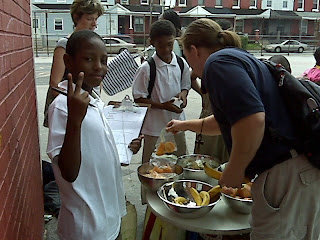
Oh, but it gets better. On Tuesday morning, after throwing together a quiche and doing a bit of laundry, Ollie and I made our way downtown to meet with Toby, the educational director of the much-lauded (and deservedly so, I would discover) Urban Nutrition Initiative. Toby filled me in on the history of the youth- and nutrition-focused organization and gave me an overview of some of the programs: fruit stands (one of the cornerstones of UNI's work -- more on this later), after school cooking clubs, high school gardens, outreach to teens by teens on nutrition-related topics, and the annual "Eat to Live" Festival (featuring food-related games, snacks, and garden tours at local schools). Toby introduced me to former social worker turned gourmet vegan chef turned educator, Kate, who brought me along to Huey Elementary where I saw one of UNI's 18 fruit stand programs in action. Kate brought the fruit, but the kids ran the show. From delegating tasks (tracking sales, making change, advertising their product -- it was a tough sell next to the italian ice and pretzel stand in the schoolyard) to accounting for the fruit costs on their balance sheet to determining what to do with the profits at the end of the school year, the kids seemed well beyond their 10 years. (One school's fruit stand team, for example, used their earnings to make smoothies for the entire student body. Very cool.) I snapped a quick pic of the kids selling a kiwi to one of their teachers. Too cute.

Next, Toby and Ollie and I walked over to University City High School where one of the students working on the urban garden gave me a tour of the site. We sampled various bits along the way -- strawberries, sorrel, mint -- and I probed his knowledge of garden- and cooking-related matters. A few students filled me in on the weekly mentoring program with nearby elementary school students. Again I was impressed. (Here's a pic of a few of the guys transfering some seedlings to bigger pots.) While at the school, I had a few moments to check in on an after school cooking and peer nutrition education group, led by UNI's capable John but, again, largely driven by students. I love it! (No picture, as I'd left my pitiful excuse for a camera -- the blackberry -- with Ollie in the garden.)

Unfortunately, Ollie and I got pretty lost in Wissahickon Park after that, so we got to Saul Agricultural High School too late to see the country's only student-run CSA in action. I did help harvest -- here's a pic with Lindsay and Nicole and a freshly-pulled rutabaga -- and weed a bit. (Wait, now I'm not sure if it's rutabaga or kohlrabi. Can you tell from the picture?) I hope to learn more about Saul's educational model and the recent shift toward organic vegetable production at some point. I did leave with a lovely bouquet of Russian kale and some bok choy, in any case, and made my way back downtown without incident to meet Alex and Tim for dinner. Over a lovely meal of largely organic and local fare at FARMacia, Alex filled me in on the exciting work he's been doing with "Grid" -- the Philly-focused sustainable living magazine he started this past fall. Great stuff. The latest issue focuses on the movement toward local food in the city: Grid's playing my tune.

And so, Wednesday morning came and I was treated to gorgeous weather on my way out of this wonderful city. Which is good, as Ollie and I were bound for navigational challenges that day....


Sent from my Verizon Wireless BlackBerry

Friday, May 15, 2009

A little culture

So I spent yesterday morning harvesting and packing greens and herbs for today's deliveries. Kale, collard greens, chard, 6 different kinds of lettuce (including one related to the Chrysanthemum which tasted mildly like parsley and had me daydreaming about tabbouleh for the last hour before lunchtime), oregano, sage, and thyme. There were also some beets and asparagus that were too small for shipping so we divvied them up among ourselves. Yum.

As we worked, I had the opportunity to get to know some of the full-time folks at Maggie's: Phyllis, Eric, and JJ. (Cliff was on mowing duty for pretty much the whole day, so only a few jokes and sarcastic comments back and forth there.) Inevitably, the conversation turned to food. Sure, I can talk about all kinds of other things -- books, music, art, film, the need for universal health care coverage, the decline of the public education system in our country, the evil powers responsible for the inane Washington Sports Clubs' member cancellation policy (and how a lack of a forwarding address should not bring the system to a screeching halt) -- but food is my favorite. And as we worked in the cooler for hours with gorgeous, newly-harvested produce, I began to brainstorm. Arugula pesto. Sauteed chard with garlic and nutmeg. Roasted asparagus with mint and lemon juice. Baby beet salad with mustard vinaigrette.

[Writing intermission: snack break.]

Clouds lingered after lunch and the weather seemed iffy, so I worked with Phyllis for a few hours on the "Defragging Phyllis' Brain" project -- essentially, it was a download of a lot of information from the farm manager's brain onto a working spreadsheet to map out weekly, monthly, and seasonal plans for the farm. Again, during lulls in the work, food occupied the majority of the conversation, so once we got to what we deemed an appropriate stopping point for the day, Phyllis let me into her kitchen and I fiddled with some of the miscellaneous organic ingredients in her refrigerator and some herbs I'd snipped from around the farm. I'd cut some fresh lettuce in the greenhouse and we proceeded to enjoy an herbal salad dressing sampling for the prototypes I was working on, each one featuring a seasonal herb: oregano, chives, sage, and thyme.


It seems both Phyllis and I liked the thyme one best, which had fresh orange juice, balsamic vinegar, olive oil, and mustard; I seem to have overdone it on the chili powder in the chive vinaigrette; the other two were fine, but nothing too crazy. As we nibbled, Phyllis told me of a gentleman in town with 6 Jersey cows who sells raw milk. I think I may have been out the door and let myself into her car and had my seatbelt on before she finished that sentence, but I can't be sure. Raw milk! We picked up a gallon, stopped for a few dozens free range eggs from another neighbor, and headed directly back to the farm....

I am perhaps a little overzealous about my affinity for fresh, plain yoghurt. It's hard to find these days outside of farmers markets. (I wouldn't characterize my frequenting of the 3 dairy suppliers at the Dupont Farmers Market as "stalking" per se, but I would get a little panicky when the supply of plain yoghurt ran low as I tried to wait patiently in line.) Phyllis pulled out her recipe and we got to work. The next morning, it was ready... and ridiculously delicious. We devoured about half the quart between us, garnished with raspberries frozen from last summer. And it was so easy!


If you want to make it yourself, here's the recipe:
- Heat 1 quart of raw milk (or store-bought milk is fine, too) in a saucepan to 180 degrees.
- Remove from stove top and cool milk to 116 degrees.
- Stir in 2 tablespoons of plain yoghurt culture. (This can be the last 2 TBSP of previous yoghurt batch or simply 2 TBSP of store-bought, plain yoghurt, preferably organic)
- Pour into a glass container and cover. (We covered a large glass jar with some tin foil.)
- Store at 116 degrees for 6 hours or overnight. (We wrapped the covered jar in a small towel, then a wool blanket, and placed it on a wooden cutting board set atop a small, metal space heater set on low overnight.)
- Chill for an hour or two. (This may apply to you, but certainly applies to the yoghurt.)

Soooo delicious.... and easy. I'll bet it would be a blast to make with kids. But then you'd probably have to set a good example and share some of it. Hmmm.... maybe make two batches.

Tuesday, March 17, 2009

Vegetable, Miracle


So my pal Ronn, fearless leader of a local Bike& Brunch group, invited me to a cycle maintenance talk yesterday at Bethesda's cool new Conte's bike shop. It's tough to beat free bagels and chats with bike experts, so of course I went. During the tire repair portion of the demonstration, the instructor advised checking the inside of the tire and wheel when you get a flat to see what caused it. Makes sense. Wish I had thought of that for my first, some may say valiant, attempt at changing my rear tire (for more details, see the premature celebration in my previous post, after which the patched tire promptly reflatted). I figured it out, though... on my second attempt. I think I nailed it (ha ha). And of course, I took some silly pictures.

Saturday was supposed to be my first visit to a local farm. I woke up to discover that while it was early it was nowhere near bright, but rather damp and around 40 degrees. Miserable. The group -- Meghan (one of my oldest friends who is visiting from Houston) and Mike (unflagging in his encouragement and advice on all things long-distance-biking who had offered to drive) -- opted to reschedule our visit and we settled in for a brunch of waffles and wild blueberries at my place. But today, still early and still far from bright, Meghan and I braved the PG County local bus system and general lack of signage and made it out to friendly Claggett Farm. We mostly worked in the greenhouse with a few other volunteers, led by Gail (who works there full time).

While I've started things from seed before -- tomatoes, peppers, various herbs and flowers -- never had I planted so many of them, nor organized them so meticulously, or really noticed how very tiny they are. (You pay attention to these things when trying to get only one seed per planter cell, or, as I like to call them, dirt divots, over the course of many hours.) I found myself meditating on more than one occasion, finding myself in awe of these tiny, hard little things -- especially the almost too small to see parsley or stevia (an herbal sweetener) seeds -- which would miraculously grow into beautiful, aromatic bursts of foliage and nutrients in a matter of weeks. Okay, maybe I was a little delirious from getting up earlier than usual or being out in the country (and Upper Marlboro is the country, in spite of the random McMansion developments not far up the road). Maybe I was a little hungry. (Reading all of the delectable sounding names of the varietals and chatting about ways to use various types of hot peppers will do that to me.) In any case, it was a good introduction to the farm and allowed us to get our hands into lots of dirt and help out. We came home to my apartment mud-caked, exhausted, and satisfied. And I can't wait to do it again!