Showing posts with label food for thought festival. Show all posts

Tuesday, September 29, 2009

Then they fight you

Michael Pollan's first speaking engagement in Madison last week centered on why so many Americans make poor food choices and what we as individuals can do to change things in our own lives as eaters. His second talk -- at the well-attended Food For Thought Festival on Saturday -- focused more on the need for major policy changes that influence food and farming across the country. In particular, diversified organic farms need more support.

Invoking such inspirational figures as Wendell Berry, Alice Waters, Martin Luther King, and even Gandhi, Pollan's talk was a call to arms. Or rather, a call to farms. It is not that we should get rid of farm subsidies, he argued, but rather than perpetuate the massive production of, say, feed corn for cattle, the money should be used to support small and medium-sized farms who grow a variety of crops and animals for human consumption. It's hard work -- I've only been doing it for 5 months, and with biking breaks periodically (and, yes, cycling is often less exhausting than farming, though perhaps it's a toss up since I've started biking into midwestern headwinds) -- and they need help. We will need many more of these farms and farmers to support a diverse network of foodsheds around the country as we wean ourselves off of the current, petroleum-dependent system of food production. This kind of farming -- without tons of fertilizers and pesticides and giant machines -- takes more people and more thought. And, contrary to the reigning propaganda out there, organic farms *can* feed the world. Look at the amount of food that programs like Growing Power (in Milwaukee) or City Farm (in Chicago) are producing, and doing it pretty much year round. (Contrary to some critics' assertions, I do not believe Mr. Pollan is pro-starvation.)

Our country and our world will be safer when people everywhere have access to fresh, responsibly-grown and regionally-distributed food. These are the sorts of things that folks at next month's Food Security Conference in Des Moines (that I am still trying to talk my way into) are convening to discuss. We are in the midst of a food revolution. The battle has begun in earnest to take back the land, to grow healthy food for all, and to do it in a way that doesn't destroy the land. The backlash from the Farm Bureau and large agriculture interest groups, Mr. Pollan pointed out, means that we, as food advocates, are now in the third stage of a revolution. As Gandhi once said, "First they ignore you. Then they ridicule you. They they fight you." Bring it on.


Sent from my Verizon Wireless BlackBerry

Monday, September 28, 2009

Young MacDonald had a farm

Yesterday and today were spent biking through southwestern Wisconsin. The weather has been a challenge -- 3 rainstorms yesterday alone and winds so strong that my main fear at the campsite last night was not the usual getting eaten by a bear or being struck by lightning but that a tree was going to fall on my head -- so I have not been encountering the usual number of bikers or woodland creatures with whom I might converse. (Also, with the fear of impending skull crushing, I laid awake most of the night.) I've had lots of time to think.

During one of these extended musing sessions, I got to thinking about how farming is simultaneously ingrained in our culture -- just look to children's songs like Old MacDonald, B-I-N-G-O (sorry if it's in your head now, too), or The Farmer in the Dell -- and devalued by it in recent years. I've been hearing about the "brain drain" from a few folks lately: how school counselors (and parents) are encouraging the best and brightest from farming communities to pursue non-farming careers. I mean, farming is hard work, who can blame them for encouraging a path that is physically less taxing, more highly respected, and often better paying than farming?

On the other side, many of the folks coming *into* farming don't come from agricultural backgrounds. In fact, most seem to be coming out of liberal arts colleges, young farmers drawn to sustainable food production because of a philosophical ideal -- maybe they harbor a pastoral vision of life as homesteaders or perhaps they pursue farming as a political act, an attempt to address food inequities. There is a sizable group of young farmers who actually grew up on farms, left, and have found themselves returning to the land, longing for a chance to grow things and feed people. This last group describes the majority of women farmers I spoke and worked with last week in the greater Madison area.

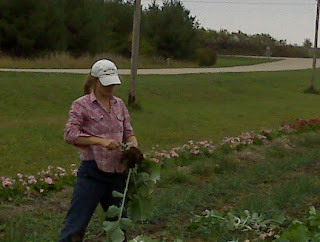
April (of West Star Farm), Kristen and Dawn (of Blue Moon Farm), and Diana (who runs Dreamfarm) each admitted to a desire to return to rural roots as the driving force behind her decision to farm. All wanted to live somewhere green, grow things, raise food for themselves and their communities. And they're succeeding. There is a thriving local food culture in Madison, with many small farms and CSAs. And yet, instead of being in competition -- as a traditional market might dictate -- the producers support each other, sharing the idea that the more the collective farms succeed, the more able they are to feed everyone. (Including me: both April and Kristen loaded Ollie up with produce before I left each farm. It's hard to turn down farm fresh produce....)

Farmers are notoriously independent and isolated. Not so with the young (and not so young) farmers around Madison. There are a few things that might explain this anomaly, but I think it comes down to community support. First, there is MACSAC (Madison Area Community Supported Agriculture Coalition) -- a group that works on everything from building farmer customer bases to subsidizing low-income CSA shares to facilitating internships at CSA farms. There are also groups like REAP (Research, Education, Action, and Policy) Food Group -- a coalition that works to build a stronger regional food system and better-educated eaters through programs like Homegrown Lunch and publications such as the Farm Fresh Atlas. (REAP also organizes events like the Food For Thought Festival, meant to highlight food issues in the region and which this year brought me in close proximity to Michael Pollan for the first time. I mean mere *feet* away: I had volunteered to help with crowd control during his book signing session following his talk on Saturday.) And, finally, there are educated consumers -- CSA shareholders, restaurants, farmers' market shoppers, co-op members -- who support these devoted farmers. If only we could mimic similar food system development in other parts of the country!


Sent from my Verizon Wireless BlackBerry