I love Thanksgiving. I mean, seriously, a day devoted to preparing and savoring a long meal with friends and family? We should do this more often as a culture, seems to me....
I shared the official holiday meal this year with mom, dad, my brother, his girlfriend, two of my uncles, and a tableful of food. No turkey, but still plenty of food. Dad started us off with some savory, free-range lambchops with cardamom and dried apricots in the slow cooker (a recipe from the Grassfed Gourmet cookbook I'd given him last year); mom went all out on the roasted brussels sprouts with pomegranate and the chestnut stuffing; I made decent work of the whole roasted duck with garlic, thyme, mustard, and tangerines with madeira gravy, and the sourdough baguettes put in a decent showing. As mom was serving up dessert, I scampered into the kitchen to get cracking on some duck soup. (What? You can't expect me to waste the best part of poultry! And she was taking too long cutting up my brother's belated birthday cake. Come on, I was back in time to sing Happy Birthday and scarf some red velvet cake before I went back to meddling with the broth.) That soup made for a lovely lunch the next day, let me tell you, with a couple of handfuls of purple stripey beans and a few carrots from the farmers' market plus a whole mess of herbs that dad and I kept tossing in. In case you can't guess, it is near impossible to leave my parents' house hungry. It gets a little heavy on the protein sometimes, though.
After all of that meat -- I come from a family of carnivores and still marvel at my ability to survive as a strict vegetarian for 5 years before my bacon relapse -- I needed a bit of detox. I had a stellar dinner of roasted root vegetables, a giant pear-walnut-bleu-cheese-red-lettuce salad, curried carrot salad (or as she and her husband refer to it, "Armenian New Year Salad" -- so delicious, who was I to point out that the onset of 2012 was more than a month away?), and chocolate pudding at cousin Sonia's last night. And as if reading my mind, my friend Abbie invited me to her co-op's annual vegan Friendsgiving potluck tonight. What a perfect ending to a long, sunny weekend filled with good people and food. And a welcome source of potatoes and cornbread and mushroom gravy and pumpkin pie after a long bike ride with my friend Ryan earlier in the day. (No, no, I packed snacks, of course, and we had a little picnic along the way, but I was hungry again after the 20-mile jaunt.) I had no idea what fun the large group meal would be, nor how delicious the offerings would be among the meatless crowd. Oh, that carrot soup! And the mashed potatoes with corn! And I must know who made that divine nut-based whipped cream! (I, lover of all things dairy, never thought the sentence "that vegan whipped cream sure was yummy" would ever come out of my mouth, but there you have it.)
My own offering was a simple curried butternut squash soup, which is fast becoming a staple of my culinary repertoire. Unfortunately, my attempt to bike it over to Abbie's place in Petworth was less than graceful, but nobody seemed phased when I dumped half of the soup that had puddled at the bottom of my pannier into the sink. The soup that remained in my malfunctioning tupperware warmed up nicely and in the end everything turned out alright. The various local beers on hand certainly didn't hurt the whole experience. (Hey, I said I'm taking a break from meat, not alcohol...though that might not be a bad idea, either. Maybe next week....)
Lest I be accused of being a full-time carnivore, I offer this relatively simple recipe, adapted from the wonderful, vegetarian Cafe Flora Cookbook (a birthday gift from my best friend Meghan last year, and also the source of the spectacular Portabella Wellington recipe):
Curried Butternut Squash Soup
Dry roast 1 tsp cumin seeds + 1/2 tsp coriander seeds until fragrant. Grind with a mortar and pestle, then add in 1-2 tsp curry powder. Set aside.
In a large pot, saute 1 onion (diced) in olive oil for a few minutes before adding a head of garlic (peeled and chopped) and a 1-inch piece of fresh ginger (peeled and minced).
Add 3-4 cups of fresh butternut squash (peeled, seeds removed, and cut into chunks) and stir in the spice mixture to coat the squash. Add 4-6 cups of vegetable broth and a bay leaf, then simmer until squash is soft (about 20 minutes).
Puree soup -- I look for any excuse to use Mike's immersion blender, but a regular blender or food processor would work almost as well -- then stir in 1 can of coconut milk. Season with salt and pepper and serve. (Don't be shy with the salt, either. I think tonight's iteration of the soup could've used a bit more of it, to be honest.)
I like to eat this alongside a hunk of sourdough and a big green salad. It's delicious and vegan-friendly...if you're into that kind of thing.
(Er, sorry, no pictures this time. I was in a bit of a rush this morning making soup and cookies and some mini quiches before the bike ride.)
Showing posts with label community life. Show all posts
Showing posts with label community life. Show all posts
Sunday, November 27, 2011


Sunday, August 1, 2010
Pay it backward
As I waited for the guys at the bike shop to give me a call back this afternoon with the verdict on Ollie's rear hub, I was out digging around in my backyard garden plot. I proudly observed my little darlings peeking up through the topsoil on this pleasant, slightly overcast day. It's not the most lush of gardens -- at least not yet -- but I'm pretty proud of my spunky little bean and squash plants. Aren't they lovely? Oooh, I'm already daydreaming about homegrown crookneck squash ratatouille and bacon-wrapped roasted green beans. Mmmm.

As I stood admiring my little Eden in the City, over the fence I heard a man's voice calling me. "Hello, Miss, I heard you were starting a garden." It was Quentin, an older gentleman peering over the divider, offering me tomato and watermelon seedlings. Really?? It was our very first conversation. After all of the kindness of strangers along my round-the-country odyssey, here again I am humbled by a simple gift from a man I've lived next door to for the better part of the last 3 years and never met until today.
It's not like I dislike my neighbors, but somehow during my previous life I was always running around too much to pause and chit chat. Between work, social engagements, cooking, keeping up with friends on the phone, if I wasn't asleep I was always going, going, going. Why is that? What's the rush? I find myself wondering now. (Of course, being unemployed these days I have more time to reflect on these sorts of things.) I do know Henry, who has lived on the other side of me, and who has even contributed to the compost bin from time to time, and Bev and Marcelo down the block have had me for dinner a couple of times. But I just met Sonny the other day. He's lived on my street since before I was born, I think, and is the unofficial neighborhood watchman from his front porch lookout. I need to bring that man some baked goods. Quentin's overdue for some as well. (I seem to be logging a lot of hours over the stove as I procrastinate, putting off the task of distilling what exactly it is that I accomplished over the past year and a half into some kind of coherent paragraph on a resume, so I'd expect a few dozen cookies or mini quiches to find their way into neighbors' hands soon.)
A few years ago I saw the movie Pay it Forward. It's a drama about a young boy who decides to change the world one person and one kind act at a time. He begins by doing something to help three people who must in turn each do good deeds for three other people, who then each reach out to three other people, and on and on. A steadily growing, one-person-at-a-time revolution -- right up my alley. Admittedly, it was a bit sentimental (and the film did not have to end that way!) but I think the idea's been percolating in my subconscious for years. In a less structured way, I've been trying to pay it forward, helping people out whenever and however I can. But considering all of the food and hugs and shelter I've been freely and openly offered by people all around the country, and help here in the District since my return, I'll be paying it backward for some time. Maybe for the rest of my life.
One of the things I have been trying to focus on since devoting myself to learning about food and community is, well, taking time to engage with the community. I'm not running off to start a commune or anything, but I am not a fan of the trend toward insulation and isolation that seems to be swallowing our country. So I'm starting my own revolution. In our normal, everyday lives it's time we look each other in the eye and smile instead of scurrying past with our heads down. Share a cup of coffee and a recipe. Offer encouragement and consolation and help. Give people the benefit of the doubt and maybe a little space in the bike lane for a change. Grow things and cook things with friends (and not-yet-friends). Maybe that's how I'm meant to give back. Cooking my way to a better world... I like it.

As I stood admiring my little Eden in the City, over the fence I heard a man's voice calling me. "Hello, Miss, I heard you were starting a garden." It was Quentin, an older gentleman peering over the divider, offering me tomato and watermelon seedlings. Really?? It was our very first conversation. After all of the kindness of strangers along my round-the-country odyssey, here again I am humbled by a simple gift from a man I've lived next door to for the better part of the last 3 years and never met until today.
It's not like I dislike my neighbors, but somehow during my previous life I was always running around too much to pause and chit chat. Between work, social engagements, cooking, keeping up with friends on the phone, if I wasn't asleep I was always going, going, going. Why is that? What's the rush? I find myself wondering now. (Of course, being unemployed these days I have more time to reflect on these sorts of things.) I do know Henry, who has lived on the other side of me, and who has even contributed to the compost bin from time to time, and Bev and Marcelo down the block have had me for dinner a couple of times. But I just met Sonny the other day. He's lived on my street since before I was born, I think, and is the unofficial neighborhood watchman from his front porch lookout. I need to bring that man some baked goods. Quentin's overdue for some as well. (I seem to be logging a lot of hours over the stove as I procrastinate, putting off the task of distilling what exactly it is that I accomplished over the past year and a half into some kind of coherent paragraph on a resume, so I'd expect a few dozen cookies or mini quiches to find their way into neighbors' hands soon.)
A few years ago I saw the movie Pay it Forward. It's a drama about a young boy who decides to change the world one person and one kind act at a time. He begins by doing something to help three people who must in turn each do good deeds for three other people, who then each reach out to three other people, and on and on. A steadily growing, one-person-at-a-time revolution -- right up my alley. Admittedly, it was a bit sentimental (and the film did not have to end that way!) but I think the idea's been percolating in my subconscious for years. In a less structured way, I've been trying to pay it forward, helping people out whenever and however I can. But considering all of the food and hugs and shelter I've been freely and openly offered by people all around the country, and help here in the District since my return, I'll be paying it backward for some time. Maybe for the rest of my life.
One of the things I have been trying to focus on since devoting myself to learning about food and community is, well, taking time to engage with the community. I'm not running off to start a commune or anything, but I am not a fan of the trend toward insulation and isolation that seems to be swallowing our country. So I'm starting my own revolution. In our normal, everyday lives it's time we look each other in the eye and smile instead of scurrying past with our heads down. Share a cup of coffee and a recipe. Offer encouragement and consolation and help. Give people the benefit of the doubt and maybe a little space in the bike lane for a change. Grow things and cook things with friends (and not-yet-friends). Maybe that's how I'm meant to give back. Cooking my way to a better world... I like it.
Friday, February 26, 2010
Everybody wins

Across town, a group of folks at Tucson's Community Food Bank (CFB) had decided to set up a program to increase access to fresh fruits and vegetables for low-income mothers and children (those qualifying for WIC). The problem was that they didn't have enough donations of fresh produce or a place to grow it themselves. They were looking for land.
The two groups came together and the Marana Farm at the Heritage River Park was born. (Does anyone else have the Brady Bunch theme song in their head?) The 10-acre working organic farm is run by a small staff of young women employed by CFB plus a few interns and AmeriCorps volunteers. The non-profit is supported by a steady stream of donations and grants that supplement sales of the farm's produce at local markets. Maintenance needs are handled by the Park staff. It's a charmed existence, but rather than congratulating themselves on their luck the folks at Marana Farm are eager to share their resources and good fortune with the larger community. (And the community members have been flooding in since Disney started offering free 1-day passes to their parks for folks who volunteer at local charitable organizations. The farm's generally had a steady stream of volunteers prior, but there's been a huge uptick in families coming out to weed the spinach beds lately. I have mixed feelings on the Disney incentive, but it does seem to get a lot of local folks out into their communities and helping out for a few hours. I'm hoping at least a handful return post-Epcot Center.)
What is really exciting to me is the way everything seems to come together here in such a serendipitous way. There is an abundance of donated tools, seeds, and volunteer time. People with needed skills just kind of show up. On our drive to Marana this morning, one of the farmers (Maggie) told me of an when she was given the task of building a greenhouse. She had little construction experience and was feeling anxious about undertaking the project. Into the farm office walked a rather muscular woman needing to fulfill some community service hours (due to a weapons charge) who happened to be a professional greenhouse builder. Presto! -- the greenhouse was built.
[I know: weapons charge?? Right. We are in Arizona, where a startlingly literal interpretation of the right to bear arms just led to legislation permitting weapons to be carried into bars. I wonder if one can exercise his or her second amendment right and bring their weapons into the courtroom for the hearing following the inevitable gunslinging bar brawl.]
The farm is a model of community cooperation, and seems to have great relationships with local businesses, from the Marana WIC clinic to the Cottonwood thrift shop to the Marana food bank (though the farm works out of the Tucson food bank) to area farms. The different entities share extra resources when possible. A few examples: the farm brings boxes of broccoli or turnips not sold at the farm stand to the local (Marana) food bank; the food bank offers use of their computer printer or broken sacks of birdseed donated from Walmart; the farm donates organic seed to home gardeners and struggling farms in the area; the local Rotary Club chapter helps fund the food forest on the farm property. Everybody shares, everybody wins.
There is some discussion of the farm moving in a more education-focused direction (rather than, say, beginning a CSA program or scaling up to grow for more farmers' markets). While there are currently a number of educational programs offered in the form of workshops (and CFB after-school nutrition sessions), the farm staff hope to develop more formal lessons that align with the local school curricula and focus more on school groups. A working educational farm that taps into the various talents and resources within the community? Sounds like something we could use in my own home town....
Sent from my Verizon Wireless BlackBerry
Monday, September 28, 2009
Young MacDonald had a farm
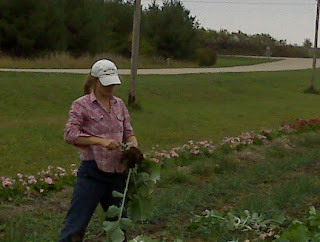

During one of these extended musing sessions, I got to thinking about how farming is simultaneously ingrained in our culture -- just look to children's songs like Old MacDonald, B-I-N-G-O (sorry if it's in your head now, too), or The Farmer in the Dell -- and devalued by it in recent years. I've been hearing about the "brain drain" from a few folks lately: how school counselors (and parents) are encouraging the best and brightest from farming communities to pursue non-farming careers. I mean, farming is hard work, who can blame them for encouraging a path that is physically less taxing, more highly respected, and often better paying than farming?
On the other side, many of the folks coming *into* farming don't come from agricultural backgrounds. In fact, most seem to be coming out of liberal arts colleges, young farmers drawn to sustainable food production because of a philosophical ideal -- maybe they harbor a pastoral vision of life as homesteaders or perhaps they pursue farming as a political act, an attempt to address food inequities. There is a sizable group of young farmers who actually grew up on farms, left, and have found themselves returning to the land, longing for a chance to grow things and feed people. This last group describes the majority of women farmers I spoke and worked with last week in the greater Madison area.
April (of West Star Farm), Kristen and Dawn (of Blue Moon Farm), and Diana (who runs Dreamfarm) each admitted to a desire to return to rural roots as the driving force behind her decision to farm. All wanted to live somewhere green, grow things, raise food for themselves and their communities. And they're succeeding. There is a thriving local food culture in Madison, with many small farms and CSAs. And yet, instead of being in competition -- as a traditional market might dictate -- the producers support each other, sharing the idea that the more the collective farms succeed, the more able they are to feed everyone. (Including me: both April and Kristen loaded Ollie up with produce before I left each farm. It's hard to turn down farm fresh produce....)
Farmers are notoriously independent and isolated. Not so with the young (and not so young) farmers around Madison. There are a few things that might explain this anomaly, but I think it comes down to community support. First, there is MACSAC (Madison Area Community Supported Agriculture Coalition) -- a group that works on everything from building farmer customer bases to subsidizing low-income CSA shares to facilitating internships at CSA farms. There are also groups like REAP (Research, Education, Action, and Policy) Food Group -- a coalition that works to build a stronger regional food system and better-educated eaters through programs like Homegrown Lunch and publications such as the Farm Fresh Atlas. (REAP also organizes events like the Food For Thought Festival, meant to highlight food issues in the region and which this year brought me in close proximity to Michael Pollan for the first time. I mean mere *feet* away: I had volunteered to help with crowd control during his book signing session following his talk on Saturday.) And, finally, there are educated consumers -- CSA shareholders, restaurants, farmers' market shoppers, co-op members -- who support these devoted farmers. If only we could mimic similar food system development in other parts of the country!
Sent from my Verizon Wireless BlackBerry
Thursday, July 23, 2009
Over hill, over dale, and around the Intervale


Around 3:00, we headed back to the CSA pickup area, just moments ahead of the first wave of eager local eaters. Had it not been so well organized, it would have been a scene of total chaos for the next 2 1/2 hours as a steady stream of people arrived to claim their weekly vittles -- collecting their veggie allotments, harvesting herbs and flowers, picking up any other items they'd requested, socializing. Whenever I could catch them for a free moment, Andy, Becky, or Aly would tell me a bit more about the food community they have helped to foster: regular community events, farming workshops (sometimes working alongside NOFA -- the Northeast Organic Farming Association), and partnerships with other local food producers (to round out CSA members' diets with minimally marked up dairy, eggs, bread, honey, and maple syrup). I meandered around until Mark and Susan showed up to pick up their share, then Susan gave me a lift to one of the local bike shops to pick up Ollie, who'd been getting some work done on her brakes in anticipation of our upcoming date with the Adirondack Mountains. (Eep.)
Wednesday morning began with lots of rain. (Par for the course, it seems, this biking in the rain....) It stopped just as Ollie and I got to the Association of Africans Living in Vermont (AALV) farm plot on the fringe of the Intervale, part of the innovative New Farms for New Americans project. There I met up with a group of resettled refugees from Burundi harvesting broccoli for the afternoon's North End Farmers' Market. Lots of smiling and gesturing ensued as we quickly realized a bit of a spoken language barrier breakdown (that is, once we made it past names and where we were from -- they beamed when I told them I lived in the same city as Obama). I played peek-a-boo with the kids, we mimed opinions on vegetable ripeness, and in general I think things went pretty well. My attempts at exchanging recipes seemed to puzzle them -- I learned later that broccoli is not a native food crop in Burundi, so perhaps it was unfamiliarity with cooking it that prompted the uncertain, polite smiles. They were kind and welcoming and proudly showed me their crops, and when we parted ways, Michel -- the man with whom I'd managed to communicate the most -- insisted that I take some of the broccoli with me. I'd asked so many questions about it, he probably thought I was a bit obsessed with broccoli. Okay, maybe I am a bit, and in the end I accepted the gift of the beautiful green bouquet. Few things are more humbling than being given food by a refugee.
The sun came out in the afternoon as Ollie and I arrived at Intervale's friendly Arethusa Collective Farm. We were just in time for carrot washing, but first Ben, Emily, and Ben's wife (a pox on my memory! I recall the entire conversation but have forgotten her name!) invited me to check out the property. Tom, the farm's founder, joined us as we cleaned and sorted carrots and the group engaged in an interesting discussion on the meaning of sustainability, farming as a political act, and the recent trends I've noticed ranging from the use of black plastic on organic farms to the pattern of well-educated young liberal arts majors flocking to farm life. They're a bright, friendly bunch who openly grapple with many of the issues I am trying to sort out for myself. (Only, of course, they're *living* the life I am only beginning to scratch the surface of.)
While no longer involved in a CSA, I learned, Arethusa remains committed to supplying farmers markets, restaurants, and City Market -- my all-time favorite grocery store in the region (and not just because of the bike helmet discount they offer, but it is a nice bonus) -- with healthy, tasty, chemical-free vegetables. At the end of the afternoon, I strapped a bag of gorgeous, freshly washed Arethusa carrots onto Ollie and we were off to Old Spokes Home (another local bike shop) to get the skinny on bike routes through the mountains of upstate New York....
Sent from my Verizon Wireless BlackBerry
Friday, June 26, 2009
The hills are alive with the sound of mooosic


From the moment of my arrival I was welcomed into the community. Even when I may have taken more than my share of strawberries and herbed soft cheese with chives at lunch or the dreamy icecream at dinner -- I couldn't resist the startlingly delicious dairy or fresh produce, and it was the feast of St. John the Baptist so I suspect the Sisters on kitchen duty were pulling out all the stops. I daresay some of the soups were divinely inspired: the cooks' hands were surely blessed. (I resisted the temptation to run into the kitchen and kiss the cook, as I had after consuming the most sublime lavender creme brulee ever during a trip through southern France a few years back. Partly, this was due to the Abbey's kitchen being in the enclosed -- and thus off-limits -- portion of the building.)
The women at the Abbey clearly appreciate good food, but also have inculcated the value of conservation, as instructed by Saint Benedict. I read up a bit on St. B. one afternoon: he had a few too many rules for my liking, but his insistence on not being wasteful of any resource -- be it food, water, the land, the human spirit -- holds a good bit of appeal. Finding meaningful, useful work for everyone, taking into account one's interests and abilities, is one of the cornerstones of the Abbey's philosophy, and during my time there, I couldn't help but notice how everyone embraced their given tasks with zeal. I even found myself thinking about how lucky I felt to be a part of this community one morning while pitchforking cow pies into a wheelbarrow outside the dairy -- hardly glamorous (or sweet-smelling) work, but oddly satisfying. (Also, I was still giddy after bottle-feeding one of the young calves, and being nuzzled by a few of the large, peaceful cows as they ambled past me toward the pasture. And I'd guzzled a large coffee with milk squeezed right out of the cow into my mug: the Sisters call it a cow-puccino, but it's really more of a latte.)
After a blissful 3 1/2 days, I departed, filled with gratitude that this community so readily welcomed me into their midst to learn and work and reflect. I hope to return here some day... maybe I'll get to try my hand at making cheese and ice cream the next time around.
Sent from my Verizon Wireless BlackBerry
Subscribe to:
Posts (Atom)