Showing posts with label CSA. Show all posts

Wednesday, May 9, 2012

Short Haul Trucker


Yesterday was my first shift picking up and delivering CSA shares for White House Meats in their refrigerated van.

What’s that? A meat CSA? Yes. Usually Community Supported Agriculture shares consist of weekly boxes of fresh, local fruits and vegetables, but they don’t have to be fruits and veggies. I’ve heard of everything from an all-herb CSA to a pie CSA to, well, a friend of mine was even talking about doing a beer CSA. (Sign me up! And dad wants a double share.) The point is you're supporting local producers and getting a high quality of a variety of tasty goodies. White House Meats approached me a few months ago to see if I could help them start up a local, grassfed meat CSA to market their pastured beef, chicken, pork, and lamb to folks in DC. I’ve tasted their wares – good stuff. How could I resist the chance to get out of the city to visit farms one day a week, yap with farmers, pick up delicious, Ibti-approved meat, then bring it back into the city and talk with folks about how to cook it? We decided on an 8-week trial run to gauge interest, test out the model, and work out the kinks.

Oh. Your question was about the driving of the van? Yes, it’s a little out of the ordinary for me. For the record, though I have never owned a car, I did drive the 15-passenger van quite often during my AmeriCorps days. I have a drivers' license, you know, even if I mostly use it when I get carded buying beer. Ollie -- my faithful Long Haul Trucker -- was pouting in the corner when I returned from my gig as a Short Haul Trucker around 7:30 last night. She didn’t seem at all impressed when I showed her the mock tenderloin Seth sent me home with as thanks for a job well done. (True, I suppose bicycles don’t eat much meat. It is a beautiful cut, though. I’ll have to cook it up with a few friends this weekend....) So, yes, I am, as a rule, a cyclist, but the local, grassfed meat CSA was too good of an idea to pass up. And it is patently ridiculous* for me to bicycle out 60-100 miles to these farms, pick up over 120 pounds of meat, and keep it cold while biking it back 60-100 miles into town each week. So, yes, I drove. And sang quite loudly along with the radio, as it was "Two For Tuesday" on the classic rock station and they just kept playing lots of The Who and Hendrix and... well, anyway, it's probably for the best that Seth got stuck in a meeting...

My first CSA drop-off day had a few hiccups, of course: Seth got stuck in a meeting, so my inaugural drive out to pick up grassfed beef from Fauquier’s Finest about an hour and a half away in Virginia was with a GPS rather than the planned human navigator; I had to make a few U-turns out on not-so-well-labeled country roads; a couple of crates toppled over in the back of the refrigerated van (due, most likely, to the aforementioned U-turns); there was a fair bit of rain; and three folks missed the pickup window at District Crossfit (we left their shares in the gym's fridge overnight).

In the end everything seemed to work out. In fact, a few folks already sent in thank you notes. This one’s my favorite: “Already made burgers with the ground beef...Best.Thing.EVER. You guys are awesome, this was such a great idea! Thanks so much!!!”

Not a bad first day. If all goes well, maybe we can expand and extend the program after the 2-month trial. Don't worry, I'll never be a full-time trucker....


*Dad, I know what you are thinking: "It was patently ridiculous to bicycle around the country for over a year...."

Wednesday, June 1, 2011

Perspire under the elms


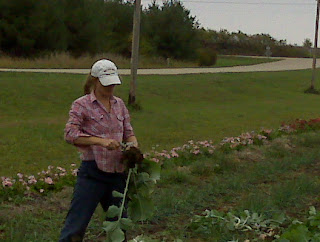
Due to some recent changes to my employment status, I have significantly more time on my hands of late. As such, I have spent the past couple of weeks catching up with those people and activities I was forced to neglect during my 4-month tenure with Arcadia: friends, family, writing, gardening, dancing, and going on bicycle adventures. Most of this has taken place around The District, but I had the good fortune to spend the past week visiting my friend Nathan on his family's farm -- the only organic plot for hundreds of miles -- tucked away below stands of cottonwood and elm in the windy southwestern corner of Nebraska.

While farm laboring wasn't my primary reason for visiting -- among his many fine qualities, my gentleman friend is a fantastic cook and salsa dancer and it was high time we spent some time together tackling the NY Times crossword puzzles (and it *was* the tail end of morel season) -- I couldn't help myself when the inevitable outdoor activities got underway each day. Planting, weeding, laying irrigation line, mulching, watering, and, my favorite, harvesting. ("One asparagus spear for me, one for the soup....") Needless to say, we spent quite a bit of time in the kitchen, and the culinary highlight of the trip was a fairly authentic Coq au Vin made from scratch. While the dish did not feature the usual french wine, we made up for the omission with the inclusion of multiple bottles of a tasty red zinfandel, a hefty handful of morels, and two rather bothersome roosters that Nathan and his brother Brian butchered themselves on Wednesday night. True, the two-year-old birds were a bit tough, but, oh, that sauce! Such flavor! And you'd better believe I made a giant pot of stock with the leftover carcasses. You know, for the creamy asparagus soup. And some chicken soup. And a big pot of risotto. (Well, I couldn't let it go to waste.) I had a chance to sleep in the following morning without that 5am cockadoodledoing, which was another side perk....


I've never been to Nebraska before. I was equally alarmed by the lack of food options in local grocery stores as by the bounty and variety of food grown on the windblown farm where I was staying. [No, seriously, that wind is like nothing I've ever seen. The gales were so intense I half expected a tornado to form during the latter part of Monday's barbecue. I don't know how the little bitty baby bok choy that we'd planted the day before were still in the ground.] Nathan's mom has quite the green thumb and was definitely in the lead during much of my time at the homestead -- planting and weeding and directing various menfolk on where to rototill -- but it was her son who decided last year to start a small CSA on the property. The brother who started the project left town, disgruntled, near the end of the first growing season, but there was enough demand among their neighbors that Rylan and a few other members of the family decided to continue, even expanding a bit. In its second year, Green Elms Community Farm is offering 10 shares of tasty, organic produce plus pastured eggs from their hens, if folks want, and potentially mushrooms as well, if Brian's winecap growing scheme proves fruitful. (Personally, I think Nathan should offer beer shares -- his homebrews are darn tasty, and they are growing hops -- but for now production is limited to family-only consumption levels. But imagine: a beer CSA! I'd sign up.) Yep, community supported agriculture is growing in some of the most unexpected places. I mean, rural Nebraska??

Okay, well, I'm just now back in DC. Guess it's time to get unpacked and do some laundry (after a *very* thorough check of all clothing and body parts following my week in Tickland). Stay tuned for posts on other small organic produce operations starting up, including a collaborative market stand with offerings from DC's urban growing spaces....

Tuesday, August 10, 2010

Will work for food


In spite of the fact that I am no longer technically on the road researching sustainable food at farms and gardens across the country, I still find myself up to my elbows in dirt and string beans fairly frequently these days. Yes, while I have yet to secure gainful employment -- which has the potential to greatly interfere with my cooking and writing aspirations unless it is the right kind of job -- I find myself volunteering in exchange for food. It's been working out pretty well, this bartering system.

This past Saturday, for instance, I cajoled my neighbor Henry into joining me at City Blossoms' Girard Street location for a little cooking in the garden: we harvested goodies for baba ghanouj and a lovely tomato salsa, which we prepared and enjoyed with pita bread and lemonade with Mia (who manages the community garden) and the other volunteers. Then yesterday I found myself back at Clagett Farm, this time picking bell peppers on a dripping hot August morning as part of my workshare. Gail had kindly offered me a ride from her place in nearby Petworth to the farm (located in Upper Marlboro, MD), as well as a ride back with my overloaded pannier and an additional crateful of organic veggies and fresh cut flowers. The farm's only 15 miles from downtown, but the roads looked a little dicey. And Gail works there so she was going that way anyway. And, okay, I'm a slacker: I'd rarely biked and farmed on the same days during my cross-country farm trip, and I'm feeling a bit beaten down by the DC summer heat.

To those who believe they can't eat well on a budget -- that a diet filled with lots of fresh, organic, local produce is out of reach -- I suggest you check out Clagett Farm. They offer CSA shares, a program that doles out weekly boxes of seasonal fresh goodies from May through November, for significantly less than what one would spend at the farmers' market (or even, believe it or not, a grocery store). It works out to around $20 per week, or around $10 weekly for a low-income share. (I know! What a deal!) Or you can work in exchange for food. Yep. Each 4-hour volunteer shift, what they term a "workshare," earns a portion of the farm's bounty. This week's share included melons, beans, garlic, squash, peppers, and cucumbers, plus all of the tomatoes and eggplant and fresh herbs I could carry, and some sweet corn that was added to the "for volunteers" pile (and which is currently simmering with potatoes on my stove as part of a savory, creamy summer chowder). They grow a LOT of food. There is so much food, in fact, that in addition to supporting your friendly neighborhood bicycling foodie and a couple hundred CSA shareholders, some 40% of the farm's output is donated to local charities in the DC area. And yet it is still smaller and more diverse than your standard conventional farm. Amazing.

So now you're probably wondering how you can get involved and get your hands on unlimited local, organic summer squash. It seems the farm welcomes volunteers all year round, and especially on CSA harvest days (Saturdays and Tuesdays) during the growing season that runs from mid-spring through late fall. You'll find yourself sweating, sometimes profusely, yet folks can take as many breaks as needed so long as their active work time adds up to four hours. The tasks are moderately challenging, but hardly slave labor. On Monday, for instance, after the morning pepper harvesting the group chatted while feasting on fresh, cold watermelon at the veggie wash station before heading out into the (never ending) bean fields after lunch.

So what's keeping you from volunteering at this impressive local farm? You've got excuses, I've got retorts....

Have a day job: Check out their Saturday shifts or bank a few regular shifts during holidays.

Don't have a car: The farm has an informal carpooling setup. (I wouldn't recommend public transit, though. It took Meghan and I nearly two hours when we tried that last time.)

Not into hot weather: You can come by in the fall for some of the work "winterizing" the garden, or in early spring months to help with indoor prep work. (You can bank your hours and redeem workshare food pickups when the harvest season begins.)

Not strong enough for farm work: Inquire about cool-weather work like seeding starter trays in the greenhouse. (Easy on the body and actually kind of interesting, especially if you have OCD tendencies.)

"Be sure to call a few days ahead," Gail insisted when I mentioned wanting to post something on the blog about the almost-too-good-to-be-true workshare program. (This is so that staff can plan appropriately in terms of tasks and management.) So now you know. Get out there and get yourself some tomatoes!

Sunday, June 6, 2010

Return of the native, Part 2

Link

During my time in Mississippi, I had a chance to visit a second young farmer -- Horton, the driving force behind Isis Gardens. Like Will, Horton recently returned to his native Tupelo after years of working on farms elsewhere. (In his case, he was returning from Colorado.) He, too, decided that home was calling, that Mississippi was in dire need of chemical-free, responsibly grown food. He, too, moved home and began cultivating a piece of land that had been in the family for years. And yet it was a very different operation from the town's other organic farm.

When Aaron and I stopped by the CSA farm on a Friday afternoon, Horton walked us around the rambling property, excitedly pointing out various cover crops, dozens of heirloom vegetable varieties, the insectary (a plot of land set aside to attract beneficial insects), purple marten houses (to attract bug eating birds), even the inside of the Depression era home he had recently come to inhabit. It was decidedly less structured, and perhaps overgrown in places, but the green space nurtured an abundance of plant and animal diversity quite rare in these parts.

As we took a little rest in the shade of the front porch to sip on cups of cool sun tea, Genevieve joined us and the couple graciously invited Aaron and me to stay for lunch. As we munched on leftover pasta and a giant salad, and sipped on cold beers spiked with chamomile flowers, Horton expanded on his passion for seed saving. As conventional American (and global) agriculture careens at a breakneck speed toward uniformity and productivity, this young farmer remains part of a small but persistent group of growers striving to preserve quality and diversity in our food system. Perpetuating strains of corn and potatoes and beans that are all but extinct. Nurturing tomato and melon varieties from places as far away as war-torn Iraq. (Consider the very real possibility that without heirloom growers like Horton, some of these treasures may be lost forever.)

Now, I know southerners have a reputation for hospitality. I have also found organic farmers to be more welcoming and generous than the general population. Horton espouses the best of both groups, with a ready smile and openness to sharing both food and knowledge. I was just giddy when he sent me away the following afternoon with a big hug and envelopes of heirloom tomato and melon seeds from my dad's native country. I can't wait to get planting, doing my part to keep some of these rare (and delicious) species around a bit longer...

Sent from my Verizon Wireless BlackBerry

Tuesday, June 1, 2010

Return of the native, Part 1

Link

I'd first met Will back at Deep Seeded Community Farm on my way through California last December. As we harvested kale and washed carrots, I learned that he had spent some years working on organic farms in Humbolt County, and now, at 24, the anthropology-student-turned-farmer was ready to start his own place. But rather than add another farm to the somewhat saturated organic produce market in coastal northern California, Will decided to move home to Mississippi, where comparatively little exists in terms of sustainably grown food. Modeled closely on the Arcata farm where he'd been interning, the goal was to provide fresh, clean food and build a sense of a food community. What I discovered during my days working with Will last week in Tupelo was that over the past five months he's managed to cultivate not only healthy plants but a healthy fan club. Organics taking root in Mississippi? Y'all better believe it.

He's something of a local celebrity, with a recent article in the local paper leading to dozens of calls from folks interested in buying fresh produce, seeking gardening advice, or sometimes letting the young farmer know he was welcome to come by to harvest their extra mulberries. People would stop him on the street, in a cafe, at the market, to compliment the work he has been doing. He seems to take it all in stride.

Cultivating a piece of land on his parents' property for vegetable farming, and with plans for a flower and animal operation on his own land soon, Will has already built up a strong group of supporters for his operation. (No, really, at the Saturday farmers' market the sole organic stand generally sells out by around 10am.) He welcomes volunteers and neighbors to come by Native Son Farm and chats easily about the different varietals, from the sweetness of the heirloom corn to the history of the "mortgage lifter" tomatoes. Folks coming to pick up their CSA-inspired produce box from the front porch on Fridays sometimes wander about the crop rows or seek advice on preparing unusual items. There's a woman in town with a penchant for kohlrabi who was the inspiration behind Will's planting of the delicious, alien-looking root vegetable. I suspect others will be stopping by with requests in coming months. People are talking; Will's listening.

It's a family affair, with dad assisting with equipment, mom reaching out to community members and sending out the weekly CSA notices, sister Lauren and girlfriend Amanda working alongside Will on the farm and at the Saturday farmers' market.

In addition to the CSA and farmers' market stand, there are plans for a series of farm dinners -- to celebrate local food and help supplement the farm's income -- featuring the talent of Will's friend David, a local chef. (More on David's amazing work in a future post.) The first farm dinner, with ingredients culled from a 30-mile radius (including fresh rabbit and goat cheese), happened to take place last Thursday, so Aaron ("the photographer from San Francisco" deemed, well, the official photographer) and I ("the woman biking around the country for over a year to visit farms" and happily designated as the evening's wine stewardess) had a chance to help out. The food was divine. In spite of a series of rain showers, the event was an overwhelming success, with gleeful, full-bellied patrons advising on dates for the next dinner as they departed. And there will be more: the farmer and chef team are looking to hold 6 or so each year under the stunning giant oak tree alongside the farm.

All in all, I was impressed by Will's insight and his success thus far. Soon hopefully other farmers will begin to provide fresh, clean food in Mississippi. Wouldn't you know that I met a second organic farming friend in town over the weekend. Check back soon for more on Horton's organic farm down the road....

[In case you're wondering about the higher quality of this photo, it was snapped by "the photographer from San Francisco" while Will and I washed veggies for the farm dinner. Yes, a real camera... and a real photographer, for once. ;)]

Sent from my Verizon Wireless BlackBerry

Monday, March 15, 2010

La Buena Vida


I first learned of La Buena Vida Farm from Dennis over at 47 Ranch just a couple of days before Aaron and I made our way 84 miles (in a single day! a new record! woo hoo!) to this agricultural model of self-sufficiency in southeastern Arizona. I enjoyed the food and the company during my time at the organic farm, but what I loved most was the story of the family that runs it.

Neither Jennifer nor Jerry grew up on a farm, nor did they study agriculture. Far from it. And yet they are two of the most inspired farmers I have met. A few years ago the pair left successful careers in Los Angeles -- as a high-end boutique manager and a fashion photographer, respectively -- in search of a place to raise their family. After scouting out possible new homes across the country over the course of many months, they landed in a tiny ranching town on the New Mexican border and took up residence at a former vineyard where Jerry's dad had graciously put a down payment on the property. The city slickers were self-proclaimed foodies, however, and quickly realized that while rural life had many charms food options in the area were slim. (This part of the state of Arizona is truly a food desert: 2 sandwich shops and no grocers for about a 50-mile radius. I know this because I was looking for a snack along the entire ride from Douglas, AZ. It's true, ask Aaron.) The couple started teaching themselves about growing their own edibles. Maybe... a modern homestead? They set themselves to building a self-supported operation run on wind and solar and elbow grease (alternative energy sources are abundant here... especially the wind... *sigh*), using mostly human-powered equipment (like the snazzy, bicycle wagon that Jen is sporting above) and DIY contraptions (like the homemade poultry plucker that Jerry built). They began growing just a little bit extra for the neighbors. Jennifer started dabbling with animal husbandry, raising heritage goats, sheep, geese and turkeys. Word spread quickly as a growing number of folks learned of the farm and not long afterward Jerry and Jennifer started selling produce at a farm stand in Portal.

Actually, they are the farmers market: one stand offering produce, eggs, freshly baked sourdough bread, and meat. Demand continued to grow, prompting the couple to take a serious look at their ability to feed the community, a philosophy aligned with their strong Christian values. They discussed how many families the land could support: 20 for the first year with the two of them working full time plus periodic volunteers, close to 30 the second if they could hire help.

In an area with a surprisingly high incidence of folks with extreme health issues (and subsequent dietary restrictions), interest in organic food continues to grow. As we worked together one afternoon on the farm, Jen mentioned an ongoing challenge trying to explain the concept of a CSA to neighbors. If only they checked out the clear and concise explanation on the farm's blog, I thought: "Community-Supported Agriculture (CSA) baskets is a way for community members to participate in a small farm like ours by paying at the beginning of the growing season for weekly baskets of freshly harvested produce. This provides farmers like us with some predictable revenue so that we can concentrate on providing a valuable local food source." Folks in the area might not use the term "CSA," but through it the farm and community are supporting each other.

In just a couple of years, Jerry and the farm have become known throughout the region. (No, really. Even as far east as Hachita, NM, I discovered when chatting with the kind folks who let me sleep in their gas station. "Oh? You were working with the organic farmers near Rodeo? Yeah, we know 'em. Good people.") I share in the admiration of these determined, imminently thoughtful and generous family farmers. And not just because they sent me off with a loaf of bread, hunk of cheese, dried fruit and nuts, and bag of fresh produce -- I'd already formed my opinion before the sendoff with unexpected, delicious treats. Theirs not a glamorous life, but it's a good one. Their small home is hardly the lap of luxury, but it in many ways encapsulates la buena vida: comfortable, happy, and filled with good food and people.

I am fascinated by tales of folks who dare to try to live differently, who leave behind successful careers to follow a path their heart calls them to pursue. And I am inspired by them. (My parents were, to put it mildly, concerned that I was leaving my teaching job -- the one with a steady, if paltry, paycheck -- to bike around the country on my savings and volunteer on farms.) Without this pursuit of something greater, what are we left with? I'm not advocating for everyone to leave their less-than-ideal day jobs, but consider ways in which you, too, might seek your own version of la buena vida.

Thursday, December 17, 2009

From the ground up

Eddie's worked on organic farms for many years. He's a darn good farmer (and a good cook, which always wins brownie points in my book) and I am indebted to my friend April for putting us in touch: I learned a lot working with him last week. He's a thoughtful observer, a meticulous record-keeper, and has a reputation for being a tireless worker. As I worked (and cooked) alongside Eddie for a few days on my way through northwestern California, I came to understand that for this inspired (and inspiring) grower, urban farming is as much about building community as it is providing fresh, healthy food to that community.

Prior to starting his own operation, Eddie had managed the nearby POTAWOT organic farm -- a local garden that provides fresh fruits and veggies to the Native American health clinic in Arcata. (Yes, a program directly linking healthcare and healthy food -- what a concept. Are you listening, Senators?) One morning when the ground was too frozen to harvest, and after we'd weeded the greenhouses, Eddie suggested that Ollie and I cycle over to check out the garden, health center, and hiking trails on the POTAWOT property. We did and I must say that it was pretty rad. Over the years, Eddie has continued to be an active member of the Arcata community and has fostered longstanding relationships with many in the small college town. So much so that when he decided to start his own farm, many of his CSA members were referred from the waiting list of another CSA farmer friend in town. (Farmers as collaborators rather than competitors -- not quite the conventional model, is it?)

When he started Deep Seeded Community Farm a year ago, Eddie explained, he could have found land further out of town for less money, an existing farm with developed soil and structures in place. But the most important element of the year-round CSA was for it to be accessible to its members -- who live and work in town -- so he's built it right in the thick of things, starting quite literally from the ground up. To Eddie, it is critical for families and friends to be able to connect with their food and each other. On CSA pickup days, Eddie chats easily with each of the 93 winter share members and their kiddos, exchanging recipe ideas, getting feedback on the quantity and variety of veggies, commenting on the unusually cold weather. They come by the urban farm each week to pick up their produce, sometimes also cutting fresh flowers in the spring or picking juicy strawberries in the summer. I overheard a few folks commenting on how they had finally gotten the hang of planning meals around the weekly boxes to use up all the produce, how they enjoyed the freshness and flavor of the new varieties available each week, and how glad they are that Eddie decided to offer a winter share (which, incidentally, was oversubscribed, but the farmer managed to produce enough to accommodate a few more people, as was the case with the popular regular season shares.) The farm and the food had become a part of their weekly routine.

I must say that the work itself seemed more manageable than some farms I've been to -- more sustainable in terms of human energy. At the end of the day, I was tired but not wiped out. Granted, it is the beginning of winter, so things slow down on farms everywhere. Eddie also confessed that he needed to maybe tone down the intensity a little in the farm's second year, that he'd put in ridiculous time and energy up until now. (I'm no slouch, but I was glad not to be banging on the frozen ground and sloshing around in rain as I had done at other farms prior to this one.) Still, he and the others I met while there seemed content and proud of their work. I enjoyed my time with the farmer and his part-time staff -- Jess, Scott, Rachel, and Will -- as we weeded, harvested, and washed produce. They were thoughtful and engaging conversationalists, passionate about food, energetic. At least two of them spoke of having their own farms in the not-too-distant future, I learned as we dug up carrots and snapped leaves of chard for the CSA. (Seriously, Will, I am going to look you up on my way through Mississippi.) During the slower cold months, in addition to evaluating the year's production and planning for the spring planting, Eddie is tinkering with the internship requirements for next season -- field work paired with an hour-long weekly seminar on a variety of topics. There is a lot of interest in local, sustainable food in Arcata, I would say (and not only because of the well-established and impressively stocked local co-op). The demand is here, the groundwork is being laid... Eddie is not only growing good food and a community of conscientious eaters. He's also helping to cultivate new farmers. Right on.

Sent from my Verizon Wireless BlackBerry

Thursday, November 5, 2009

Farm to four-top


I've been hearing about CSAs -- Community Supported Agriculture -- for quite some time. Some years ago I recall my friend Yochi and I sitting on his living room floor discussing whether or not it made sense for us to split a CSA share from one of the few options in the DC area. (This was years before the Washington Post published a convenient list of CSAs in the area and back when I had a refrigerator. Ah, memories.) These days there are thousands of CSAs all around the country. It's exciting to see individuals, couples, groups of friends, and families making the decision to directly support their local farms by purchasing a share. But how about larger buyers like restaurants, that could really help boost the local farm economy by guaranteeing a market for small producers? Is it even possible to run an eatery that entirely (or even mostly) sources its ingredients locally? Well, it turns out the answer is yes. Enter, the RSA -- Restaurant Supported Agriculture.

In Chicago, I remember chatting with Derrick, of the scrumptious Lula Cafe, and learning of periodic chef visits to local farms, including the urban City Farm, and regular scouring of the city's many farmers' markets for seasonal ingredients. But the first time I heard the term "RSA" was when I was up to my elbows in bike grease from changing a flat tire and happened to walk into Julie's office where she was meeting with chef and local food advocate Dave Swanson in Milwaukee. The two were in the middle of a meeting (and, as I said, I was covered in grease) so I didn't chat for long, but the brief explanation I got from Dave was enough to inspire me to learn more about the farm-to-restaurant connection. The Milwaukee-based program fosters connections between farmers and chefs, and Dave helps interested restaurants work out the financial and logistical pieces of the puzzle. But there are also a growing number of bistrots who are independently working to source their food locally. As I've made my way westward, when I am fortunate enough to find a place that isn't too cost prohibitive for me to splurge on a meal (or, on occasion, be treated to one), I've been doing my best to learn how innovative restauranteurs connect with local growers. There are some common challenges among restaurants, but also viable models for success. In coming posts, I'll be looking into some of the innovative farm-to-table connections I've discovered along the way....

Monday, September 28, 2009

Young MacDonald had a farm

Yesterday and today were spent biking through southwestern Wisconsin. The weather has been a challenge -- 3 rainstorms yesterday alone and winds so strong that my main fear at the campsite last night was not the usual getting eaten by a bear or being struck by lightning but that a tree was going to fall on my head -- so I have not been encountering the usual number of bikers or woodland creatures with whom I might converse. (Also, with the fear of impending skull crushing, I laid awake most of the night.) I've had lots of time to think.

During one of these extended musing sessions, I got to thinking about how farming is simultaneously ingrained in our culture -- just look to children's songs like Old MacDonald, B-I-N-G-O (sorry if it's in your head now, too), or The Farmer in the Dell -- and devalued by it in recent years. I've been hearing about the "brain drain" from a few folks lately: how school counselors (and parents) are encouraging the best and brightest from farming communities to pursue non-farming careers. I mean, farming is hard work, who can blame them for encouraging a path that is physically less taxing, more highly respected, and often better paying than farming?

On the other side, many of the folks coming *into* farming don't come from agricultural backgrounds. In fact, most seem to be coming out of liberal arts colleges, young farmers drawn to sustainable food production because of a philosophical ideal -- maybe they harbor a pastoral vision of life as homesteaders or perhaps they pursue farming as a political act, an attempt to address food inequities. There is a sizable group of young farmers who actually grew up on farms, left, and have found themselves returning to the land, longing for a chance to grow things and feed people. This last group describes the majority of women farmers I spoke and worked with last week in the greater Madison area.

April (of West Star Farm), Kristen and Dawn (of Blue Moon Farm), and Diana (who runs Dreamfarm) each admitted to a desire to return to rural roots as the driving force behind her decision to farm. All wanted to live somewhere green, grow things, raise food for themselves and their communities. And they're succeeding. There is a thriving local food culture in Madison, with many small farms and CSAs. And yet, instead of being in competition -- as a traditional market might dictate -- the producers support each other, sharing the idea that the more the collective farms succeed, the more able they are to feed everyone. (Including me: both April and Kristen loaded Ollie up with produce before I left each farm. It's hard to turn down farm fresh produce....)

Farmers are notoriously independent and isolated. Not so with the young (and not so young) farmers around Madison. There are a few things that might explain this anomaly, but I think it comes down to community support. First, there is MACSAC (Madison Area Community Supported Agriculture Coalition) -- a group that works on everything from building farmer customer bases to subsidizing low-income CSA shares to facilitating internships at CSA farms. There are also groups like REAP (Research, Education, Action, and Policy) Food Group -- a coalition that works to build a stronger regional food system and better-educated eaters through programs like Homegrown Lunch and publications such as the Farm Fresh Atlas. (REAP also organizes events like the Food For Thought Festival, meant to highlight food issues in the region and which this year brought me in close proximity to Michael Pollan for the first time. I mean mere *feet* away: I had volunteered to help with crowd control during his book signing session following his talk on Saturday.) And, finally, there are educated consumers -- CSA shareholders, restaurants, farmers' market shoppers, co-op members -- who support these devoted farmers. If only we could mimic similar food system development in other parts of the country!


Sent from my Verizon Wireless BlackBerry

Monday, August 31, 2009

A new spin on things

From Oakwood, Ollie and I got a lift across the border with Scott and JT who were dropping off some stuff at Three Rivers -- the natural food co-op in Fort Wayne, Indiana. While chatting with a few of the staff as we unloaded crates in the produce department, I learned of an organic farm that was more or less along the route I would be taking to get myself to La Porte, where Don and Judie were expecting me in a few days. I cycled on over to see if Dan, who runs the Country Garden & Farm Market in nearby Roanoke, could use a hand for a day or two. (Seriously, would any farmer turn down a woman willing to pull weeds or dig up potatoes? If so, I haven't met that farmer yet.)

I drifted in just after lunchtime, introduced myself, changed out of my bike gear (spandex is good for biking but not so much for walking through thistle patches, which are quite abundant on midwestern farms, incidentally), and not 20 minutes after my arrival was picking tomatillos and chatting away with Emily. I learned as we worked, and later while we cooked dinner together at her house the next two evenings, that my picking partner was the only other full-time worker on the farm. With dozens of heirloom varieties bursting with color amid the foliage across the farm -- tomatoes, sweet and hot peppers, leeks, okra, strawberries, beans, and more -- I was amazed at how much the farm could produce with such a small workforce. Dan's wife helps with some of the work at the various markets they supply, but she has a job off the farm so the lion's share of the manual labor falls on Dan's shoulders. There are a few folks who do work shares a few hours per week in exchange for food during the growing season, but with over 100 shares for the year-round CSA and multiple farmers markets, out of necessity Dan has to be creative and efficient wherever possible. All the while he refuses to sacrifice the quality or diversity of his crops.

In many ways, Dan epitomizes the kind of thoughtful observation and connection to the land that agriculture lost when it became industrialized...and what it needs to relearn. He knows his land and his crops down to the most minute detail, but he looks outward, too. He was curious about other farms I'd visited: what kinds of cover crops they used, how they managed weeds (and if everyone had quite so many -- they generally did), what varieties of garlic they grew. As a general practice, he regularly evaluates his methods to see if there are things he could be doing better, incorporating ideas from his own observations, from what he's read, from his peers. On occasion he'll come up with something quite novel.

Take his method for washing greens, for instance. He grows quite a cornucopia of lettuce greens -- I know because I helped to harvest at least 5 or 6 varieties -- and is meticulous about rinsing and storing them for his customers. The same goes for kale -- at least 3 varieties (including my favorite, dinosaur kale). Dan and I stood next to each other at the deep sinks, talking as we worked, soaking everything in the first tank, picking out any leaves that were questionable before giving them a soak in the second sink. But the best part was the drying. Dan had bought a second-hand washing machine recently. He tossed the double-washed greens in, flipped the machine on the spin cycle, and about 15 seconds later our greens were crisp and ready for bagging. It was essentially a giant salad spinner -- you know, like the kind your mom uses. Now the greens would not be in danger of getting soggy and we didn't have to crank bucket after bucket of the stuff in the usual, small spinners. This is the kind of practical ingenuity I keep encountering on the farms I have been working on, the kind of thing the Podolls would have come up with in "Deeply Rooted" (which I just finished reading last night). Whether for philosophical or economic reasons, these farmers are constantly inventing new ways to do things, working to minimize the oil-dependent energy and chemical use in their practices, and quietly, slowly succeeding.

I departed around lunchtime on Friday for Goshen, where I would be staying with Emily's friend Joe and checking out the farmers market before at last trucking myself (most of the way) to La Porte on Saturday. Before I left, I teased Dan that he needed to take a vacation. It'd been something like 5 years since the last one, he admitted, but with so many folks counting on him for fresh, local food each week, how could he take time off? "I mean, they depend on me. Plus, all I'd want to do was be back tinkering with some of the stuff on the farm I never seem to get to, anyway," he smiled. "That reminds me, I need to look into a few more garlic varieties for next year. And I need to figure out a way to cut down on weeds in the melon patch. And I keep meaning to revise that cookbook for the CSA members...."


Sent from my Verizon Wireless BlackBerry

Thursday, July 23, 2009

Over hill, over dale, and around the Intervale

Monday was CSA (community supported agriculture) pickup day at the Intervale Community Farm -- the area's oldest (celebrating 20 years) and largest (with something like 500 shares, and a waiting list!) CSA. I arrived just after lunch to chat with Andy, Becky, and others for a bit before heading out to weed one of their outer fields. As we hand-weeded and thinned out a long row of beets, Aly filled me in a bit on the farm and how it fits into the larger Intervale scene of organic agriculture and education.

Around 3:00, we headed back to the CSA pickup area, just moments ahead of the first wave of eager local eaters. Had it not been so well organized, it would have been a scene of total chaos for the next 2 1/2 hours as a steady stream of people arrived to claim their weekly vittles -- collecting their veggie allotments, harvesting herbs and flowers, picking up any other items they'd requested, socializing. Whenever I could catch them for a free moment, Andy, Becky, or Aly would tell me a bit more about the food community they have helped to foster: regular community events, farming workshops (sometimes working alongside NOFA -- the Northeast Organic Farming Association), and partnerships with other local food producers (to round out CSA members' diets with minimally marked up dairy, eggs, bread, honey, and maple syrup). I meandered around until Mark and Susan showed up to pick up their share, then Susan gave me a lift to one of the local bike shops to pick up Ollie, who'd been getting some work done on her brakes in anticipation of our upcoming date with the Adirondack Mountains. (Eep.)

Wednesday morning began with lots of rain. (Par for the course, it seems, this biking in the rain....) It stopped just as Ollie and I got to the Association of Africans Living in Vermont (AALV) farm plot on the fringe of the Intervale, part of the innovative New Farms for New Americans project. There I met up with a group of resettled refugees from Burundi harvesting broccoli for the afternoon's North End Farmers' Market. Lots of smiling and gesturing ensued as we quickly realized a bit of a spoken language barrier breakdown (that is, once we made it past names and where we were from -- they beamed when I told them I lived in the same city as Obama). I played peek-a-boo with the kids, we mimed opinions on vegetable ripeness, and in general I think things went pretty well. My attempts at exchanging recipes seemed to puzzle them -- I learned later that broccoli is not a native food crop in Burundi, so perhaps it was unfamiliarity with cooking it that prompted the uncertain, polite smiles. They were kind and welcoming and proudly showed me their crops, and when we parted ways, Michel -- the man with whom I'd managed to communicate the most -- insisted that I take some of the broccoli with me. I'd asked so many questions about it, he probably thought I was a bit obsessed with broccoli. Okay, maybe I am a bit, and in the end I accepted the gift of the beautiful green bouquet. Few things are more humbling than being given food by a refugee.

The sun came out in the afternoon as Ollie and I arrived at Intervale's friendly Arethusa Collective Farm. We were just in time for carrot washing, but first Ben, Emily, and Ben's wife (a pox on my memory! I recall the entire conversation but have forgotten her name!) invited me to check out the property. Tom, the farm's founder, joined us as we cleaned and sorted carrots and the group engaged in an interesting discussion on the meaning of sustainability, farming as a political act, and the recent trends I've noticed ranging from the use of black plastic on organic farms to the pattern of well-educated young liberal arts majors flocking to farm life. They're a bright, friendly bunch who openly grapple with many of the issues I am trying to sort out for myself. (Only, of course, they're *living* the life I am only beginning to scratch the surface of.)

While no longer involved in a CSA, I learned, Arethusa remains committed to supplying farmers markets, restaurants, and City Market -- my all-time favorite grocery store in the region (and not just because of the bike helmet discount they offer, but it is a nice bonus) -- with healthy, tasty, chemical-free vegetables. At the end of the afternoon, I strapped a bag of gorgeous, freshly washed Arethusa carrots onto Ollie and we were off to Old Spokes Home (another local bike shop) to get the skinny on bike routes through the mountains of upstate New York....


Sent from my Verizon Wireless BlackBerry

Friday, June 5, 2009

Where kids run the show

Philadelphia put in a strong bid for my favorite city on the trip so far. (The best ice cream thus far is an even closer race: a 3-way tie between Bedford, Carlisle, and Mechanicsburg. Ah, but I digress.) While only in the city for approximately 4 1/2 days, I managed to peek through many windows into a brighter, more sustainable future for our country. And as I suspected, it all came down to educating people, especially kids. And the best educating was done BY kids.

Monday morning, after a frustrating wild goose chase around the downtown municipal office building attempting to learn more about the mayor's proposed Greenworks Philadelphia project (I was sent to 3 different floors before I managed to locate the Office of Sustainability only to be told that there was nobody I could speak with and nobody could set up an appointment -- not particularly helpful or friendly, that receptionist), I had a cup of coffee (ohhhh, sweet elixir that I've been missing while camping) and headed to the Pennsylvania Horticultural Society headquarters. I'd read up on some of the innovative programs and partnerships and was happily met by PHS's lovely Eileen who filled me in a bit more on the City Harvest partnership, which marvelously harnesses the energy and expertise of different groups around the city. Here's how it works: seedlings are started by inmates and 2 part-time PHS staff in the prison greenhouse (I fortuitously met Lisa, one of the two PHS prison gardeners, during a jaunt up to Weaver's Way later that afternoon); seedlings are then distributed to community gardens around the city; SHARE (Self Help and Research Exchange) connects the food growers at these gardens with local food cupboards; and the Health Promotion Council organizes nutrition workshops and develops recipes for the food distribution centers. Pretty smart collaboration, I think.

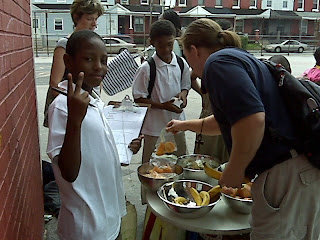
Oh, but it gets better. On Tuesday morning, after throwing together a quiche and doing a bit of laundry, Ollie and I made our way downtown to meet with Toby, the educational director of the much-lauded (and deservedly so, I would discover) Urban Nutrition Initiative. Toby filled me in on the history of the youth- and nutrition-focused organization and gave me an overview of some of the programs: fruit stands (one of the cornerstones of UNI's work -- more on this later), after school cooking clubs, high school gardens, outreach to teens by teens on nutrition-related topics, and the annual "Eat to Live" Festival (featuring food-related games, snacks, and garden tours at local schools). Toby introduced me to former social worker turned gourmet vegan chef turned educator, Kate, who brought me along to Huey Elementary where I saw one of UNI's 18 fruit stand programs in action. Kate brought the fruit, but the kids ran the show. From delegating tasks (tracking sales, making change, advertising their product -- it was a tough sell next to the italian ice and pretzel stand in the schoolyard) to accounting for the fruit costs on their balance sheet to determining what to do with the profits at the end of the school year, the kids seemed well beyond their 10 years. (One school's fruit stand team, for example, used their earnings to make smoothies for the entire student body. Very cool.) I snapped a quick pic of the kids selling a kiwi to one of their teachers. Too cute.

Next, Toby and Ollie and I walked over to University City High School where one of the students working on the urban garden gave me a tour of the site. We sampled various bits along the way -- strawberries, sorrel, mint -- and I probed his knowledge of garden- and cooking-related matters. A few students filled me in on the weekly mentoring program with nearby elementary school students. Again I was impressed. (Here's a pic of a few of the guys transfering some seedlings to bigger pots.) While at the school, I had a few moments to check in on an after school cooking and peer nutrition education group, led by UNI's capable John but, again, largely driven by students. I love it! (No picture, as I'd left my pitiful excuse for a camera -- the blackberry -- with Ollie in the garden.)

Unfortunately, Ollie and I got pretty lost in Wissahickon Park after that, so we got to Saul Agricultural High School too late to see the country's only student-run CSA in action. I did help harvest -- here's a pic with Lindsay and Nicole and a freshly-pulled rutabaga -- and weed a bit. (Wait, now I'm not sure if it's rutabaga or kohlrabi. Can you tell from the picture?) I hope to learn more about Saul's educational model and the recent shift toward organic vegetable production at some point. I did leave with a lovely bouquet of Russian kale and some bok choy, in any case, and made my way back downtown without incident to meet Alex and Tim for dinner. Over a lovely meal of largely organic and local fare at FARMacia, Alex filled me in on the exciting work he's been doing with "Grid" -- the Philly-focused sustainable living magazine he started this past fall. Great stuff. The latest issue focuses on the movement toward local food in the city: Grid's playing my tune.

And so, Wednesday morning came and I was treated to gorgeous weather on my way out of this wonderful city. Which is good, as Ollie and I were bound for navigational challenges that day....


Sent from my Verizon Wireless BlackBerry

Wednesday, April 1, 2009

Critical mass

These days everybody seems to be talking about buying -- even growing -- food locally and sustainably. For awhile I thought this might be just because of the people I tend to hang out with, but I'm not so sure any more. I got into a fairly detailed discussion at the bank the other day with one of the account managers who was telling me about the vermiculture his family has been practicing for decades on their farm in Cali, his home town in Colombia. (Way more interesting than discussing my checking account, to be sure.) This chat simply would not have happened a year ago.

I was just this morning catching up on a backlog of articles and blog postings I have been meaning to read. (The fact that there is such a plethora of writing out there on sustainable food is exciting in itself.) There was a long piece in the New York Times Business section that lauded the progress that the organic food movement has made in recent years, but implied an impending Congressional smackdown of the progressive food consciousness generated by the Obamas and Agricultural Secretary Tom Vilsack. (I'm intrigued that the 3-page article appeared in the Business section rather than, say, the weekend magazine. Telling, I think.) An article reprinted on the Irresistible Fleet of Bicycles site (one of my favorites these days) posits that change is coming, but slowly. The key seems to be making this a more broadly supported social movement, rather than a foodie fad. And it needs politically savvy leaders. In a critique of the NYT piece, Tom Laskawy, a Grist guest blogger, seemed to concur. He offered cautious hope. My [albeit ham handed] summary of his argument: Things are moving in the right direction. The great failing of the NYT article was the way it seemed to minimize the growing collaboration between the sustainable ag, fair trade, international development, climate change, public health, nutrition, and food safety folks. People are beginning to buy into the idea that all of these things are related and that they need to be addressed. Food is the linchpin. We're moving toward a tipping point. Soon, policymakers will have to start listening in earnest.

Agribusiness is a tough nut to crack. What can we do? Grow things. Cook things. Support responsible producers of our food. Talk to people about it. (Am I sounding like a broken record here?)

One of the more inventive variations on eating local, in my humble opinion, comes out of San Francisco: a Community Supported Forage (CSF) box. It riffs off of the idea of the Community Supported Agriculture (CSA) arrangement -- a chunk of cash up front for a supply of whatever is locally harvested over a number of weeks. They're playing my song. Wild mushrooms? Really?? I've been too nervous to try mushroom foraging on my own, due to my fear of inadvertent self-poisoning. (I had some crazy Danish friends back when I lived in Mexico who used to go all the time. They admitted to having 2 designated mushroom taste testers -- human canaries, if you will -- with them on each fungus hunt. I wonder if I was being recruited as one of these.) Ah, but if someone who knew what they were doing would supply me with seasonal fiddleheads, morels, and wild blueberries -- or even let me tag along -- well, that sounds divine.

Finally, I've been in conversation in recent weeks with Zeke of Washington's Green Grocer, who has always marketed an organic produce box, and now is offering artisanal breads and cheeses (yum!). With all of the interest in local produce these days -- if the tripling of crowds at the Dupont farmers market on Sundays is any indication -- I've been pestering him to offer a "local produce" box, a subset of the weekly organic box along the lines of the $29 "dogma box" now available in the Boston area. (Ah, my people.) This may mean some weeks of stockpiled potatoes, apples, and rutabaga, but you can always do the "will call" rather than the "weekly" box. Or get creative with your recipes. Is the interest out there? I think it is.

Tuesday, February 10, 2009

Show me the money

This weekend included my first meal of spaghetti and homemade venison meatballs (yes, Bambi -- my former vegetarian self is still reeling) and my first foray into the world of the next generation of farmers via the Pennsylvania Association for Sustainable Agriculture's (PASA) annual conference. Both were made possible by my dear cousin Caroline and her boyfriend Gary, an organic garlic farmer in the Poconos.

PASA was great. I found that everyone I spoke with was eager to share their knowledge. Not in the "look how much I know" kind of way -- contrary to my earlier conference experiences at, say, the Modern Language Association annual meetings (if you want to ever feel truly illiterate, I recommend that you check these out) -- but rather along the lines of "I'm so glad you asked because I've been thinking about that, too." I learned the basics of crop rotation (how, when, and why), the benefits of urban gardening (from community building to beautification of bombed out lots), and celebrated backyard gardening (apparently you can grow enough to feed a person year round on just an eighth of an acre -- mom, dad, I'm helping you develop a bigger vegetable plot in the backyard). I'm still trying to work out the difference between tilling (bad?) and aerating (good?), but I'm sure that will get cleared up at some point.

Some of the more interesting conversations I had over the course of the day were about the financial aspects of sustainable farming. The first of these occurred with the grass-fed dairy farmer I happened to sit next to at lunch. (The cows he raised were grass-fed, not him.) He explained to me how he'd run a conventional dairy for years, but how recently he'd decided to overhaul his whole operation. It wasn't a moment of enlightenment about animal welfare or environmental stewardship that served as the impetus for the conversion. His epiphany: there's a market for it. About a decade ago, he told me, he began hearing rumblings of a growing demand for grass-fed dairy. He did some calculations. He consulted with his son who had recently finished school with a degree in business and who, for the first time, was taking an interest in the family business (my understanding was that this interest came out of the sustainable nature of the project). And so he moved ahead. It was a major financial risk. He had to hire significantly more workers to manage the now 300-strong herd in this more labor-intensive arrangement. Now, he said, he's sorry it took him so long to make the switch. He's elated that the business has brought the family together and he's proud to employ a skilled, local workforce. He has started reading about the nutritional and environmental benefits of his methods -- knowledge that bolsters his confidence beyond the financial rationale. (At this point, having consumed a pitcher and a half of water, I hopped off to the ladies' room. I returned to the table to discover that he and his wife had left and I berated myself for not writing down his name or the name of the dairy beforehand. Note to self: bring notebook and pencil everywhere. And drink less water.)

My second memorable conversation was with our friend Jim, with whom we were carpooling back from the conference. (Call me a slacker, but I was not up to biking to State College, PA, in the snow quite yet.) While I'd sat in on a session on the flourishing community garden programs in downtown Philadelphia (which I'm hoping to learn more about), Jim had been hearing about the plight of CSAs (Community Supported Agriculture programs) in the region. There are many forms a CSA might take, but my general understanding is that community members buy a "share" up front (usually in the $400-700 range) and then are supplied with a weekly box of fresh, local produce over the course of the growing season (usually April or May-October). Seems like a great deal for everyone. The issue that arose at the end of the session, it turned out, was the question of financial sustainability: could a CSA be, if not "profitable" by traditional business standards, at least financially independent? At least in the case of the groups represented on the panel, the answer seemed to be "no." One depended largely on outside grants to subsidize the costs involved; another was something of a pet project for a farmer who didn't seem too concerned about the monetary gains or losses. My question is: are there CSAs out there that can serve as viable business models? I don't mean that CSA managers need MBAs and fancy cars and performance bonuses -- certainly not -- but is there a way to set things up so that growers are not merely scraping by (or, worse, operating at a loss)?

The good news is that local produce is becoming more available more often and in more places around the country. CSAs are catching on. The Washington Post Food Section recently came out with a listing of CSAs in the DC metro area. I hope to speak/meet with some of the amazing people who run these programs. If anyone (beyond my two loyal readers: mom and dad) is connected with a CSA in your area -- as a volunteer, manager, participant in some aspect of the program -- I'd love to hear from you!