I listen to my local NPR station every morning. This morning as I was warming up some breakfast I heard an excerpt from my very first radio interview on WAMU: a piece on the challenge faced by aspiring urban farmers to identify and secure a plot of vacant land to farm here in the District. Those who have tried to grow food on city, federal, or park land can tell you better than I can how circuitous and frustrating the process can be in this town. I happen to know a lot of them.
In fact, there are a number of challenges facing folks who want to raise crops, start a compost operation of any magnitude (thus building soil instead of loading up landfills), keep laying hens or honeybees, build aquaponics (fish farming) systems, or pursue other sustainable agricultural projects here in the city. Creating jobs, providing access to healthy food, improving the soil -- seems like a no-brainer that any politician or government office would love to support. (They could certainly use the positive press.) And yet.... In terms of the interview, I was speaking on behalf of the informally-named DC Urban Agriculture Coalition, a collection of local experts -- farmers, gardeners, educators, advocates, land developers, and policy folks -- who have come together to discuss ways we might inform city officials about the benefits of a robust urban agriculture sector, identify the barriers that currently prevent (or strongly discourage) food production and composting in our nation's capital, offer models from other cities, and propose a set of recommendations to encourage sustainable urban agriculture. (No, it's not one of my 6 paid part-time jobs; it's one of my 4 unpaid ones, and some days managing the group felt a bit like herding cats. Nice cats, mind you, but still tough to shepherd.) In the weeks since we drafted an advisory white paper and letter to the Mayor, many of us Coalition members have joined up with the recently announced Sustainable DC initiative. If there's even a chance of sincere commitment from city government to address some of the barriers to urban food production, I'll bike myself to the series of 8 meetings over the next few months.
I mean, seriously, what are our alternatives as supporters of healthy, local food? Some folks who have tried to grow here have given up. Some have started guerrilla gardening. Some have gotten jobs in the government to try and change things from within. Some have gone elsewhere to grow food, to places like... Baltimore??
Most in the sustainable food world know that Detroit is leaps and bounds ahead of DC in terms of urban food production. Some may have heard of similarly cool urban ag projects in Cleveland and Philadelphia. Okay, fine. But when, a few months ago, I learned how city officials in nearby Baltimore have been working with urban growers to revamp zoning regulations and streamline land assessment/leasing to encourage urban food production, I really got worked up. I mean, for crying out loud, the First Lady has an organic garden on the White House lawn... how are there not urban growing spaces on every street corner here in DC? I never thought we'd be looking up to Baltimore as a model for urban food production, but these are strange times. (Even so, I would not advise biking around there when you go to visit the urban farms.)
Anyway, at least three different friends sent me a message within a few minutes of the short broadcast this morning to say they were excited to hear me on WAMU. Yes, a five-second blurb on local radio. Well, I hope it helps spread the word on the urgent need for reforming the way vacant land is used in DC -- especially in areas of DC that are considered "food deserts," where fresh food is hard to find -- but I'm not exactly a local celebrity.
Friday, December 9, 2011


Tuesday, December 6, 2011
So *you're* the one teaching my daughter to make that stinky food
As one of my heroes, Sandor Katz, once said, you can ferment just about anything. Well, a week ago, a roomful of adolescents and I made kim chi from the greens of daikon radishes. (We pickled the radish roots along with some beets and cucumbers during the following class, but I'm getting ahead of myself. Clearly, I am behind on the blogging about this fantastic project.) It was part of the sustainable food and garden club activities I've been running a couple of afternoons each week at a middle school in Suitland, MD, with my fearless co-instructor Jessica... and boy was it fun.
We started class with the students tasting some turnip green kim chi I'd made two weeks before. (See, this teacher is always thinking ahead: I wanted it to be good and spicy and stinky for them, heheh.) As they fished around the jar with chopsticks, we talked about Korean cuisine and food preservation methods. And, oh, the faces some of them made! It was hilarious. "Wow, that's really spicy!" and "Whoah, that really stinks!" echoed throughout the classroom. We passed around the various ingredients for students to see and smell and, if they wanted to, taste: fresh ginger, garlic, onion, red pepper flakes, sea salt. Then we hauled out the giant radishes that Jessica had brought from the farm, filled up some buckets with clean water for washing everything, and broke out the kitchen equipment.

The 7th and 8th graders really got into it, chatting and chopping and mincing and mashing away. If you've been following this blog for awhile, you might guess that it was a variation on the easy kim chi I've made a few times. (No, it's not exactly authentic kim chi. For one thing, it lacks the particular kind of peppers that are traditionally used. And it's vegan, so actually less fishy smelling than the real stuff.) If you're looking for the recipe we used, it's here.


I was tickled to find William showing a few of his peers the trick to removing garlic skins, to overhear Tiara and Tiffany discussing the complex smell of fresh ginger, to see sometimes rather rowdy teenagers mash, mash, mashing away one layer after another of greens and spices and asking each other if their jar needed more salt/pepper/garlic. I think it was one of the most popular classes to date. It was certainly one of the most intense on the nasal passages.
There was a bit of cleaning up to do afterwards -- note to self: end class 15 minutes early so the kids can help with the cleaning -- but it was definitely one of the more memorable classes for the students. And their parents, apparently. One mother who stopped in to pick up her daughter after the next class said that her teen had loaded up a hamburger with her homemade kim chi one night at dinner. (And here I thought the student wasn't paying attention when I'd casually mentioned doing something similar when Jessica and I had experimented with kim chi and hotdogs a few months ago. Who knew?) Another mother asked if I was the teacher her daughter had been talking about that sent her home with the stinky green jar. Yep, that's me. Sure, some of the food we're making can smell and taste a bit intense. But it's so good for you. And the kids are expanding their taste horizons. (And there is the added bonus of the kim chi's ability to mask the faint smell of garlic emanating from one's person. Or maybe that's just me.)
[Thanks to my dear friend Jeff for capturing some of this excitement on camera!]
We started class with the students tasting some turnip green kim chi I'd made two weeks before. (See, this teacher is always thinking ahead: I wanted it to be good and spicy and stinky for them, heheh.) As they fished around the jar with chopsticks, we talked about Korean cuisine and food preservation methods. And, oh, the faces some of them made! It was hilarious. "Wow, that's really spicy!" and "Whoah, that really stinks!" echoed throughout the classroom. We passed around the various ingredients for students to see and smell and, if they wanted to, taste: fresh ginger, garlic, onion, red pepper flakes, sea salt. Then we hauled out the giant radishes that Jessica had brought from the farm, filled up some buckets with clean water for washing everything, and broke out the kitchen equipment.

The 7th and 8th graders really got into it, chatting and chopping and mincing and mashing away. If you've been following this blog for awhile, you might guess that it was a variation on the easy kim chi I've made a few times. (No, it's not exactly authentic kim chi. For one thing, it lacks the particular kind of peppers that are traditionally used. And it's vegan, so actually less fishy smelling than the real stuff.) If you're looking for the recipe we used, it's here.


I was tickled to find William showing a few of his peers the trick to removing garlic skins, to overhear Tiara and Tiffany discussing the complex smell of fresh ginger, to see sometimes rather rowdy teenagers mash, mash, mashing away one layer after another of greens and spices and asking each other if their jar needed more salt/pepper/garlic. I think it was one of the most popular classes to date. It was certainly one of the most intense on the nasal passages.
There was a bit of cleaning up to do afterwards -- note to self: end class 15 minutes early so the kids can help with the cleaning -- but it was definitely one of the more memorable classes for the students. And their parents, apparently. One mother who stopped in to pick up her daughter after the next class said that her teen had loaded up a hamburger with her homemade kim chi one night at dinner. (And here I thought the student wasn't paying attention when I'd casually mentioned doing something similar when Jessica and I had experimented with kim chi and hotdogs a few months ago. Who knew?) Another mother asked if I was the teacher her daughter had been talking about that sent her home with the stinky green jar. Yep, that's me. Sure, some of the food we're making can smell and taste a bit intense. But it's so good for you. And the kids are expanding their taste horizons. (And there is the added bonus of the kim chi's ability to mask the faint smell of garlic emanating from one's person. Or maybe that's just me.)
[Thanks to my dear friend Jeff for capturing some of this excitement on camera!]
Tuesday, November 29, 2011
I've been framed!

I can hardly believe we actually finished the coldframe for my garden! And boy is it beautiful. Even my dad noted the sleek design and superior craftsmanship when he came by to pick me up for Thanksgiving. This meticulously crafted work of art will allow me to grow goodies in my garden through the snowy winter months. Or cold months, anyway -- one never knows about wintery precipitation here in the District.
It all started with my friend Jen dropping off her gorgeous, solid oak bedframe this past July, prior to her move back home to California. (I was sad for the departure of one of my favorite yoga teachers, but was somewhat comforted by the great second life I would be offering her heavy, wooden possession.) There we were, my new friend Jeff and I, with a pile of oak planks, a few bags of tools, and lots of hairbrained ideas about recycled materials and butterfly hinges and interchangeable screens. It seems like so long ago. Actually, I guess it was: nearly four months from start to finish. Look, there are spindly tomato plants still growing in the background as Jeff was getting started on the base boards.

Slowly, slowly, the pieces came together amid our other respective projects around town. Every week or two Jeff would stop by with his trunkful of tools (my favorite being the countersink attachment on the drill), the occasional homemade quiche (as he is aware of my food obsession and has himself begun tinkering with recipes), and additional pieces to integrate into our coldframe project (bits of wood, plexiglass, wood glue).
Here he is working on the top flaps during one of the warm spells earlier this autumn. Note the protective eyewear. And that cutting technique -- that seemingly precarious balancing act is a practiced, efficient, surefooted method used by those in the trade.

Things were moving along. By early November it was time for some hinges...

...and some braces... (Well, no sense in having snow-laden, hinged coldframe flaps falling on my head when I'm harvesting spinach in mid-February.)

He does nice work, eh? Not your usual old, termite-eaten window frames for this fancy coldframe.
I learned a ton in the process, and in spite of my constant harassment about using safety goggles and a dogmatic insistence on periodic snack breaks Jeff assured me that he also enjoyed the creative project immensely. If you ask him, my friend will most likely attempt to assign me a good deal of the kudos, but in truth this most humble carpentering friend of mine deserves all of the credit (and probably a good amount of spinach, come February) for the coldframe. I am merely The Carpenter's Apprentice.
Sunday, November 27, 2011
Friendsgiving
I love Thanksgiving. I mean, seriously, a day devoted to preparing and savoring a long meal with friends and family? We should do this more often as a culture, seems to me....
I shared the official holiday meal this year with mom, dad, my brother, his girlfriend, two of my uncles, and a tableful of food. No turkey, but still plenty of food. Dad started us off with some savory, free-range lambchops with cardamom and dried apricots in the slow cooker (a recipe from the Grassfed Gourmet cookbook I'd given him last year); mom went all out on the roasted brussels sprouts with pomegranate and the chestnut stuffing; I made decent work of the whole roasted duck with garlic, thyme, mustard, and tangerines with madeira gravy, and the sourdough baguettes put in a decent showing. As mom was serving up dessert, I scampered into the kitchen to get cracking on some duck soup. (What? You can't expect me to waste the best part of poultry! And she was taking too long cutting up my brother's belated birthday cake. Come on, I was back in time to sing Happy Birthday and scarf some red velvet cake before I went back to meddling with the broth.) That soup made for a lovely lunch the next day, let me tell you, with a couple of handfuls of purple stripey beans and a few carrots from the farmers' market plus a whole mess of herbs that dad and I kept tossing in. In case you can't guess, it is near impossible to leave my parents' house hungry. It gets a little heavy on the protein sometimes, though.
After all of that meat -- I come from a family of carnivores and still marvel at my ability to survive as a strict vegetarian for 5 years before my bacon relapse -- I needed a bit of detox. I had a stellar dinner of roasted root vegetables, a giant pear-walnut-bleu-cheese-red-lettuce salad, curried carrot salad (or as she and her husband refer to it, "Armenian New Year Salad" -- so delicious, who was I to point out that the onset of 2012 was more than a month away?), and chocolate pudding at cousin Sonia's last night. And as if reading my mind, my friend Abbie invited me to her co-op's annual vegan Friendsgiving potluck tonight. What a perfect ending to a long, sunny weekend filled with good people and food. And a welcome source of potatoes and cornbread and mushroom gravy and pumpkin pie after a long bike ride with my friend Ryan earlier in the day. (No, no, I packed snacks, of course, and we had a little picnic along the way, but I was hungry again after the 20-mile jaunt.) I had no idea what fun the large group meal would be, nor how delicious the offerings would be among the meatless crowd. Oh, that carrot soup! And the mashed potatoes with corn! And I must know who made that divine nut-based whipped cream! (I, lover of all things dairy, never thought the sentence "that vegan whipped cream sure was yummy" would ever come out of my mouth, but there you have it.)
My own offering was a simple curried butternut squash soup, which is fast becoming a staple of my culinary repertoire. Unfortunately, my attempt to bike it over to Abbie's place in Petworth was less than graceful, but nobody seemed phased when I dumped half of the soup that had puddled at the bottom of my pannier into the sink. The soup that remained in my malfunctioning tupperware warmed up nicely and in the end everything turned out alright. The various local beers on hand certainly didn't hurt the whole experience. (Hey, I said I'm taking a break from meat, not alcohol...though that might not be a bad idea, either. Maybe next week....)
Lest I be accused of being a full-time carnivore, I offer this relatively simple recipe, adapted from the wonderful, vegetarian Cafe Flora Cookbook (a birthday gift from my best friend Meghan last year, and also the source of the spectacular Portabella Wellington recipe):
Curried Butternut Squash Soup
Dry roast 1 tsp cumin seeds + 1/2 tsp coriander seeds until fragrant. Grind with a mortar and pestle, then add in 1-2 tsp curry powder. Set aside.
In a large pot, saute 1 onion (diced) in olive oil for a few minutes before adding a head of garlic (peeled and chopped) and a 1-inch piece of fresh ginger (peeled and minced).
Add 3-4 cups of fresh butternut squash (peeled, seeds removed, and cut into chunks) and stir in the spice mixture to coat the squash. Add 4-6 cups of vegetable broth and a bay leaf, then simmer until squash is soft (about 20 minutes).
Puree soup -- I look for any excuse to use Mike's immersion blender, but a regular blender or food processor would work almost as well -- then stir in 1 can of coconut milk. Season with salt and pepper and serve. (Don't be shy with the salt, either. I think tonight's iteration of the soup could've used a bit more of it, to be honest.)
I like to eat this alongside a hunk of sourdough and a big green salad. It's delicious and vegan-friendly...if you're into that kind of thing.
(Er, sorry, no pictures this time. I was in a bit of a rush this morning making soup and cookies and some mini quiches before the bike ride.)
I shared the official holiday meal this year with mom, dad, my brother, his girlfriend, two of my uncles, and a tableful of food. No turkey, but still plenty of food. Dad started us off with some savory, free-range lambchops with cardamom and dried apricots in the slow cooker (a recipe from the Grassfed Gourmet cookbook I'd given him last year); mom went all out on the roasted brussels sprouts with pomegranate and the chestnut stuffing; I made decent work of the whole roasted duck with garlic, thyme, mustard, and tangerines with madeira gravy, and the sourdough baguettes put in a decent showing. As mom was serving up dessert, I scampered into the kitchen to get cracking on some duck soup. (What? You can't expect me to waste the best part of poultry! And she was taking too long cutting up my brother's belated birthday cake. Come on, I was back in time to sing Happy Birthday and scarf some red velvet cake before I went back to meddling with the broth.) That soup made for a lovely lunch the next day, let me tell you, with a couple of handfuls of purple stripey beans and a few carrots from the farmers' market plus a whole mess of herbs that dad and I kept tossing in. In case you can't guess, it is near impossible to leave my parents' house hungry. It gets a little heavy on the protein sometimes, though.
After all of that meat -- I come from a family of carnivores and still marvel at my ability to survive as a strict vegetarian for 5 years before my bacon relapse -- I needed a bit of detox. I had a stellar dinner of roasted root vegetables, a giant pear-walnut-bleu-cheese-red-lettuce salad, curried carrot salad (or as she and her husband refer to it, "Armenian New Year Salad" -- so delicious, who was I to point out that the onset of 2012 was more than a month away?), and chocolate pudding at cousin Sonia's last night. And as if reading my mind, my friend Abbie invited me to her co-op's annual vegan Friendsgiving potluck tonight. What a perfect ending to a long, sunny weekend filled with good people and food. And a welcome source of potatoes and cornbread and mushroom gravy and pumpkin pie after a long bike ride with my friend Ryan earlier in the day. (No, no, I packed snacks, of course, and we had a little picnic along the way, but I was hungry again after the 20-mile jaunt.) I had no idea what fun the large group meal would be, nor how delicious the offerings would be among the meatless crowd. Oh, that carrot soup! And the mashed potatoes with corn! And I must know who made that divine nut-based whipped cream! (I, lover of all things dairy, never thought the sentence "that vegan whipped cream sure was yummy" would ever come out of my mouth, but there you have it.)
My own offering was a simple curried butternut squash soup, which is fast becoming a staple of my culinary repertoire. Unfortunately, my attempt to bike it over to Abbie's place in Petworth was less than graceful, but nobody seemed phased when I dumped half of the soup that had puddled at the bottom of my pannier into the sink. The soup that remained in my malfunctioning tupperware warmed up nicely and in the end everything turned out alright. The various local beers on hand certainly didn't hurt the whole experience. (Hey, I said I'm taking a break from meat, not alcohol...though that might not be a bad idea, either. Maybe next week....)
Lest I be accused of being a full-time carnivore, I offer this relatively simple recipe, adapted from the wonderful, vegetarian Cafe Flora Cookbook (a birthday gift from my best friend Meghan last year, and also the source of the spectacular Portabella Wellington recipe):
Curried Butternut Squash Soup
Dry roast 1 tsp cumin seeds + 1/2 tsp coriander seeds until fragrant. Grind with a mortar and pestle, then add in 1-2 tsp curry powder. Set aside.
In a large pot, saute 1 onion (diced) in olive oil for a few minutes before adding a head of garlic (peeled and chopped) and a 1-inch piece of fresh ginger (peeled and minced).
Add 3-4 cups of fresh butternut squash (peeled, seeds removed, and cut into chunks) and stir in the spice mixture to coat the squash. Add 4-6 cups of vegetable broth and a bay leaf, then simmer until squash is soft (about 20 minutes).
Puree soup -- I look for any excuse to use Mike's immersion blender, but a regular blender or food processor would work almost as well -- then stir in 1 can of coconut milk. Season with salt and pepper and serve. (Don't be shy with the salt, either. I think tonight's iteration of the soup could've used a bit more of it, to be honest.)
I like to eat this alongside a hunk of sourdough and a big green salad. It's delicious and vegan-friendly...if you're into that kind of thing.
(Er, sorry, no pictures this time. I was in a bit of a rush this morning making soup and cookies and some mini quiches before the bike ride.)
Thursday, November 24, 2011
A Bike House in search of a Home
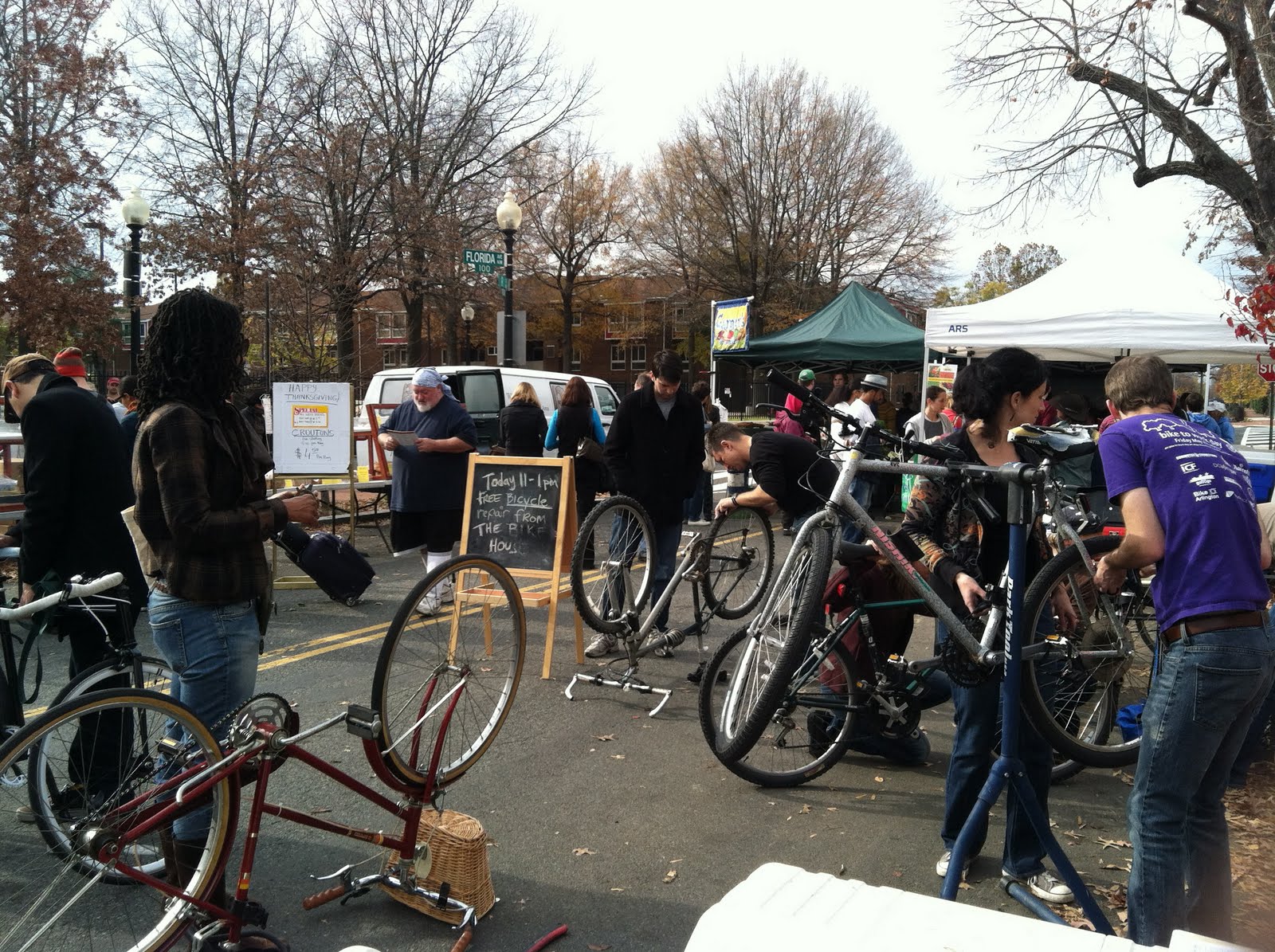
So a few months ago, I wrote about my first (awesome) experience with The Bike House. I had meant to get involved right then, so impressed was I with the co-op members' friendliness and helpfulness and commitment to empowering cyclists young and old to ride -- and fix -- their bikes. And yet, like many folks with 146 balls in the air these days, the mental note fell off my mental notebook page. At least until a reminder email popped up in my inbox from Maggie, The Bike House's volunteer coordinator, a few weeks ago inviting me to a volunteer orientation. So I went.
I tried to explain that I was a self-taught, MacGuyver-style mechanic, but the group was not phased by my tales of sticks-in-place-of-screws or possibly-inappropriate-use-of-duct-tape or self-wounding-with-a-multi-tool. They smiled and said that enthusiasm and curiosity and a desire to help were the only criteria. There I was the very next Saturday afternoon helping neighborhood kids that pulled up into the alley behind Qualia Coffee pump up their bike tires and clean their chains, then furrowing my brow in concentration as I watched more experienced mechanics install new brakes and realign derailleurs. I did don an apron, at least, and apparently had sufficient amounts of chain lube and bike grease on my hands that I was taken for someone who knew what they were doing.
A week later, I found myself at the Bike House holiday potluck with a loaf of pumpkin bread, half of which disappeared within 20 minutes of my arrival. So they like food, too, it seems. My kind of people....

So you should not be surprised that the next morning, I rolled up for a shift at the Bike House's stand at the Bloomingdale farmers' market. Before my very eyes, a capable team of volunteer mechanics got 15 folks back on the road over the 2-hour session of brake adjusting and chain cleaning and tire inflating. (I helped mostly with these last two items, plus taking photos and checking folks in on the very official looking clipboard.) I could see myself getting involved with this group more long term. He must've seen it in my eyes, because Ryan chased me down later that afternoon while I was selling pasta to invite me to the bi-monthly Bike House planning meeting.
This past Monday night I joined my newfound biking friends for a brainstorming session as their 3-year tenure at Qualia comes to a close. They must know I am developing a soft spot for the place. Or rather, a soft spot for what the Bike House stands for. You see, the Bike House is actually an idea, though an active one, made up of a devoted core of cycling advocates with a couple of bike stands and a few sets of tools. There isn't actually a Bike HOUSE. At least not yet.
The co-op is currently in search of a home for the upcoming year, a place to store tools and run regular bike repair clinics and classes (on Saturdays, but possibly even during the week if they find the right place). They're such a community asset, this group, that I'm surprised there aren't hordes of local business owners with extra space banging down the Bike House's virtual door. There are a few possible options on the table at present, but they're still on the lookout. If you know of a place that might be a good home for the Bike House clinics, especially in the general vicinity of Petworth, drop 'em a line.
Meanwhile, drop by Qualia for the final few Saturday clinics. They run from 12-3pm until Dec 10th. More than likely, I'll see you there...
Saturday, November 19, 2011
Fermentation without Representation
Something about Thanksgiving always makes me think of good beer. Most likely it's the memory of the roasted pumpkin ale that Nick and I made at my cousin Caroline's place in the Poconos back in 2003, and which we drank like water it was so smooth, sharing it with our collective families during that Thanksgiving dinner. (Well, really it was Nick's masterful brewing, but I like to think I played a decent Igor role in the affair. "Bring me the hops!" "Yesss, massster....") Dad and I still reminisce about that pumpkin ale every now and then, usually around this time of year.
I may not make beer myself (yet), but I know a thing or two about it. I believe my appreciation of beer began a few years after my AmeriCorps days of drinking $2 pints of Bud Light, when I was living and teaching in Brooklyn and dating the aforementioned wonderful young gentleman who had gotten his hands on his first used homebrew kit. Those were good nights and weekends of us concocting blackberry wheat ales and caramel fig porters and scottish red ales. Mmmm. I've been angling for exceptional beer (and an exceptional partner) ever since. And, oh, that pumpkin ale. With a few empty carboys lazing around under the back deck behind my apartment and a Rogue Nation homebrewer's card in my wallet, I'm thinking it's high time I got cracking on recreating that delicious brew. But first: research.
Small-scale craft beer brewing has really taken off recently in these United States. While there's quite a tradition of homebrewing and microbrewpubs in parts of the Pacific Northwest especially, it's only more recently that folks around DC have had access to anything approaching "local" beer. (My backup since college has been Pottsville, PA's own Yuengling lager, though Flying Dog and a few Baltimore-based breweries have sprung up over the past handful of years.) Ah, but earlier today I joined my newlywed friends Meredyth and Greg for a tour of DC Brau -- the answer to the thirst for what D.C. has not had in over 60 years: a brewery whose product is available in local stores and on tap outside of its site of production. Here's a snapshot of Mere and Greg at the end of our tour -- don't they look happy to have a local source for good beer?

The tour itself was pretty interesting once we got past the rather nondescript, giant metal tanks and into the area with cask-aging ales and the secluded sour beer fermentation room (where rare, wild yeasted brews do their thing for a couple of years before being imbibed). The canning machinery was also pretty fun to learn about, though it wasn't running when we walked past while sipping on samples from the 4 varieties on tap and admiring the cool sculptures and murals scattered about the space. I especially liked the Belgian-style Citizen tripel and the (also Belgian-style) Penn Quarter porter. Looks like I'll have to make my way over to Meridian Pint for a taste of the Fermentation Without Representation, DC Brau's seasonal pumpkin porter, as there was none to be found on site at the brewery for us to fill up Greg's growlers.... Maybe I can pick up some free empty 750ml bottles while I'm there, instead of drinking endless 4-packs of Grolsch like Nick and I used to do to build up our supply of resealable bottles. I do love all things pumpkin, after all (and have a hard time looking at a bottle of Grolsch after that first summer of being a homebrewer's assistant.)
Speaking of local breweries springing up, I also just a couple of weeks ago tried out a few of the inaugural offerings of Cerveza Nacional and Cornerstone Copper Ale from Chocolate City Beer. It was part of the background research I was doing on local entrepreneurs for the next issue of Bittersweet Zine. No, really. I haven't yet toured their brew space, nor that of the soon-to-open Three Stars Brewing Company, but I aim to get myself to both in coming months. So much beer to try, so little time. Oh, wait, no, that's not quite right. I am a food educator, after all, and high-quality, locally-made beer must somehow fall under my purview. It's for the good of the food community, I assure you, as few things complement a good, locally-sourced meal like a good, locally-sourced drink.
I may not make beer myself (yet), but I know a thing or two about it. I believe my appreciation of beer began a few years after my AmeriCorps days of drinking $2 pints of Bud Light, when I was living and teaching in Brooklyn and dating the aforementioned wonderful young gentleman who had gotten his hands on his first used homebrew kit. Those were good nights and weekends of us concocting blackberry wheat ales and caramel fig porters and scottish red ales. Mmmm. I've been angling for exceptional beer (and an exceptional partner) ever since. And, oh, that pumpkin ale. With a few empty carboys lazing around under the back deck behind my apartment and a Rogue Nation homebrewer's card in my wallet, I'm thinking it's high time I got cracking on recreating that delicious brew. But first: research.
Small-scale craft beer brewing has really taken off recently in these United States. While there's quite a tradition of homebrewing and microbrewpubs in parts of the Pacific Northwest especially, it's only more recently that folks around DC have had access to anything approaching "local" beer. (My backup since college has been Pottsville, PA's own Yuengling lager, though Flying Dog and a few Baltimore-based breweries have sprung up over the past handful of years.) Ah, but earlier today I joined my newlywed friends Meredyth and Greg for a tour of DC Brau -- the answer to the thirst for what D.C. has not had in over 60 years: a brewery whose product is available in local stores and on tap outside of its site of production. Here's a snapshot of Mere and Greg at the end of our tour -- don't they look happy to have a local source for good beer?

The tour itself was pretty interesting once we got past the rather nondescript, giant metal tanks and into the area with cask-aging ales and the secluded sour beer fermentation room (where rare, wild yeasted brews do their thing for a couple of years before being imbibed). The canning machinery was also pretty fun to learn about, though it wasn't running when we walked past while sipping on samples from the 4 varieties on tap and admiring the cool sculptures and murals scattered about the space. I especially liked the Belgian-style Citizen tripel and the (also Belgian-style) Penn Quarter porter. Looks like I'll have to make my way over to Meridian Pint for a taste of the Fermentation Without Representation, DC Brau's seasonal pumpkin porter, as there was none to be found on site at the brewery for us to fill up Greg's growlers.... Maybe I can pick up some free empty 750ml bottles while I'm there, instead of drinking endless 4-packs of Grolsch like Nick and I used to do to build up our supply of resealable bottles. I do love all things pumpkin, after all (and have a hard time looking at a bottle of Grolsch after that first summer of being a homebrewer's assistant.)
Speaking of local breweries springing up, I also just a couple of weeks ago tried out a few of the inaugural offerings of Cerveza Nacional and Cornerstone Copper Ale from Chocolate City Beer. It was part of the background research I was doing on local entrepreneurs for the next issue of Bittersweet Zine. No, really. I haven't yet toured their brew space, nor that of the soon-to-open Three Stars Brewing Company, but I aim to get myself to both in coming months. So much beer to try, so little time. Oh, wait, no, that's not quite right. I am a food educator, after all, and high-quality, locally-made beer must somehow fall under my purview. It's for the good of the food community, I assure you, as few things complement a good, locally-sourced meal like a good, locally-sourced drink.
Sunday, November 13, 2011
I must have that recipe!
Today marked the first Slow Food University event that I have organized: a book talk and potluck with local author and culinary adventurer, Nani Power. She's my kind of woman. In fact, we have quite a bit in common:
1. We share a persistent search for meaning, love, and community through food.
2. Food is officially an obsession.
3. We find cooking therapeutic.
4. We are both just itching to get ourselves to India, primarily for the food.
We probably share a lot of ideals that I don't even know about yet. I need to get myself a copy of her latest work, Ginger and Ganesh, which tells the story of her life-changing experience learning to prepare authentic Indian cuisine from women all around her native Northern Virginia -- a two-year adventure which began with a simple ad on Craigslist offering to supply ingredients + $10 per hour for in-home cooking lessons from Indian women. Yep, I do believe this may be next up on my reading list. And I'm pretty sure quite a few of the 40-some folks at the gathering were thinking the same thing as we stacked chairs and bid our adieus at the end of the event.
So, yes, in spite of the past 48 hours of hand-wringing... and fear that nobody would show up... or that a bunch of people would arrive but wouldn't have brought any food... or that the guard would be home sick and hadn't unlocked the building... or... I swear I'm not a worrier (that's dad's specialty)... it was a resounding success. It's not just my own impression, either, I swear. Our esteemed speaker asked if I might be able to gather some of the recipes for the food offered by our humble Slow Food DC community this evening. A number of attendees seconded the request.
As I await the recipe for the divine coconut burfi made by my friend (and former teaching colleague) Carol, I offer my own Indian-inspired concoction. No, not the curried chickpeas with sweet potatoes and kale. (What can I say, I was worried people wouldn't bring enough food, so I made a few dishes.) I'm talking about the
Dark Chocolate Torte with Cardamom and Ginger Whipped Cream
...which is not so much authentic Indian as inspired by Indian spices...
Preheat oven to 350°F.
1. We share a persistent search for meaning, love, and community through food.
2. Food is officially an obsession.
3. We find cooking therapeutic.
4. We are both just itching to get ourselves to India, primarily for the food.
We probably share a lot of ideals that I don't even know about yet. I need to get myself a copy of her latest work, Ginger and Ganesh, which tells the story of her life-changing experience learning to prepare authentic Indian cuisine from women all around her native Northern Virginia -- a two-year adventure which began with a simple ad on Craigslist offering to supply ingredients + $10 per hour for in-home cooking lessons from Indian women. Yep, I do believe this may be next up on my reading list. And I'm pretty sure quite a few of the 40-some folks at the gathering were thinking the same thing as we stacked chairs and bid our adieus at the end of the event.
So, yes, in spite of the past 48 hours of hand-wringing... and fear that nobody would show up... or that a bunch of people would arrive but wouldn't have brought any food... or that the guard would be home sick and hadn't unlocked the building... or... I swear I'm not a worrier (that's dad's specialty)... it was a resounding success. It's not just my own impression, either, I swear. Our esteemed speaker asked if I might be able to gather some of the recipes for the food offered by our humble Slow Food DC community this evening. A number of attendees seconded the request.
As I await the recipe for the divine coconut burfi made by my friend (and former teaching colleague) Carol, I offer my own Indian-inspired concoction. No, not the curried chickpeas with sweet potatoes and kale. (What can I say, I was worried people wouldn't bring enough food, so I made a few dishes.) I'm talking about the
Dark Chocolate Torte with Cardamom and Ginger Whipped Cream
...which is not so much authentic Indian as inspired by Indian spices...
Preheat oven to 350°F.
Brush an 8 or 9-inch cake pan with butter and dust with flour.
Melt in a small saucepan over low heat, stirring frequently:
- 7 oz dark chocolate, cut into pieces
- 1 1/2 sticks (12 TBSP) butter, cut into pieces
Remove from heat and whisk in:
- 1/4 cup cocoa powder
- seeds from 6-8 crushed cardamom pods
- a dash of ground allspice
Let cool for about 10 minutes.
In a separate bowl, beat together until thick (6 minutes or so) with an electric mixer:
- 5 large farm fresh eggs, at room temperature
- 1/4 cup raw/brown sugar
Gently fold chocolate mixture into the egg mixture until just mixed (uniform color). Pour batter into prepared pan and bake 40-45 minutes.
Cool in pan, run a knife around the edge of the pan to loosen if needed, and then turn out on a wire rack or plate to slice.
Serve with fresh whipped cream beaten with:
- a few spoonfuls of powdered sugar
- a dash of ground/powdered ginger
Subscribe to:
Posts (Atom)